
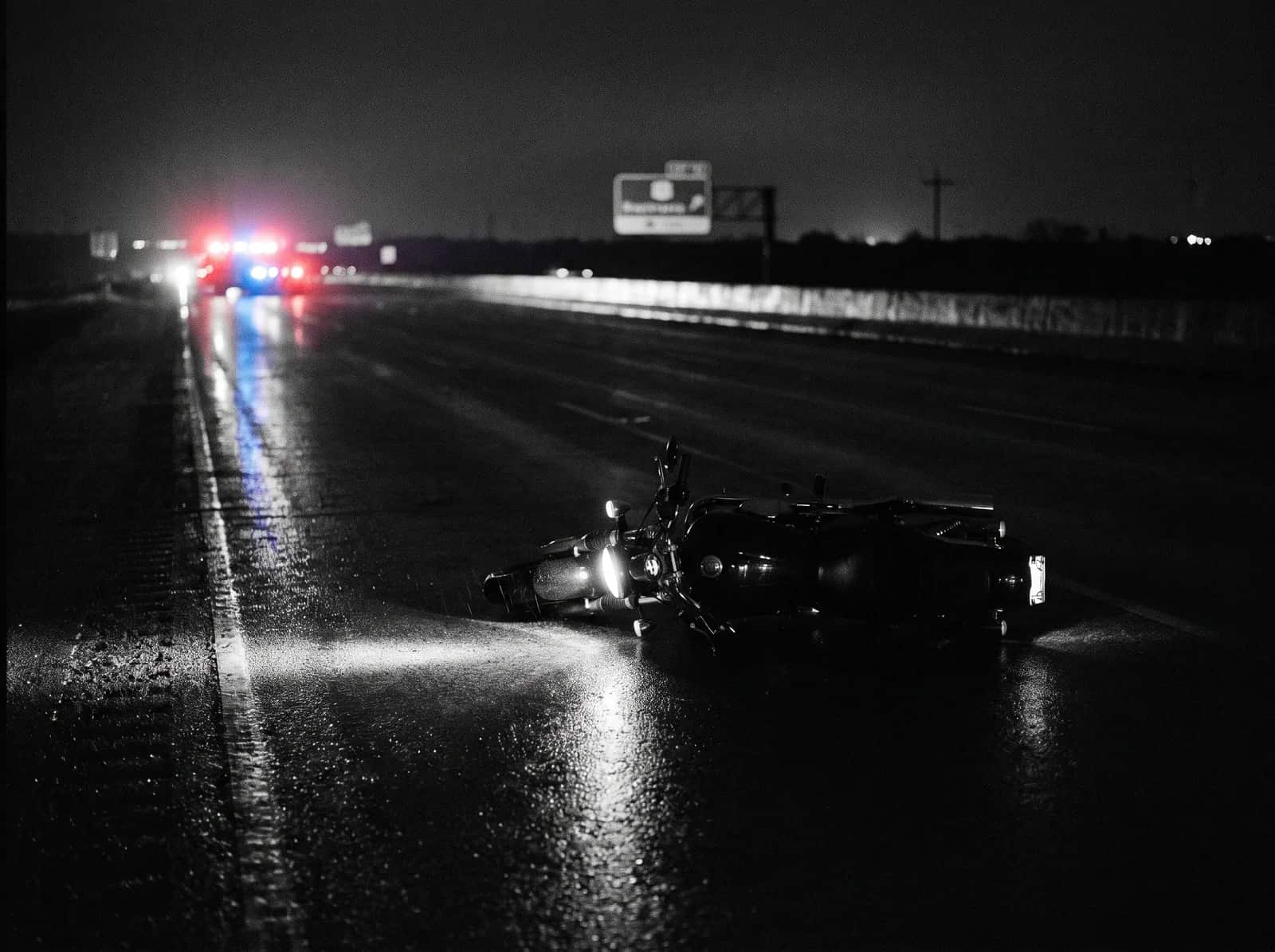
In Spring, a person hurt in a motorcycle accident caused by someone else can recover medical costs, lost income, and pain under Texas law. Owsley Law Firm handles Spring motorcycle accidents from its Houston offices, comes to you, and charges no fee unless it wins. Call before you speak with any insurer.
Motorcycle Accidents in Spring
Where do Spring motorcycle accidents happen?
Spring riders are hit on Spring Cypress Road, Kuykendahl, and FM 2920, where drivers turn left across them from subdivision entrances.
Spring riders are hit where subdivision entrances meet fast roads. Spring Cypress Road, Kuykendahl, Louetta, and FM 2920 toward Tomball carry steady traffic past dozens of neighborhood and shopping-center entrances, and drivers turning left out of them misjudge a motorcycle’s speed. The firm’s Spring motorcycle cases most often involve exactly that left turn, or a driver changing lanes into a rider on the I-45 frontage road. Witnesses, nearby business cameras, and the bike’s damage pattern usually decide how fault is split. The firm’s Spring motorcycle cases also arise on FM 2920 toward Tomball, where the road narrows and drivers pass slower traffic without seeing a rider ahead. Injuries are often serious, so the firm reviews every available policy, including the rider’s own underinsured coverage.
Corridors where Spring motorcycle accidents cluster
- I-45 at FM 1960 and the Cypresswood Drive exits
- I-45 at the Grand Parkway interchange
- Hardy Toll Road at the Grand Parkway and Rayford Road
- FM 1960 between I-45 and Kuykendahl Road
- Spring Cypress Road from Kuykendahl to the Grand Parkway
- Louetta Road at the Tomball Parkway (SH-249) feeder
Cases from Spring
What does a Spring motorcycle accident case look like?
A commuter exiting I-45 at FM 1960 is rear-ended on the frontage road by a delivery van that never slowed.
What does Texas law say about the driver who turned left or pulled out in front of a Spring rider?
Two statutes cover the crashes Spring's roads set up. A driver turning left must yield to oncoming traffic close enough to be an immediate hazard, and a driver entering the road from a driveway or private road must yield to traffic already on it.
Spring's main roads, Spring Cypress, Kuykendahl, Louetta, FM 2920, and the I-45 frontage roads, are lined with subdivision entrances, shopping centers, and gas stations. Every one of those openings is a place where a driver crosses the path of through traffic. Transportation Code section 545.152 requires a driver turning left at an intersection or into a driveway or private road to yield to a vehicle approaching from the opposite direction that is in the intersection or close enough to be an immediate hazard. Section 545.155 requires a driver about to enter or cross a road from an alley, building, private road, or driveway to yield to vehicles approaching on that road.
A motorcycle is a vehicle under both rules. The usual defense is that the driver looked and did not see the rider, or that the motorcycle was going too fast. Neither ends the case. Whether the rider was close enough to be an immediate hazard, how fast the bike was moving, and what the driver could have seen are questions for evidence: the scrape and gouge marks, the crush pattern on the car, the position of the bike, and any video from a store or a neighbor's doorbell camera.
Speed arguments are common because insurers know juries can be skeptical of riders. The answer is data and physics rather than denial. Many cars, and some motorcycles, have event data recorders that capture speed and braking in the seconds before impact, and a reconstruction can test a driver's claim that the bike came out of nowhere.
How dangerous are Texas roads for riders, and what do the local numbers show?
TxDOT counted 585 motorcyclists killed in Texas in 2024 and 2,532 seriously injured. Harris County, where most of Spring lies, had 579 traffic deaths of all kinds that year, the most in Texas.
TxDOT's 2024 motorcyclist table counts 585 riders and passengers killed statewide: 557 operators and 28 passengers. Another 2,532 suffered suspected serious injuries, 175 of them passengers. Of the 585 killed, 348 were wearing a helmet, 216 were not, and helmet use was unknown for 21. Those numbers answer an argument riders hear often, that the injuries came from the rider's choices rather than the crash. Most of the riders killed in Texas that year were wearing helmets.
Spring has no city government, so TxDOT counts its crashes at the county level. Harris County recorded 579 traffic deaths in 2024, and Montgomery County, which takes in the northern Spring addresses, recorded 61. Those totals include every road through Spring, from I-45 and the Hardy Toll Road to the subdivision collectors where most riders begin and end their trips.
Which Spring roads matter most in a rider's claim?
FM 2920, which TxDOT describes as a four-lane undivided road it plans to widen; the tolled Grand Parkway segments; the I-45 frontage roads; and the subdivision arterials like Spring Cypress and Kuykendahl.
TxDOT's Houston District describes FM 2920 from North Willow Street in Tomball to I-45 as an 11.1-mile, four-lane undivided road and one of the main east-west connectors to I-45. It has proposed widening the road to six lanes with a raised median to improve traffic flow and safety, with environmental work, design, and right-of-way acquisition still ahead. Until that happens, there is no median between opposing lanes and many driveways along the way, which means left turns across a rider's path and passing maneuvers into oncoming traffic. If construction starts, lane closures and work-zone traffic control will add to the risk, and the contractor's traffic control plan becomes evidence.
The Grand Parkway segments through the area, F-2 from SH-249 to I-45 and G from I-45 to US-59, opened and began tolling in 2016, according to the Federal Highway Administration. Riders on those segments travel at highway speed among trucks serving distribution sites and commuters merging at long ramps. Because the road is tolled, the transaction records of the vehicles involved can show when each entered and exited, which can help test a driver's account of speed and timing.
On the I-45 frontage roads, the hazard is drivers cutting across lanes to reach an exit ramp, a store entrance, or a U-turn lane. A rider in the right lane can be clipped by a driver who never checked a mirror. Section 545.060 requires a driver to stay within a single lane as nearly as practical and not move out of it until the move can be made safely.
Spring has no police department. Who writes the report, and how do you get it?
Usually the Harris County Sheriff's Office, a Harris County constable precinct, or DPS, and on the Montgomery County side, that county's agencies. The report is sold through TxDOT's online crash report system.
Because Spring is unincorporated, there is no city police department to call. A crash on a subdivision street or arterial is often worked by a sheriff's deputy or a constable, and a crash on I-45 or the Grand Parkway may be worked by a DPS trooper. Under Transportation Code section 550.062, the officer must file a report with TxDOT within ten days when anyone is injured or killed or property damage reaches $1,000, and the report can then be bought through TxDOT's crash report system using the agency and date.
Riders are often taken from the scene by ambulance before they can give a statement, so the first version an officer hears may come only from the driver. Read the narrative and the contributing factors on the report closely. If the report says the rider was speeding or failed to control speed and nothing supports it, witness statements, photos, and video are how that is corrected, and the officer can sometimes be asked to supplement the report.
Officers also record the helmet use of each rider on the report. That entry is not a finding of fault, and as explained below, it matters only in limited circumstances.
What should a Spring rider save in the first days after a crash?
The helmet, the bike in its damaged state, the riding gear, any camera footage, and the names of witnesses. Each of those can disappear quickly if no one acts.
Keep the helmet even if it looks ruined. Its scrapes, cracks, and liner damage show where the head struck and how hard, and an expert may need to examine it. Do not let the motorcycle be repaired or sold for salvage until it has been photographed and, in a serious case, inspected; the bike's damage pattern is often the best evidence of the angle and speed of impact. Keep the jacket, gloves, and boots as they are.
Video goes first. Many Spring subdivisions and businesses along FM 1960, Spring Cypress, and the frontage roads have cameras, but many systems record over themselves within days. Helmet cameras and phone ride-tracking apps can preserve speed and route data. Write down or save the names and phone numbers of anyone who stopped, because witnesses who left before the officer arrived are often not listed on the report.
- Helmet, gloves, jacket, and boots, unwashed and unrepaired
- Motorcycle, unrepaired, with photos of every side
- Helmet camera and phone ride-tracking data
- Business and doorbell camera video near the crash
- Toll transaction records for crashes on the Grand Parkway or Hardy Toll Road
- Witness names and phone numbers
Where are injured riders taken from Spring, and which hospitals are trauma centers?
The nearest designated Level II centers are HCA Houston Healthcare Northwest and Memorial Hermann The Woodlands Medical Center. St. Luke's Hospital in Springwoods Village has a 24-hour emergency room but is not on the state trauma list.
On the Texas Department of State Health Services list of designated trauma facilities, current as of October 1, 2026, HCA Houston Healthcare Northwest and Memorial Hermann The Woodlands Medical Center are Level II (Major) trauma centers, as are HCA Houston Healthcare Kingwood and HCA Houston Healthcare Conroe. HCA Houston Healthcare Tomball is Level III (Advanced). The Level I (Comprehensive) centers in the region are Harris Health Ben Taub Hospital and Memorial Hermann Texas Medical Center, and Texas Children's Hospital is also designated Level I.
St. Luke's Hospital - Springwoods Village, at 2255 East Mossy Oaks Road, opened in 2016 and lists a 24-hour emergency room, but it does not appear on the state's designated trauma list. A rider with a head, spine, chest, or pelvic injury may be taken past it to a designated center or flown to the Medical Center. A rider who first goes to a non-trauma emergency room and is transferred will have records and bills from both, and each belongs in the claim.
Rider injuries are often orthopedic and skin injuries as well as head injuries: fractured legs, ankles, wrists, and collarbones, and road rash that may need grafting and leave scars. Follow-up care with orthopedic surgeons, wound care, and physical therapy often lasts months, and consistent treatment records are what prove those injuries later.
Does riding without a helmet hurt a Spring rider's claim?
Only if the evidence shows the missing helmet caused or worsened a specific injury, and even then it goes to the rider's share of responsibility rather than a separate cut. Many adult riders are legally exempt from wearing one.
Transportation Code section 661.003 requires motorcycle operators and passengers to wear protective headgear that meets state standards, and makes it an offense to carry a passenger without one. The rule does not apply to a rider who is at least 21 and has completed an approved motorcycle operator training and safety course or is covered by a health insurance plan that pays for injuries from a motorcycle crash. Under the same section, an officer may not stop a rider solely to check whether the rider has taken the course or has that coverage.
An insurer may say a helmet would have prevented a head injury. Under Chapter 33 of the Civil Practice and Remedies Code, that point can only shift some percentage of responsibility to the rider, and only when medical or engineering proof ties the missing helmet to that particular injury. The Texas Supreme Court built that rule for seat belts in Nabors Well Services v. Romero (2015), and courts apply the same logic to helmets. It has no bearing on a shattered ankle, a broken pelvis, or road rash.
What are the Texas lane rules for riders, including group rides and passengers?
A motorcycle is entitled to the full use of a lane. Two riders may share a lane side by side, but lane splitting and passing within a lane are not allowed. Passengers must have their own seat, footrests, and handholds.
Since September 1, 2023, Transportation Code section 545.0605 has given a motorcycle the full use of a lane and barred drivers from crowding a rider out of it. The same section allows two motorcycles to ride two abreast in one lane, but not more than two, and bars riding between lanes of traffic moving in the same direction or passing a vehicle within the same lane. A driver who drifts into a rider's half of the lane on Kuykendahl, or squeezes past a pair of riders on FM 2920, is breaking that rule.
Insurers sometimes claim a rider was splitting lanes in stopped traffic on I-45 or the frontage road. Whether that happened is a question of evidence, and even if a rider broke a traffic rule, it matters only if it caused the crash; the driver's own violations are weighed alongside it under Chapter 33.
Section 545.416 allows a passenger only on a motorcycle designed to carry more than one person and equipped with footrests and handholds for the passenger, and generally bars carrying a child younger than five. A passenger hurt in a crash has a claim of his or her own, which may run against the other driver, the rider of the motorcycle, or both.
Which insurance pays a Spring rider?
The at-fault driver's liability policy first, then the rider's own uninsured and underinsured motorist coverage, and an employer's commercial policy if the driver was working.
Every Texas driver must carry at least $30,000 per person, $60,000 per crash, and $25,000 in property damage coverage under Transportation Code section 601.072, and plenty carry only that. A helicopter transfer and a few days in a Level I center can use up $30,000 before the rider is discharged. Under Insurance Code section 1952.101, uninsured and underinsured motorist coverage is part of a Texas policy unless the policyholder turned it down in writing, so the rider's own declarations page and any signed rejection form are worth pulling right away.
Underinsured motorist coverage is a contract claim against the rider's own insurer. If the at-fault driver's insurer offers its limits, the rider's own insurer should be notified before a release is signed; under Hernandez v. Gulf Group Lloyds (Tex. 1994), an insurer that relies on a consent-to-settle clause generally has to show it was actually prejudiced by the settlement. A hit-and-run claim under uninsured motorist coverage requires actual physical contact between the unidentified vehicle and the rider or the motorcycle, so a driver who forced a rider off the road without touching the bike is a harder claim.
Delivery vans, contractors' pickups, and box trucks are common on Spring's arterials and around the distribution sites near the Grand Parkway. When the at-fault driver was working, the employer's commercial policy usually applies and typically carries much higher limits than a personal policy.
What if a sheriff's vehicle, constable car, or school bus hit the rider?
Spring has no city, so no city charter deadline applies. Claims against Harris County, Montgomery County, or a school district generally require notice within six months, and damages are capped.
Sheriff's deputies and constables patrol Spring's subdivisions and arterials, and county road crews and Harris County Toll Road Authority vehicles, a Harris County department, work its highways. A claim against a county is brought under Chapter 101 of the Civil Practice and Remedies Code. Section 101.101 generally requires notice within six months of the crash describing the injury, the time and place, and the incident, and section 101.023 caps a county's liability at $100,000 per person and $300,000 per occurrence for bodily injury.
Spring ISD and Klein ISD buses run the same roads riders use, and Conroe ISD serves northern Spring addresses. A school district can be sued under the Tort Claims Act only for claims arising from the use of motor vehicles, which includes buses, and the same local government caps apply. A DPS unit or TxDOT vehicle falls under the state's caps of $250,000 per person and $500,000 per occurrence. Any private driver who shared fault can be pursued without those caps.
Is a Spring motorcycle case filed in Houston or in Conroe?
It depends on where the crash happened, not the mailing address. Harris County cases go to the civil district courts at 201 Caroline in Houston; Montgomery County cases are filed with the District Clerk in Conroe.
A Spring mailing address can sit in north Harris County or south Montgomery County. Under Civil Practice and Remedies Code section 15.002, a suit can generally be filed in the county where the crash happened, in the county where an individual defendant lived, or in the county of a company defendant's principal office in Texas. For a Harris County crash, that usually means the Harris County Civil District Courts at 201 Caroline Street. For a Montgomery County crash, the Montgomery County District Clerk is at 301 North Main Street, Suite 103, in Conroe.
Both counties are in the Houston Division of the U.S. District Court for the Southern District of Texas, so a case removed to federal court because every defendant is from out of state and more than $75,000 is at stake would be heard in Houston either way. Removal on that basis is not allowed when a properly joined and served defendant is a Texas citizen.
How are hospital bills handled, what is the claim worth, and what does the firm charge?
Hospital liens and health plan claims are paid from the settlement under limits set by statute. Value depends on the injuries, treatment, lost income, and scarring, reduced by any share of fault. There is no fee unless the firm wins.
A hospital that treats a rider within 72 hours of the crash, emergency room included, holds a lien on the claim under Property Code sections 55.002 and 55.0015. Section 55.004 confines it to reasonable and regular hospital charges for the first 100 days and emergency physician charges for the first seven days, and it can never take more than half of what the rider recovers. Section 41.0105 limits the medical damages themselves to what was actually paid or incurred. Health plans that paid bills may want reimbursement: an employer's self-funded ERISA plan relies on its own plan language rather than Chapter 140 of the Civil Practice and Remedies Code, and Texas Medicaid asserts its recovery right under Human Resources Code section 32.033.
Damages for a rider include the cost of care, wages lost now and earning capacity lost later, pain, mental anguish, impairment, and disfigurement such as road rash scarring. Any share of fault the jury assigns the rider reduces the award, and a share over 50 percent defeats it under section 33.001. Section 16.003 generally gives two years from the crash to sue, but a county or school district claim needs notice within six months.
Owsley Law Firm handles Spring motorcycle cases from its Houston offices at 601 Sawyer Street and 3535 Westheimer Road and does not have an office in Spring. Riders can handle the case by phone, video, and mail, and the firm will come to a rider at home or in the hospital. There is no fee unless the firm wins your case. Clients may be responsible for case expenses, such as court costs, as set out in the written fee agreement.
Common Spring rider crashes and the rule that usually applies
| What happened | Rule usually at issue | Evidence that matters | Typical Spring setting |
|---|---|---|---|
| Driver turned left across the rider | Transportation Code section 545.152 (yield to oncoming traffic) | Video, crush pattern, bike data, sight lines | Spring Cypress, Kuykendahl, Louetta intersections |
| Driver pulled out of a driveway or subdivision entrance | Section 545.155 (yield when entering from a driveway or private road) | Doorbell and store cameras, witness statements | FM 2920, FM 1960, shopping center exits |
| Driver changed lanes into the rider | Sections 545.060 and 545.0605 (stay in lane; full use of a lane) | Dashcam, mirror and blind-spot evidence | I-45 frontage roads, Grand Parkway |
| Rider rear-ended at a light or in a backup | Section 545.062 (following distance); no presumption against the rear driver, so speed and distance must be shown | Vehicle data, skid marks, video | Frontage road signals, FM 1960 |
| Hit-and-run | Uninsured motorist coverage; actual physical contact required | Paint transfer, damage to the bike, video | Any arterial |
| County vehicle or school bus | Civil Practice and Remedies Code Chapter 101; notice within six months | Agency report, fleet records | Subdivision streets, school routes |
What to do now
What should you do after a motorcycle accident in Spring?
- Get examined the same day, even for road rash. HCA Houston Healthcare Northwest (Level II trauma) and Memorial Hermann The Woodlands Medical Center (Level II trauma) handle the serious rider injuries from Spring.
- Keep your helmet, jacket, gloves, and boots as they are. Do not wash, repair, or throw them away; the damage shows where you were hit and how hard.
- Photograph the bike, the other vehicle, skid marks, gravel or potholes, and the sight lines, especially at crashes on I-45 (North Freeway) and Hardy Toll Road.
- Get the Spring crash report. Most Spring crashes are worked by the Harris County Sheriff’s Office, a Harris County constable precinct, or DPS on I-45 and the Grand Parkway, because Spring has no city police department. The report (Texas form CR-3) is available through the TxDOT Crash Report Online Purchase System. The firm obtains it for clients at no charge. Read it closely: reports sometimes assume the rider was speeding or lane splitting without evidence, and errors can be corrected.
- Expect the other driver's insurer to look for reasons to blame the rider. Report the crash to your own insurer, but give no recorded statement to the other carrier until you have counsel.
- Know where the case goes. Spring motorcycle accidents suits are filed in the Harris County Civil District Courts, 201 Caroline St, or Montgomery County District Courts, Montgomery County Courthouse, Conroe (for Spring addresses north of Spring Creek) depending on the crash location.
- Call the firm. Spring clients are handled from Houston by phone, video, and mail, and the firm travels to Spring for meetings, depositions, and court. The consultation is free.
Go deeper
More on motorcycle accident claims in Spring and Texas.
Common questions
Spring motorcycle accident questions
Where do motorcycle crashes happen most in Spring?
On Spring Cypress Road, Kuykendahl, Louetta, FM 2920, and the I-45 frontage roads.
What if a driver pulled out of a subdivision and hit me?
A driver entering a road from a private drive or side street must yield to traffic already on it. Failure to yield is one of the most common causes of motorcycle crashes and usually places most of the fault on the driver.
Does it matter that Spring has no city police department?
Only for who writes the report, usually the sheriff or a constable. The rules for fault and recovery are the same.
Where is a Spring motorcycle accident case filed?
In Harris County for crashes south of Spring Creek, and in Conroe for crashes north of it.
A driver turning into a Spring subdivision hit me. Who is at fault?
A driver turning left must yield to oncoming traffic close enough to be an immediate hazard under Transportation Code section 545.152. The driver will often claim the rider was speeding, so video, the crash damage, and vehicle data usually decide how fault is divided.
Is St. Luke's in Springwoods Village a trauma center?
It has a 24-hour emergency room but is not on the Texas Department of State Health Services list of designated trauma facilities current as of October 1, 2026. The nearest designated Level II centers are HCA Houston Healthcare Northwest and Memorial Hermann The Woodlands Medical Center.
Can two of us ride side by side in one lane?
Yes. Texas allows two motorcycles to ride two abreast in a single lane, but not more than two, and bars lane splitting and passing within a lane.
I was over 21 and not wearing a helmet. Can I still recover?
Yes. Riders 21 and older who completed an approved safety course or have qualifying health coverage are exempt from the helmet law, and helmet use matters to a claim only if the evidence shows it caused or worsened a specific injury.
Who writes the crash report if Spring has no police department?
Usually the Harris County Sheriff's Office, a constable precinct, or DPS, or Montgomery County agencies on that side of the county line. The report is available through TxDOT's online crash report system.
Should I get my motorcycle fixed right away?
Not until it has been photographed and, in a serious case, inspected. The damage to the bike and the helmet is some of the best evidence of how the crash happened.
My passenger was hurt too. Does she have her own claim?
Yes. A passenger has a separate claim, which may run against the other driver, the operator of the motorcycle, or both, depending on who caused the crash.
Sources
Sources this page relies on
- Texas DSHS, designated trauma facilities (current as of October 1, 2026)
- TxDOT, Motorcyclist Fatalities and Injuries by Age Group and Helmet Use, 2024
- TxDOT, Crashes and Injuries by County, 2024
- TxDOT, FM 2920 from North Willow Street to I-45
- FHWA, Grand Parkway project profile (Segments F-2 and G)
- Montgomery County District Clerk
- Texas Transportation Code, chapter 545 (sections 545.0605, 545.152, 545.155, 545.416)
- Texas Transportation Code, chapter 661 (motorcycle helmets)