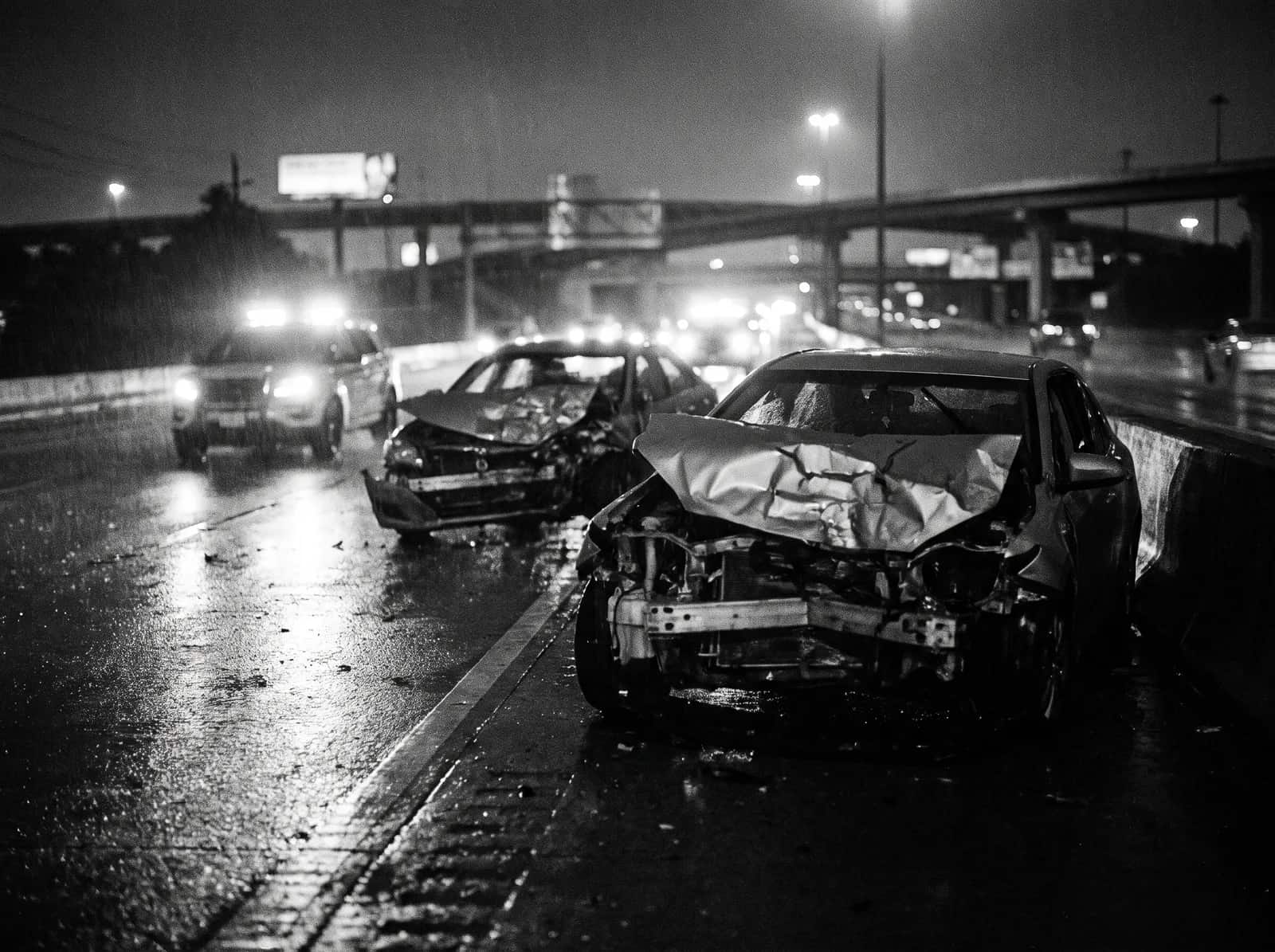
Why Houston roads produce so many serious crashes
Harris County records more traffic deaths than any other county in Texas: 536 in 2023 and 579 in 2024, according to TxDOT's Crashes and Injuries by County tables. Inside the city limits, the City of Houston reported 331 deaths and 1,624 serious injuries on its roads in 2021, and 324 deaths and 1,592 serious injuries in 2022, with pedestrians making up 35 percent of the 2022 deaths.
The causes the city names have not changed since 2014: speeding, impaired driving, unsafe driving maneuvers, and disregarding traffic signs and signals. What changes from road to road is the setting. A freeway interchange built before current design standards, a construction zone that narrows the lanes, and a six-lane commercial street with a driveway every few hundred feet each produce a different kind of crash and a different kind of claim.
Congestion is where the rear-end and lane-change crashes happen
Every year the Texas A&M Transportation Institute ranks the most congested road segments in Texas for TxDOT. In the 2025 report, which measures 2024 traffic, Houston holds seven of the ten most congested segments in the state, led by the West Loop (I-610) between the Katy Freeway and the Southwest Freeway, which has been ranked first in each of the last four reports.
Delay is not a crash statistic, and the report does not count collisions. But stop-and-go traffic is where following too closely, sudden braking, and late lane changes turn into crashes, and those are the claims Houston drivers bring most often.
- #1: W Loop Fwy/I-610, Katy Fwy/I-10 to Southwest Fwy/I-69 (under construction during 2024)
- #2: Eastex Fwy/I-69/US 59, SH 288 to I-10 (also #1 for trucks)
- #4: Southwest Fwy/I-69/US 59, W Loop/I-610 to South Fwy/SH 288
- #5: N Loop W Fwy/I-610, North Fwy/I-45 to Katy Fwy/I-10
- #6: Katy Fwy/I-10, W Loop N/I-610 to North Fwy/I-45
- #7: Gulf Fwy/I-45, I-10 to S Loop E Fwy/I-610
- #10: I-10, North Fwy/I-45 to Eastex Fwy/US 59 (#3 for trucks)

I-45: the North and Gulf Freeways
TxDOT is rebuilding the downtown and north sections of I-45 through the North Houston Highway Improvement Project, and its 2020 fact sheet on safety says the corridor still has crash rates higher than average interstate crash rates in Texas, and that many of its roadways do not meet current Federal Highway Administration or TxDOT design standards. The same fact sheet cites a 2019 ValuePenguin study that ranked I-45 the second most dangerous road in America.
TxDOT's numbers for 2018 are specific. Between I-10 and I-610, a stretch it calls a crash hot spot because of its merging locations, left-hand exits, and substandard lane and shoulder widths, there were 234 crashes, 79 of them fatal or injury crashes. Between I-10 and Scott Street there were 783 crashes. From 2015 through 2018 there were 66 incidents in those two segments where a truck struck a bridge passing underneath it.
South of downtown, the Gulf Freeway between I-10 and the South Loop is the seventh most congested road segment in Texas in the 2025 statewide ranking, and new to the top ten this year.
- Common crashes: rear-end collisions in stop-and-go traffic, sideswipes at short merges, crashes at left-hand exits and entrances
- Claim angle: construction under the I-45 rebuild can involve a TxDOT contractor, whose traffic control and lane closures become part of the fault question
- Claim angle: a bridge strike or a truck on the corridor brings federal trucking rules and a commercial policy into the claim
I-610: the Loop and its interchanges
The West Loop between the Katy Freeway and the Southwest Freeway is the most congested road segment in Texas, ranked first in the 2025, 2024, 2023, and 2022 statewide reports, and it was under construction during 2024. The North Loop West between I-45 and I-10 ranks fifth.
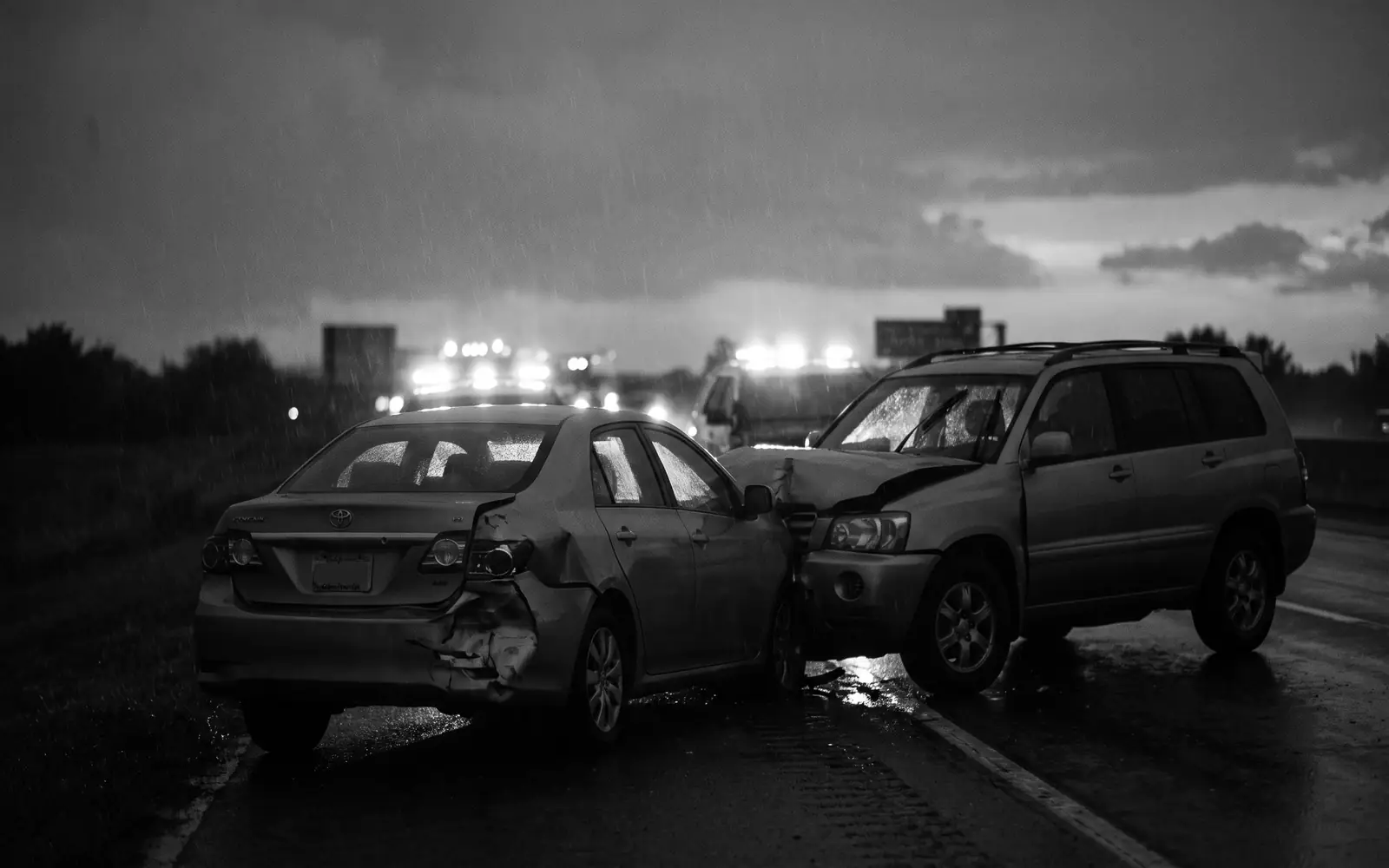
The worst trouble on the Loop is at its interchanges. When TxDOT began its $259 million rebuild of the I-69 and I-610 interchange, it listed the problems it was fixing: one-lane direct connectors that were over capacity, lack of shoulders, low vertical clearances, sight distances below minimum standards, and crashes in merge areas. Those are the same conditions that produce sideswipes and chain-reaction rear-end crashes on connector ramps.
- Common crashes: lane-change and merge crashes on connector ramps, rear-end crashes at the back of a queue, multi-vehicle pileups
- Claim angle: a multi-car crash often involves several insurers who each blame the others, so early statements matter
I-69 and US 59: the Southwest and Eastex Freeways
The Eastex Freeway between SH 288 and I-10, the stretch that runs along the east side of downtown, is the second most congested road segment in Texas for all vehicles and the first for trucks in the 2025 statewide report. The Southwest Freeway between the West Loop and SH 288 ranks fourth.
That combination, heavy truck volume in slow traffic, is why so many Eastex Freeway crashes are claims against a commercial carrier. A loaded 18-wheeler needs more distance to stop than a passenger car, and a truck driver who follows too closely in stop-and-go traffic can push one rear-end crash into three or four vehicles.
- Common crashes: truck rear-end crashes, lane-change crashes with trucks in blind spots, chain-reaction collisions
- Claim angle: a commercial carrier must carry federal minimum liability coverage, and its electronic logs and dashcam footage need preservation letters quickly
I-10: the Katy and East Freeways
The Katy Freeway between the West Loop and I-45 ranks sixth for all vehicles in the 2025 statewide report. East of downtown, I-10 between I-45 and US 59 ranks tenth for all vehicles and third for trucks, and it is new to the top ten this year.
The Katy Freeway runs main lanes, managed toll lanes, and frontage roads side by side. That layout brings its own crash pattern: drivers cutting across several lanes at once to reach an exit or a managed-lane entrance, and sudden slowdowns where the faster lanes meet the queue for an interchange.
Beltway 8 and the Sam Houston Tollway
Toll roads are not immune. The North Sam Houston Parkway East between the Hardy Toll Road and Old Humble Road jumped from 186th to 31st in the 2025 congestion ranking. The report's explanation is construction: in 2024 the center lanes were shut down across the segment, funneling traffic into one lane on either side of the highway.
A crash on a toll road raises a legal question most drivers never think about. The Sam Houston Tollway is run by the Harris County Toll Road Authority, part of Harris County government. A claim that the road itself was dangerous is a claim against a governmental unit under the Texas Tort Claims Act, and Civil Practice and Remedies Code section 101.022(c) limits the duty owed for a premise defect on a toll road to the duty owed to a licensee, even though the driver paid to use it.
Surface streets: Westheimer, Bissonnet, Telephone Road, and FM 1960
The City of Houston tracks the streets where people are killed and seriously injured most often and calls them its High Injury Network. The city has received federal grants to redesign streets on that network, and it has funded safety redesigns of the Bissonnet Corridor ($29 million from the federal Safe Streets and Roads for All program) and Telephone Road ($21 million from a federal RAISE grant).
Westheimer Road, where the firm's Westheimer office sits, is a good example of a crash pattern freeways do not have: a long commercial corridor with constant turning traffic, driveways, and pedestrians. Left-turn, T-bone, and pedestrian crashes dominate streets like it. FM 1960 and other farm-to-market roads are part of the state highway system, so a claim that the road itself was defective there runs to TxDOT rather than to the city.
- Common crashes: left-turn crashes at intersections and driveways, T-bone crashes at signals, pedestrians struck crossing mid-block
- Claim angle: nearby businesses often have cameras that record the intersection, and that footage is usually overwritten within days
Construction zones and government defendants
Much of Houston's freeway system is under construction at any given time, and a construction zone changes who can be responsible. The contractor that set up the lane closure, the company whose truck was parked on the shoulder, and in limited cases TxDOT or the county can all share fault.
Claims against a governmental unit follow the Texas Tort Claims Act. The government must receive written notice of the claim within six months of the crash under Civil Practice and Remedies Code section 101.101, and the City of Houston's charter shortens that window to 90 days for claims against the city. Liability is capped: $250,000 per person for the state and for cities, and $100,000 per person for other local governments, under section 101.023. A failed traffic signal or a missing sign only supports a claim if the government did not fix it within a reasonable time after notice, under section 101.060.
What to do after a crash on a Houston freeway
Texas law tells you what to do in the first minute. If the crash happened on a main lane, ramp, shoulder, or median of a freeway in a metropolitan area and every vehicle can still be driven safely, Transportation Code section 550.022(b) requires each driver to move to the frontage road, the nearest cross street, or another safe place before exchanging information. If anyone is hurt or a vehicle cannot be driven, call 911, get to a safe spot away from traffic, and do not leave the scene.
Other drivers have duties to you while you wait. Under Transportation Code section 545.157, a driver approaching a stopped emergency vehicle, tow truck, or TxDOT vehicle with its lights on must leave the lane closest to it or slow to 20 miles per hour below the posted limit. A driver who ignores that rule and hits a car or a person at a crash scene is breaking Texas law.
- Photograph the vehicles, lane markings, construction signs, and the exit or mile marker before moving if it is safe to do so
- Get the responding agency's name (Houston Police, Harris County Sheriff, a constable precinct, or DPS) so you can order the crash report
- Note any business, toll gantry, or traffic camera that may have recorded the crash
- Get medical care the same day, even if you feel fine, and keep every record
Common questions
Common questions
What is the most dangerous highway in Houston?
There is no single official ranking of Houston highways by crashes. TxDOT's own study of I-45 found crash rates higher than the Texas interstate average, with 783 crashes between I-10 and Scott Street in 2018 alone, and the West Loop (I-610) is the most congested road segment in Texas in the 2025 statewide report. The dangerous road in your case is the one where the other driver broke the rules.
Can I sue TxDOT for a crash in a construction zone?
Sometimes, but the rules are narrow. Claims against TxDOT fall under the Texas Tort Claims Act, require written notice within six months, and are capped at $250,000 per person. In many construction-zone crashes the stronger claim is against the private contractor that set up the lane closure or the driver who ignored it.
Who do I sue for a crash on the Sam Houston Tollway?
Usually the other driver, like any other crash. If the road itself caused the crash, the claim runs against Harris County through its toll road authority under the Texas Tort Claims Act, which limits the duty owed for a premise defect on a toll road and carries short notice deadlines.
Do I have to move my car after a freeway crash in Houston?
Yes, if the crash happened on a freeway in a metropolitan area and every vehicle can be driven normally and safely. Transportation Code section 550.022(b) requires you to move to the frontage road or another safe place. If anyone is injured or a car cannot be driven, call 911 and stay with the vehicle in a safe spot.
How do I get the crash report for a Houston freeway crash?
Every Texas officer crash report (form CR-3) can be bought through TxDOT's online crash report system once the agency files it. Freeway crashes inside Houston may be worked by Houston Police, the Harris County Sheriff, a constable precinct, or DPS, so the first step is knowing which agency responded.
Does congestion make the other driver less responsible?
No. Heavy traffic is a reason to slow down and leave more space, not an excuse. Texas law requires drivers to keep a safe following distance and to change lanes only when it is safe, and those duties apply in stop-and-go traffic just as they do on an open road.
This guide is not legal advice and does not create an attorney-client relationship. Deadlines and legal rights depend on the facts.
Discuss your circumstancesKeep reading