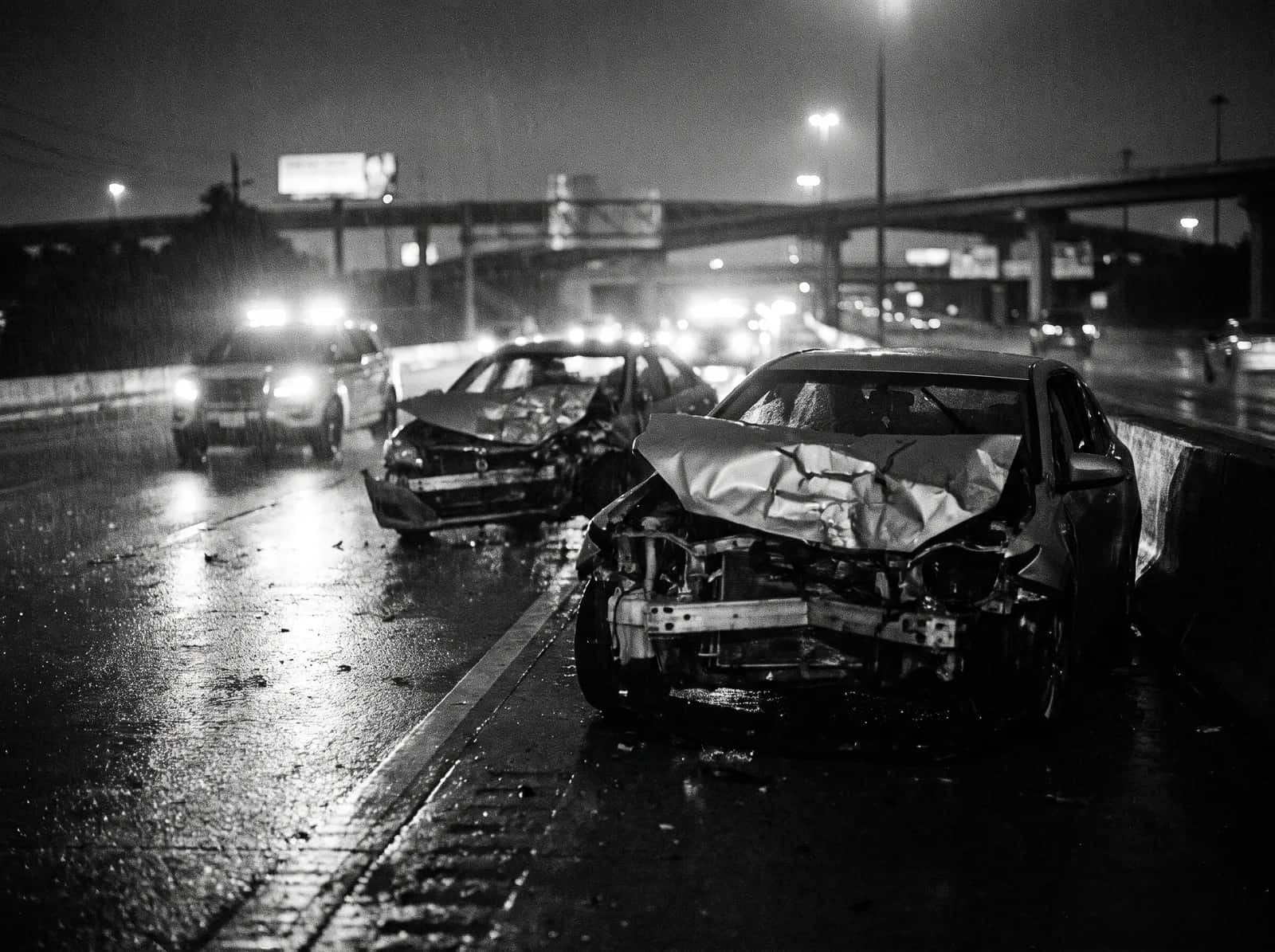

In Texas, a T-bone or side-impact crash is usually caused by a driver who ran a red light or stop sign or failed to yield the right-of-way, and the fault fight turns on signal timing, witnesses, and video. The side of a car has little room to absorb a crash, so injuries are often serious. Owsley Law Firm handles these cases and charges no fee unless it wins.
Why are side-impact crashes so dangerous?
The front and rear of a car have crumple zones that absorb a crash. The side has a door, a few inches of structure, and the occupant. In a T-bone crash, the striking vehicle can push the door into the person sitting closest to the impact, and the head can strike the window, pillar, or the other vehicle. Side airbags help, but they do not change the basic physics.
Common injuries include rib fractures, pelvic and hip fractures, shoulder injuries, traumatic brain injury, neck injuries from the sideways whipping motion, and internal injuries to the spleen and liver. The person on the struck side usually suffers the worst injuries, while the person on the far side may be hurt by the sideways motion or by an unbelted passenger.
Who is at fault in a T-bone crash in Texas?
Most T-bone crashes happen at intersections, and Texas right-of-way rules usually decide fault. Transportation Code section 544.007 governs what a driver must do at a red, yellow, or green signal. Section 545.151 governs intersections controlled by stop or yield signs, and section 545.152 requires a driver turning left to yield to oncoming traffic. A driver who enters an intersection against a red light or rolls through a stop sign and strikes a car that had the right-of-way has broken the law that exists to prevent that exact crash.
The common dispute is the signal: each driver says the light was green. The answer usually comes from independent witnesses, nearby business and traffic cameras, dash cameras, and in some cases the signal timing data kept by the city or TxDOT. Under Chapter 33 proportionate responsibility, a jury can split fault, and a driver more than 50 percent at fault recovers nothing, so the signal evidence matters.
What evidence proves a T-bone crash claim?
Intersection crashes are frequently captured on video, but the video is not kept long. Business cameras often record over themselves within days or weeks.
The firm moves to preserve evidence before it disappears.
- Video from nearby businesses, gas stations, buses, and traffic cameras
- Dash camera footage from either vehicle or from witnesses
- Event data recorder downloads showing speed and braking
- Signal timing and phasing records for the intersection
- Witness statements taken while memories are fresh
- The crash report and any statements made at the scene
- Photographs showing the point of impact and vehicle damage
Where do T-bone crashes happen in Houston?
In Houston, side-impact crashes cluster where freeway frontage roads meet major streets. Drivers leave the Katy Freeway, Southwest Freeway, North Freeway, or Gulf Freeway at speed and arrive at a signal on the frontage road, sometimes running it. Busy surface streets like Westheimer, Bellaire, Gessner, and FM 1960 have long signal cycles and heavy turning traffic. Parking lot exits onto busy roads are another frequent site.
Location matters for the evidence plan. A crash on a TxDOT frontage road involves different records than a crash on a city street, and a crash at a business exit may involve video from that business.
What if the other driver says I ran the light?
This is the most common defense in an intersection crash, and it is why the evidence matters. Do not argue at the scene and do not give a recorded statement to the other driver’s insurer. The firm builds the timeline from objective sources: video, signal timing, the position of the vehicles, and the damage pattern. An independent witness with no stake in the outcome is often the most persuasive evidence of all.
If both drivers share some fault, Texas still allows recovery so long as your share is not more than 50 percent. Your recovery is reduced by your percentage.
What can I recover after a side-impact crash?
A claim can include medical bills paid or incurred, future medical care, lost wages, lost earning capacity, physical pain, mental anguish, physical impairment, and disfigurement. Property damage, a rental car, and loss of use of your vehicle are part of the claim too.
Texas minimum liability coverage of 30/60/25 often falls short when the injuries are serious. Your own uninsured and underinsured motorist coverage and personal injury protection can fill gaps. Insurance Code section 1952.152 requires insurers to include PIP unless you rejected it in writing.
How much is a T-bone crash case worth?
There is no formula. The value of a side-impact claim depends on the injuries and how long they last, the medical bills paid or incurred, lost wages and earning capacity, any permanent impairment or scarring, how fault is divided, and the insurance available. A rib fracture that heals in eight weeks is a different case from a pelvic fracture that requires surgery and leaves a limp.
Insurance is often the practical limit. Texas only requires 30/60/25 liability coverage, so in a serious T-bone crash the at-fault driver’s policy may be exhausted quickly. The firm checks for an employer’s policy if the driver was working, your own UM/UIM coverage, and any umbrella policy before evaluating an offer.
What should you do after a T-bone crash?
Get medical care, even if you feel shaken more than hurt; side-impact injuries to the ribs, spleen, and neck are sometimes missed at first. Photograph the intersection, the signal heads, both vehicles, and the debris field. Write down which businesses face the intersection so their video can be requested. Get witnesses’ names and numbers. Report the crash to your insurer, but do not give a recorded statement to the other driver’s insurer until you have advice. Most claims must be filed within two years under section 16.003.
Common questions
What clients ask about t-bone and side-impact crashes.
Who has the right-of-way at a four-way stop in Texas?
The vehicle that arrived first goes first. If two arrive at the same time, the driver on the left yields to the driver on the right. Section 545.151 sets these rules.
Does the person who hit the side of the car always win?
No. The driver who ran the light or failed to yield is usually at fault, whether that driver struck the other car or was struck. In many T-bone crashes, the driver at fault is the one whose car was hit.
What if there are no witnesses or video?
The physical evidence still tells a story: the point of impact, vehicle positions, and event data. A reconstruction expert can often determine speeds and the sequence of events.
Can a passenger in a T-bone crash recover from both drivers?
Yes. A passenger is rarely at fault and can claim against either or both drivers depending on how fault is divided.
How long does a T-bone crash case take?
Cases with clear fault and finished medical treatment can resolve in months. Cases with a disputed light or serious injuries often take longer, especially if a lawsuit is filed.