
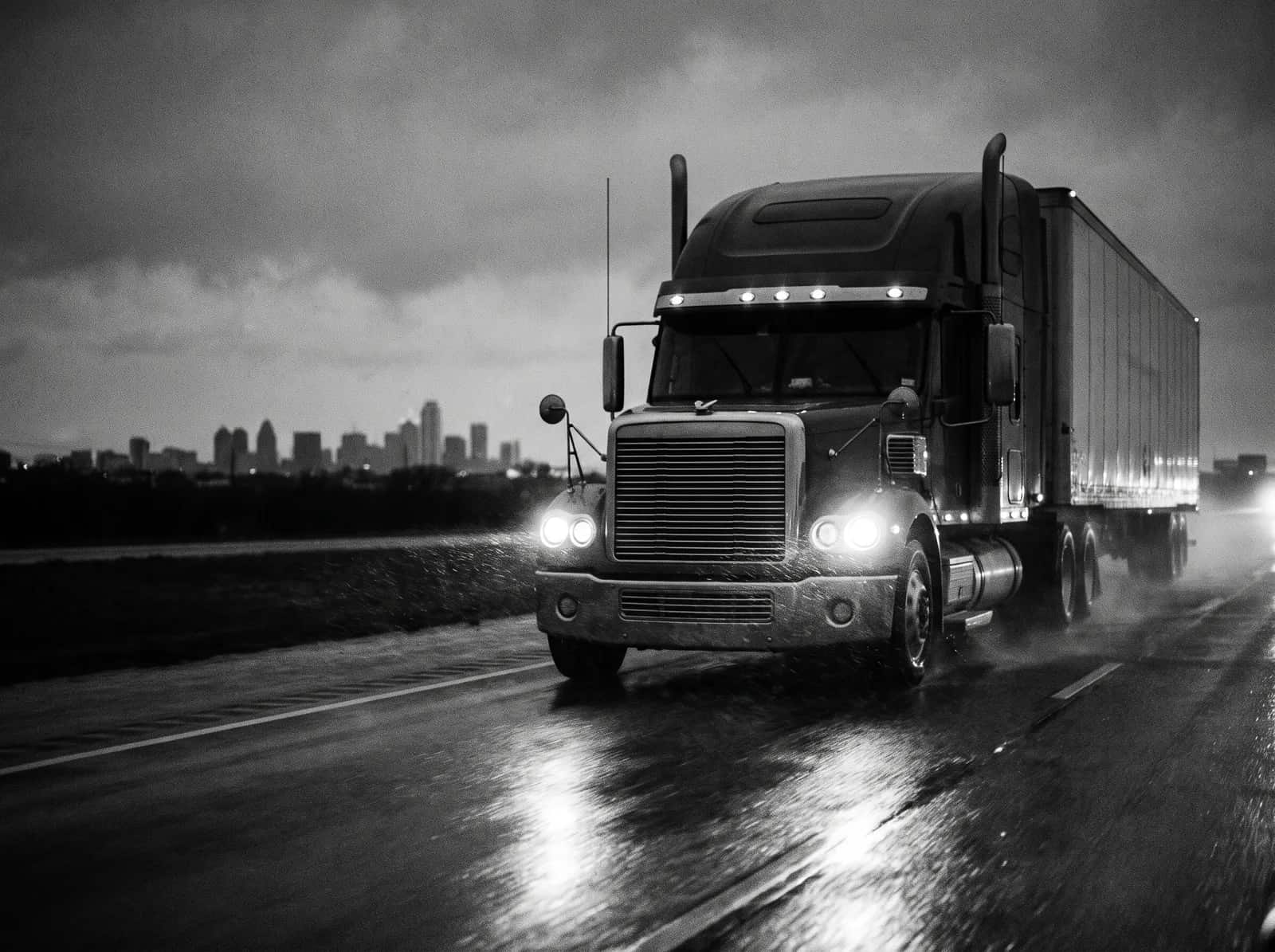

In Houston, a person hurt in a truck accident caused by someone else can recover medical costs, lost income, and pain under Texas law. Owsley Law Firm handles Houston truck accidents from its Houston offices, comes to you, and charges no fee unless it wins. Call before you speak with any insurer.
Truck Accidents in Houston
Where do Houston truck accidents happen?
Harris County carries some of the heaviest commercial truck traffic in Texas: container trucks from the Port of Houston, chemical tankers from the Ship Channel, and freight on I-10 and I-45. Truck cases here are carrier cases, and the carriers are local and well-defended.
Houston carries heavy commercial truck traffic, and its truck crashes follow the freight routes. Container trucks from the Port of Houston run Loop 610 East and I-10 East to the distribution centers along Beltway 8. Chemical tankers from the Ship Channel run SH-225 and Beltway 8. Long-haul freight runs I-10 and I-45 through the city center. The typical Houston truck case is a rear-end or sideswipe in stopped freeway traffic, and the carrier is usually local, well-insured, and quick to put an investigator on the scene.
Corridors where Houston truck accidents cluster
- I-45 Gulf Freeway at the 610 South Loop and Broadway
- I-10 Katy Freeway between Beltway 8 and the 610 West Loop
- US-59 Southwest Freeway through the 610 interchange and Westpark
- I-45 North Freeway at Beltway 8 and the Hardy Toll Road merge
- US-290 Northwest Freeway at 34th Street and the 610 interchange
- Westheimer Road from Kirby to Beltway 8, one of the county’s busiest surface streets
Cases from Houston
What does a Houston truck accident case look like?
A tanker truck leaving the Ship Channel drifts across a lane on SH-225 and forces a sedan into the barrier; the carrier’s investigator is on scene before the ambulance leaves.
Why are Houston truck crashes different from truck crashes elsewhere?
Because so much of Houston's truck traffic is port and petrochemical freight. Container trucks, chemical tankers, and flatbeds share the same freeways as commuters, often on short trips that repeat all day.
Port Houston runs two container terminals: Barbours Cut in La Porte and Bayport in Pasadena. Containers leaving those terminals move by truck to warehouses and rail yards across the region, which puts a steady stream of drayage trucks on SH-225, SH-146, Beltway 8, and the 610 East Loop. Along the Houston Ship Channel, refineries and chemical plants generate tanker and flatbed traffic that runs the same corridors at shift change. Long-haul freight crosses the city on I-10 and I-45, and I-69 carries trucks south toward the Valley.
That mix matters for an injury claim. A drayage driver may make several runs a day under tight dock appointments, which raises hours-of-service and fatigue questions. A chemical tanker brings hazardous materials rules, higher federal insurance minimums, and special license endorsements into the case. A long-haul carrier based in another state brings federal court and out-of-state corporate records into play. The first job in a Houston truck case is working out which of those worlds the truck came from.
- Port drayage: container trucks between Barbours Cut, Bayport, and inland warehouses
- Ship Channel tankers and flatbeds: chemicals, fuel, pipe, and plant equipment
- Long-haul freight on I-10 and I-45 through downtown
- Local delivery and construction trucks on the frontage roads and surface streets
Who can be held responsible for a Houston 18-wheeler crash?
Often more than the driver. The motor carrier, a company that loaded the cargo, a shop that maintained the truck, or a parts manufacturer can share responsibility, depending on what caused the crash.
The driver is responsible for his or her own careless driving. The motor carrier, the company whose operating authority the truck runs under, is generally responsible for a driver acting within the job, and it can also be responsible for its own failures: hiring a driver it should not have, pushing schedules that cannot be met legally, or skipping maintenance. Those direct claims against the company are where Texas's special trial rules for commercial vehicle cases come in, discussed below.
Other companies can be involved too. A shipper or loader that overloaded or improperly secured cargo may share fault for a shifted load or a rollover. A repair shop that worked on the brakes or tires may be responsible for a mechanical failure. A manufacturer can be liable for a defective part. In 2026 the U.S. Supreme Court held in Montgomery v. Caribe Transport II that federal law does not block a state-law claim that a freight broker carelessly chose an unsafe carrier, so a broker that arranged the load can be a defendant when the facts support it.
Each added defendant can mean added insurance. That is why the investigation looks past the driver from the first week.
How much insurance does a trucking company have to carry?
Federal rules set minimums for trucks of 10,001 pounds or more: $750,000 for for-hire interstate carriers of general freight, $1 million for oil and most hazardous materials, and $5 million for certain bulk hazardous materials. Many carriers carry more.
Under 49 CFR 387.9, a for-hire carrier hauling non-hazardous property in interstate commerce must carry at least $750,000 in liability coverage. Carriers hauling oil or most other hazardous materials must carry at least $1 million, and carriers hauling certain bulk hazardous materials, such as hazardous substances in cargo tanks, must carry $5 million. Those are floors, not ceilings, and larger fleets often carry excess or umbrella policies on top of their primary coverage.
Compare that with an ordinary Texas car policy, where the legal minimum under Transportation Code section 601.072 is $30,000 per person. The difference is why truck cases are worth investigating carefully, and why the carrier's insurer often has an adjuster or investigator working the crash within hours. Carriers that operate only inside Texas register with the Texas Department of Motor Vehicles and file proof of insurance under state rules, so their required coverage can differ from the federal interstate minimums, which is one more reason to identify the carrier's authority early.
Which federal trucking rules matter most in a Houston case?
The hours-of-service limits, driver qualification rules, maintenance and inspection rules, and post-crash drug and alcohol testing. Violations become evidence of negligence.
The Federal Motor Carrier Safety Regulations govern how commercial trucks are driven and maintained. They are not a checklist the jury sees in the abstract. They are the standard the carrier agreed to follow, and the carrier's own records show whether it did.
- Hours of service (49 CFR Part 395): a property-carrying driver gets 11 hours of driving after 10 consecutive hours off, inside a 14-hour window, with a 30-minute break after 8 hours of driving.
- Driver qualification (Part 391): carriers must keep a qualification file for each driver, including the employment application, driving records from each licensing state, the road test certificate, and the medical examiner's certificate. A driver must be at least 21 to drive in interstate commerce.
- Inspection and maintenance (Part 396): carriers must systematically inspect, repair, and maintain their trucks and keep those records for a year and for six months after the truck leaves the carrier's control.
- Post-crash testing (49 CFR 382.303): after a crash that kills someone, the carrier must test its surviving driver for alcohol and drugs. Testing is also required after injury or tow-away crashes when the driver is cited.
- Accident register (49 CFR 390.15): carriers must keep a register of reportable crashes for three years, which can show a pattern.
- Cargo securement (49 CFR 392.9): the driver must check the cargo and its securement within the first 50 miles of a trip and periodically after that.
What evidence does the trucking company have, and how long does it last?
The most important evidence is in the carrier's hands and some of it disappears on a schedule. A preservation letter in the first days protects it.
Modern trucks record their own driving. The engine control module can store speed, braking, and throttle data around a hard-braking event. The electronic logging device records driving and duty time. Many fleets run forward and driver-facing cameras, GPS tracking, and dispatch messaging. None of that belongs to the injured person, and some of it is overwritten in the ordinary course of business unless the carrier is put on notice to keep it.
Federal rules only require some of these records to be kept for limited periods, such as six months for hours-of-service supporting documents. Once a carrier receives a written demand to preserve evidence after a crash, destroying it can carry consequences in court. That is why the preservation letter goes out early in every Owsley Law Firm truck case.
What happens in a Texas commercial truck trial?
Texas has special rules for trials against commercial vehicle companies. The company can ask the court to split the trial into phases, and some claims against the company are limited if it admits the driver was on the job.
Chapter 72 of the Civil Practice and Remedies Code, added in 2021, lets a commercial motor vehicle defendant ask for a bifurcated trial. In the first phase the jury decides liability and compensatory damages; in the second, liability for and the amount of exemplary damages. If the employer stipulates in time that the driver was its employee acting within the scope of employment, its liability for the driver's ordinary negligence rests on that employment, and evidence on ordinary negligence claims against the company, such as negligent entrustment, generally waits for the second phase. For carriers regulated under federal or Texas motor carrier safety law, a listed set of safety evidence can still come in during the first phase to prove negligent entrustment, including whether the driver was licensed, disqualified, or under an out-of-service order at the time of the crash.
Those rules shape how a Houston truck case is built. Evidence of the company's own failures still matters, but it has to be developed and presented with the bifurcation rules in mind. A firm that handles truck cases plans for that from the first discovery request.
What if a hazardous materials tanker was involved?
Tanker crashes bring higher insurance minimums, special driver endorsements, and often burn, chemical, or evacuation injuries. The investigation also involves more agencies.
A driver hauling a tank vehicle or placarded hazardous materials needs a commercial license with the matching endorsements, a tank vehicle endorsement and a hazardous materials endorsement under federal rules. Carriers must also query the federal Drug and Alcohol Clearinghouse before hiring a driver. A missing endorsement or a skipped Clearinghouse query is evidence about the carrier, not just the driver.
In the Ship Channel corridor, a tanker crash on SH-225, Beltway 8, or I-10 East can involve fire, chemical exposure, or a shelter-in-place order. Injuries range from burns and inhalation injuries to the crash injuries any truck collision causes. Hospital records, hazmat incident reports, and the carrier's shipping papers all become part of the case.
What can you recover after a Houston truck crash?
Medical expenses, lost earnings and earning capacity, pain, mental anguish, physical impairment, and disfigurement. Exemplary damages are possible for gross negligence but are capped in most cases.
Texas does not cap ordinary compensatory damages against a private trucking company. The value of a truck case comes from the injury, the medical care it requires now and later, the effect on work, and how the injury changes daily life. Under Chapter 33, your recovery is reduced by any share of fault assigned to you and barred if you are found more than 50 percent responsible, which is why carriers work hard to blame the car driver.
Exemplary damages require clear and convincing proof of gross negligence or worse, and under Chapter 41 they are generally capped at the greater of $200,000 or two times economic damages plus up to $750,000 of non-economic damages. The cap does not apply to certain felony conduct, including intoxication assault and intoxication manslaughter. Burns, spinal injuries, and brain injuries are common in truck cases and are covered in the firm's injury guides.
What does it cost to hire Owsley Law Firm for a truck case?
Nothing up front. The firm works on a contingency fee and is paid only if it recovers money for you.
Truck cases are expensive to build: crash reconstruction, downloading truck data, and medical experts all cost money before any recovery. The firm advances those costs so the case can be built properly, and the fee and expense terms are set out in the written agreement before work begins. Clients may be responsible for case expenses, such as court costs, as stated in that agreement.
The phones are answered 24/7 by the firm's team, and Steven Owsley has been licensed in Texas since 1985. Truck cases are handled from the Sawyer Street and Westheimer offices, minutes from the Harris County courthouse.
Evidence in a Houston truck case and who holds it
| Evidence | Who has it | Why it matters |
|---|---|---|
| Engine control module data | The carrier (in the truck) | Speed, braking, and throttle around the crash |
| Electronic logging device records | The carrier and its ELD provider | Hours of service and fatigue |
| Dashcam and driver-facing video | The carrier | What the driver saw and was doing |
| Driver qualification file | The carrier | Hiring, licensing, medical certification, prior record |
| Maintenance and inspection records | The carrier and repair shops | Brakes, tires, lights, and known defects |
| Post-crash drug and alcohol tests | The carrier | Impairment, and whether testing was done as required |
| Bills of lading and dispatch messages | Carrier, shipper, broker | Who controlled the load and the schedule |
| Crash report and reconstruction | Houston Police, Harris County Sheriff, or DPS | Officer findings, diagrams, and citations |
What to do now
What should you do after a truck accident in Houston?
- Get examined the same day. Truck crashes cause injuries that surface late, and Memorial Hermann Texas Medical Center (Level I trauma) and Ben Taub Hospital (Level I trauma) take the serious ones from Houston.
- Photograph the truck's USDOT number, the company name on the door, the trailer, and the plates. On I-10 (Katy Freeway and East Freeway) the rig is often towed within the hour.
- Move fast on the carrier's records. The truck's electronic logging data, dashcam video, and engine data sit with the trucking company, and federal rules only require hours-of-service records to be kept for six months, so a preservation letter should go out early.
- Get the Houston crash report. Houston Police Department crash reports (Texas form CR-3) are available through the TxDOT Crash Report Online Purchase System about 10 days after the crash, and HPD Records Division also provides them. The firm obtains it for clients at no charge.
- Do not give a statement to the trucking company's investigator or its insurer. They often start working the crash within hours; your own insurer only needs the basic facts.
- Know where the case goes. Houston truck accidents suits are filed in the Harris County Civil District Courts, 201 Caroline St.
- Call the firm. Both Houston offices are minutes from the courthouse, and the consultation is free.
Houston truck accidents we handle
Specific Houston truck accident cases
Go deeper
More on truck accident claims in Houston and Texas.
Common questions
Houston truck accident questions
Which Houston roads have the most truck accidents?
I-10 East and the 610 East Loop near the port, SH-225 and Beltway 8 through the refinery belt, I-45 North, and the Katy Freeway west of the Loop.
Who investigates a Houston truck crash?
Houston Police for crashes inside the city, the Harris County Sheriff or DPS outside it, and DPS commercial vehicle enforcement troopers may inspect the truck after a fatal or hazmat crash. The carrier’s own investigators arrive first, which is why the firm sends a preservation demand the same week.
What if the Houston truck driver was an owner-operator leased to a carrier?
Federal leasing rules generally make the motor carrier responsible for a truck operating under its authority, even when an owner-operator owns the rig. That matters because the carrier’s commercial policy is usually far larger than the driver’s. The lease agreement, the carrier number on the cab door, and the bill of lading show who was in control.
Can a Houston truck accident case be moved to federal court?
It can. When the trucking company and every other defendant are from outside Texas, none shares a home state with you, and more than $75,000 is at stake, the defense can move the case to the U.S. District Court for the Southern District of Texas, Houston Division. Texas law still governs fault and damages, but federal procedure, deadlines, and a broader jury pool apply, so the case is prepared for that from the start.
What if my Houston crash involved a container truck from Barbours Cut or Bayport?
The truck may be owned by one company, operated under another company's authority, and pulling a chassis supplied by a third. The door markings, the USDOT number, and the container and chassis numbers identify who is responsible and which insurance applies. Photograph them if you can, and keep the crash report, which should list the carrier.
Can I bring a truck accident claim if the driver was not ticketed?
Yes. A citation is not required to prove a civil claim. Officers often do not issue tickets at serious crash scenes, especially when people are taken to the hospital. The civil case is proven with the truck's data, the driver's records, witnesses, and reconstruction, under a lower standard of proof than a traffic case.
Does the trucking company have to drug test the driver after a crash?
After a crash involving a death, federal rules require the carrier to test its surviving driver for alcohol and controlled substances. After a crash with an injury treated away from the scene, or a vehicle towed, testing is required if the driver receives a citation for a moving violation within the time limits in the rule. Whether the carrier tested on time is itself evidence.
What if a tire tread or debris from a truck hit my car on I-10?
The carrier may be responsible if the debris came from poor maintenance, an under-inflated or worn tire, or unsecured cargo. Federal rules require the driver to inspect cargo securement early in a trip and carriers to keep their equipment in safe condition. Photograph the debris and the truck if it stopped, and note any company name or number.
How long do I have to file a Houston truck accident lawsuit?
Generally two years from the date of the crash under Civil Practice and Remedies Code section 16.003. Claims against a government entity require written notice much sooner. Truck evidence disappears long before the deadline, so the practical deadline for protecting the case is measured in days.
Will my Houston truck case go to trial?
Most injury cases settle, but a truck case should be built as if it will be tried, because carriers and their insurers value cases by how ready the other side is for a jury. Whether a particular case settles or goes to trial depends on the evidence, the injuries, and the offers made.
Sources
Sources this page relies on
- 49 CFR Part 387 (federal minimum insurance for motor carriers)
- 49 CFR Part 395 (hours of service)
- 49 CFR Part 391 (driver qualification)
- 49 CFR Part 396 (inspection and maintenance)
- 49 CFR Part 382 (drug and alcohol testing)
- Texas Civil Practice and Remedies Code, chapter 72 (commercial vehicle trials)
- Port Houston container terminals (Barbours Cut and Bayport)
- Texas DMV, motor carrier registration (TxDMV number)