
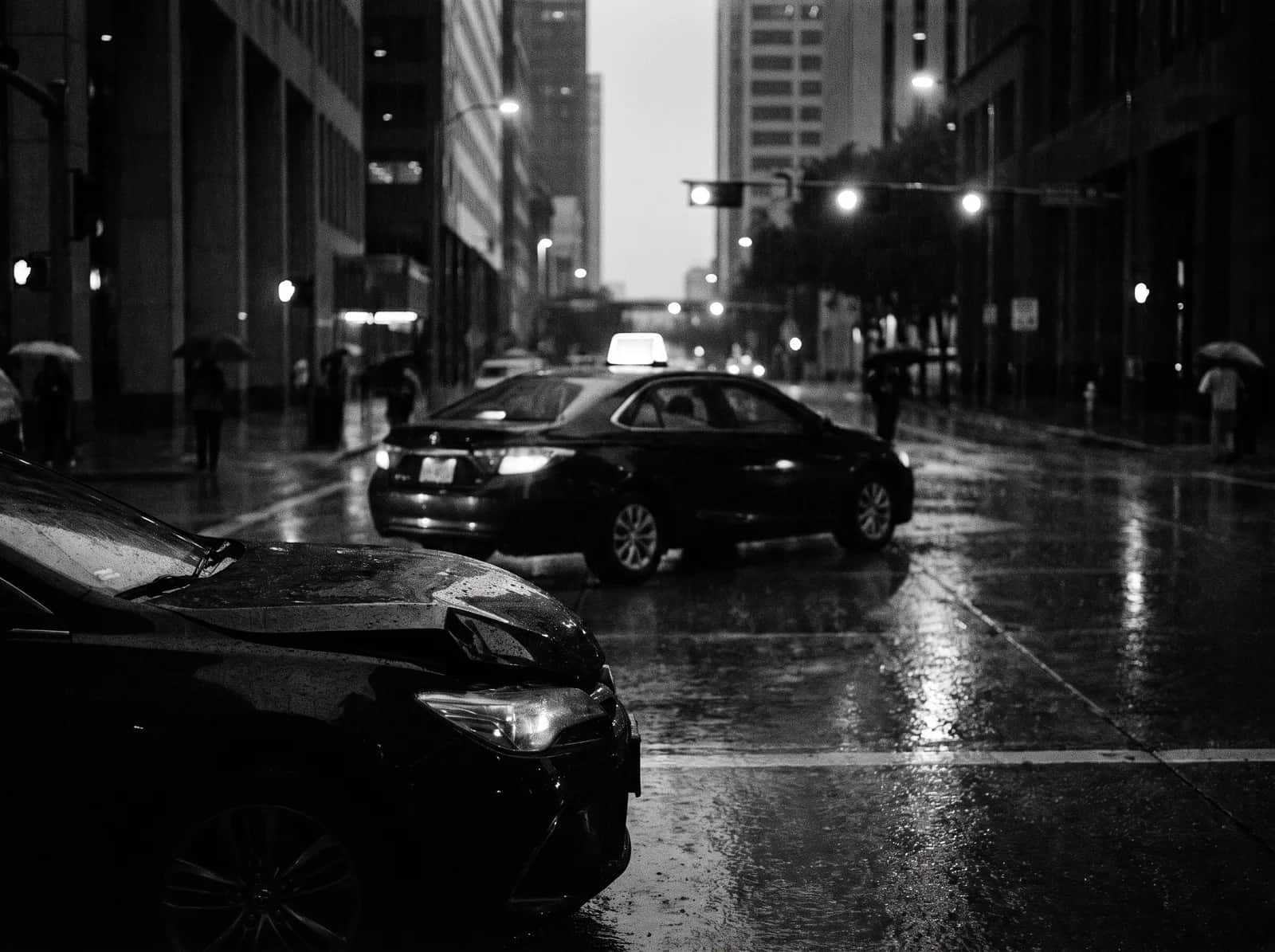

In The Woodlands, a person hurt in a rideshare accident caused by someone else can recover medical costs, lost income, and pain under Texas law. Owsley Law Firm handles The Woodlands rideshare accidents from its Houston offices, comes to you, and charges no fee unless it wins. Call before you speak with any insurer.
Rideshare Accidents in The Woodlands
Where do The Woodlands rideshare accidents happen?
Rideshare crashes concentrate at Market Street, Hughes Landing, the Pavilion, and the Sawdust Road entertainment strip.
Woodlands rideshare crashes concentrate at Market Street, Hughes Landing, the Pavilion on concert nights, and on I-45 for rides to Bush Airport and Houston. The firm’s Woodlands rideshare cases most often involve a passenger hurt when the car was rear-ended on I-45 or a third driver ran a light on Woodlands Parkway.
Corridors where The Woodlands rideshare accidents cluster
- I-45 at the Grand Parkway interchange
- I-45 at Woodlands Parkway and Lake Woodlands Drive
- I-45 through Conroe at SH-105 and Loop 336
- Grand Parkway between I-45 and FM 2978
- FM 1488 from I-45 to Magnolia
- Rayford Road and Sawdust Road at I-45
Cases from The Woodlands
What does a The Woodlands rideshare accident case look like?
A commuter on I-45 near Woodlands Parkway is rear-ended by a tractor-trailer that could not stop for the morning backup.
Does The Woodlands have its own rules for Uber and Lyft?
No. Texas law makes rideshare regulation a state matter, so the township, Shenandoah, and Oak Ridge North cannot add their own insurance or licensing rules. The state coverage tiers apply here exactly as written.
Occupations Code section 2402.003 says the regulation of transportation network companies, their drivers, and the vehicles used for app rides is an exclusive power of the state and may not be regulated by a municipality or other local entity, whether through a tax, an added permit, rate setting, or operating requirements. The one carve-out that matters for Woodlands riders is the airport: an airport owner or operator may impose its own regulations on rideshare companies that pick up or drop off on airport property.
For a passenger, this uniformity is useful. It means the questions after a crash on Lake Robbins Drive or Research Forest Drive are the same ones a passenger in Austin or Dallas would ask: what was the driver's app status, who caused the crash, and which policies cover each driver. The local part of the case is the evidence, the agencies, and the courthouse.
Which policy pays depends on what the driver's app showed
From the moment the driver accepts a ride until the last passenger gets out, Texas requires $1 million in liability coverage. While the driver is logged in and waiting for a request, the minimum drops to $50,000 per person.
Insurance Code section 1954.052 sets the waiting-period minimums: $50,000 for bodily injury to each person, $100,000 per incident, and $25,000 for property damage, plus uninsured or underinsured motorist coverage and personal injury protection where the Insurance Code requires them. Section 1954.053 applies once the driver is engaged in a prearranged ride and requires a total aggregate limit of $1 million for death, bodily injury, and property damage for each incident, along with the same uninsured motorist and PIP requirements.
If the driver's own policy has lapsed or does not provide the required coverage, section 1954.054 requires the rideshare company's policy to provide it from the first dollar, and section 1954.055 says that coverage does not depend on the driver's personal insurer first denying the claim. A driver who was fully logged out is covered only by a personal policy, and section 1954.151 allows personal insurers to exclude losses while a driver is logged in or on a ride.
The practical point for a Woodlands passenger is that the coverage tier is fixed by a timestamp. The app records when the driver logged on, when the request was accepted, and when the trip ended, and those times decide which policy is first in line.
How do you get the app's records when the companies point at each other?
Texas requires the rideshare company and its insurer to share the driver's log-on and log-off times for the 12 hours before and after the crash with the people directly involved in the claim. A preservation request should still go out early.
Under Insurance Code section 1954.154, in an insurance claim investigation the company and any insurer providing the rideshare coverage must give directly interested persons the precise times the driver logged on and off in the 12-hour periods before and after the crash, along with a clear description of the coverage, exclusions, and limits. That statute is the starting point when the driver says the app was off and the rideshare insurer says the personal insurer should pay.
The statute does not cover everything a claim may need. GPS route data, speed, in-app messages, and the driver's account history are kept by the company on its own schedule, and the claim should ask for them to be preserved in writing at the start. If a lawsuit becomes necessary, those records can be obtained by subpoena or through discovery.
Your own phone is evidence too. Before closing the app, capture the driver's name and photo, the vehicle and plate, the route map, the pickup and drop-off times, and the receipt, and use the app's safety or crash report feature so the company opens a file.
- Screenshots of the trip, driver, vehicle, route, and receipt
- The in-app crash report, filed the same day
- A written request that the company preserve GPS and trip data
- The 12-hour log-on and log-off times under section 1954.154
- The investigating agency's name and case number
What about a crash on the way to or from Bush Airport?
A trip with a passenger aboard is an accepted ride, so the $1 million tier covers the rideshare driver's share of fault. On the drive south the crash may happen in Harris County or inside Houston, which changes the agency and the court.
Rides from The Woodlands to George Bush Intercontinental Airport travel south through Montgomery County and into Harris County, and the investigating agency changes along the way. A crash in Montgomery County may be worked by the sheriff's office, a constable, a city department such as Shenandoah's, or DPS. A crash closer to the airport may be worked by a Harris County agency or the Houston Police Department, which has an Airport-IAH division for the airport and the surrounding area.
The airport itself is run by the Houston Airport System, a City of Houston department, and section 2402.003 lets an airport operator set its own rules for rideshare pickups on airport property. A crash at the terminal curb or on an airport road can therefore involve airport rules and City of Houston records in addition to the ordinary crash report.
Which county the crash happened in matters for where the case can be filed. A crash in Harris County on the way to the airport can generally be filed in the Harris County Civil District Courts, even though the trip started in The Woodlands, and venue may also be proper where an individual defendant lived.
What if the crash involved a Woodlands Express bus or a Town Center trolley?
Then a public transit vehicle is part of the claim, and the first step is identifying exactly who operated it. Notice deadlines for government-related claims can be short, so written notice should go out early.
The Woodlands Township Transportation Department runs The Woodlands Express, a park and ride commuter bus service, and free Town Center trolleys. Rideshare cars share the same Town Center streets and park and ride access roads, and a crash between a rideshare car and a bus or trolley brings a different set of rules into play.
Whether the Texas Tort Claims Act and its caps apply depends on the entity that owned and operated the vehicle and on the contracts behind the service, which should be confirmed rather than assumed. When a governmental unit is involved, Civil Practice and Remedies Code section 101.101 requires written notice of the claim within six months, describing the injury, the time and place, and the incident, and city charters can require notice sooner than six months. Sending notice early costs nothing and protects the claim while the operator's status is sorted out.

How is fault divided when the rideshare driver and another driver both made mistakes?
A jury assigns each a percentage under Chapter 33 of the Civil Practice and Remedies Code. A passenger who did nothing wrong can claim against each driver's coverage for that driver's share.
Picture a rideshare driver who glances at the next request while turning left out of a Town Center garage, and an oncoming driver who is speeding. Transportation Code section 545.152 requires a left-turning driver to yield to oncoming traffic close enough to be an immediate hazard, but the speeding driver can share the blame. Each pays its own percentage, and under Civil Practice and Remedies Code section 33.013 a defendant is responsible for the whole judgment only if its share is more than 50 percent.
That is why the rideshare driver's share matters even when the other driver looks worse. The $1 million trip coverage is often the largest policy in the case, and a modest percentage assigned to the rideshare driver can still be a meaningful part of the recovery. Witnesses, business cameras facing the intersection, and the app's speed data are the tools for proving those shares.
Insurers sometimes try to assign part of the fault to the passenger. Rear-seat passengers 15 and older must wear a seat belt under Transportation Code section 545.413, and under Nabors Well Services v. Romero (Tex. 2015) not wearing one can be considered in assigning the passenger a share of responsibility only if it caused or added to the injuries. It does not change who caused the crash.
What if you drive for Uber or Lyft out of The Woodlands and were hit?
Claim against the driver who caused the crash first. If that coverage falls short, the uninsured and underinsured coverage tied to your app status, and your own policy's terms, decide what fills the gap.
Drivers who work The Woodlands spend long stretches waiting between requests, which is exactly the period when the required coverage is lowest. If you were hit while logged in and waiting, the uninsured and underinsured motorist coverage available under section 1954.052 applies where the Insurance Code requires it. If you had a passenger aboard, the section 1954.053 tier applies. Your personal policy may exclude the crash entirely if you were logged in.
Because Occupations Code section 2402.114 treats drivers as independent contractors when the company meets the statute's conditions and the two agree in writing, workers' compensation usually does not cover an app driver. Keep the app's earnings records for the weeks before the crash, because they are the proof of lost income.
Where are injured passengers treated, and what about hospital liens?
Memorial Hermann The Woodlands Medical Center and HCA Houston Healthcare Conroe are Level II trauma centers; the most serious injuries may go to the Level I centers in the Texas Medical Center. A hospital that treats you can claim a lien on the recovery.
The Texas Department of State Health Services list of designated trauma facilities, current as of October 1, 2026, shows Memorial Hermann The Woodlands Medical Center, listed in Shenandoah, and HCA Houston Healthcare Conroe as Major (Level II) facilities, and Memorial Hermann Texas Medical Center and Harris Health Ben Taub Hospital as Comprehensive (Level I). HCA Houston Healthcare Northwest in north Houston is also Level II. Houston Methodist The Woodlands and St. Luke's Health The Woodlands are hospitals, but they are not designated trauma centers.
Under Property Code chapter 55, a hospital that treats a patient within 72 hours of the crash, including in the emergency room, has a lien on the claim. The lien is limited to hospital charges for the first 100 days, plus physician charges for the first seven days, and it cannot exceed 50 percent of the recovery. Health plans have their own reimbursement rules: a fully insured plan is governed by Civil Practice and Remedies Code chapter 140, which does not apply to self-funded ERISA plans, and Texas Medicaid recovers under Human Resources Code section 32.033.
Woodlands rideshare crash: which coverage tier applies
| Driver's app status | Required liability minimum | What to request |
|---|---|---|
| Logged out | Driver's personal policy only (may exclude app driving) | Driver's insurance card and the company's log-on times |
| Logged in, waiting for a request | $50,000 per person, $100,000 per incident, $25,000 property (section 1954.052) | Log-on times for the 12 hours before and after (section 1954.154) |
| Ride accepted, heading to pickup | $1 million aggregate per incident (section 1954.053) | Acceptance timestamp and GPS route |
| Passenger aboard, including airport trips | $1 million aggregate per incident (section 1954.053) | Trip screenshots, receipt, investigating agency |
| Driver's own policy lapsed or short | Company policy pays from the first dollar (section 1954.054) | The rideshare insurer's coverage description |

What to do now
What should you do after a rideshare accident in The Woodlands?
- Get examined the same day. Memorial Hermann The Woodlands Medical Center (Level II trauma) and Houston Methodist The Woodlands Hospital handle the serious crash injuries from The Woodlands.
- Screenshot the trip in the Uber or Lyft app now: driver name, vehicle, route, and receipt. Whether the driver was logged in, waiting for a ride, or carrying a passenger decides which insurance policy applies under Texas Insurance Code chapter 1954.
- Photograph both vehicles, the plates, and the scene, especially on I-45 (North Freeway) and Grand Parkway (SH-99), where scenes are cleared within minutes.
- Report the crash in the app so the company's insurer opens a claim. Get the The Woodlands crash report. Montgomery County Sheriff, Harris County Precinct 4 Constable (Creekside Park), Shenandoah, Oak Ridge North, and DPS reports are available through the TxDOT Crash Report Online Purchase System, usually within 10 days. The firm obtains it for clients at no charge.
- Do not give a recorded statement to the rideshare company's insurer or the other driver's carrier until you have counsel.
- Know where the case goes. The Woodlands rideshare accidents suits are filed in the Montgomery County District Courts, Montgomery County Courthouse, Conroe, or Montgomery County Courts at Law depending on the crash location.
- Call the firm. Forty minutes north of the firm’s Houston offices. The firm comes to you. The consultation is free.
Go deeper
More on rideshare accident claims in The Woodlands and Texas.
Common questions
The Woodlands rideshare accident questions
Where do Woodlands rideshare accidents happen most?
Market Street, Hughes Landing, the Pavilion, Sawdust Road, and I-45 on rides to the airport and Houston.
Where is a Woodlands rideshare accident case filed?
In the Montgomery County District Courts in Conroe.
What if my rideshare crashed leaving a concert at The Woodlands Pavilion?
Event traffic crashes are covered like any other trip in progress, with $1 million in coverage when a passenger is on board. If another driver caused the crash and had been drinking at the event or a nearby bar, a dram shop claim may also be possible. Get witness names before the lots clear, because event crowds disperse quickly.
Is a rideshare driver in The Woodlands an employee of Uber or Lyft?
The companies classify their drivers as independent contractors, which limits claims against the company itself. That is why Texas law requires the rideshare insurance coverage instead. For an injured passenger, the practical question is not employment status but which coverage period applied when the crash happened.
Can The Woodlands Township require extra insurance for Uber and Lyft drivers?
No. Occupations Code section 2402.003 makes rideshare regulation an exclusive state power that a municipality or other local entity may not add to. Only airport operators may set their own rules for pickups on airport property.
The driver says the app was off when we crashed. How do I prove it was on?
Your trip screenshots and receipt are the first proof. Texas also requires the rideshare company and its insurer to give directly interested persons the driver's log-on and log-off times for the 12 hours before and after the crash.
My crash happened in Harris County on a ride from The Woodlands to the airport. Is the case filed in Conroe?
Usually not. Venue generally follows where the crash happened, so a Harris County crash can be filed in the Harris County Civil District Courts. It may also be proper where an individual defendant lived.
Does the rideshare insurer have to wait for the driver's own insurer to deny the claim?
No. Insurance Code section 1954.055 says the rideshare coverage does not depend on the personal insurer first denying the claim.
Which police agency do I ask for my report in Creekside Park?
Creekside Park is patrolled by the Harris County Constable, Precinct 4, under the township's contract. The CR-3 report from that office, like any other agency's, can be bought through the TxDOT Crash Report Online Purchase System.
Was I taken to a trauma center after my rideshare crash?
Memorial Hermann The Woodlands Medical Center and HCA Houston Healthcare Conroe are state-designated Level II trauma centers. Houston Methodist The Woodlands and St. Luke's Health The Woodlands are not on the designated trauma list.
I drive for Lyft. Will workers' compensation pay for my injuries?
Usually not. Texas treats app drivers as independent contractors when the company meets the conditions in Occupations Code section 2402.114, so the claim runs against the at-fault driver and the coverage tied to your app status.
Sources
Sources this page relies on
- TxDOT, Crashes and Injuries by Investigating Agency, 2024
- Texas DSHS, Texas Trauma Facilities
- The Woodlands Township Transportation (The Woodlands Express and Town Center trolleys)
- The Woodlands Township, Law Enforcement
- Montgomery County District Clerk
- Texas Insurance Code, chapter 1954 (transportation network company insurance)
- Texas Occupations Code, chapter 2402 (transportation network companies)
- Texas Civil Practice and Remedies Code, chapter 33 (proportionate responsibility)