
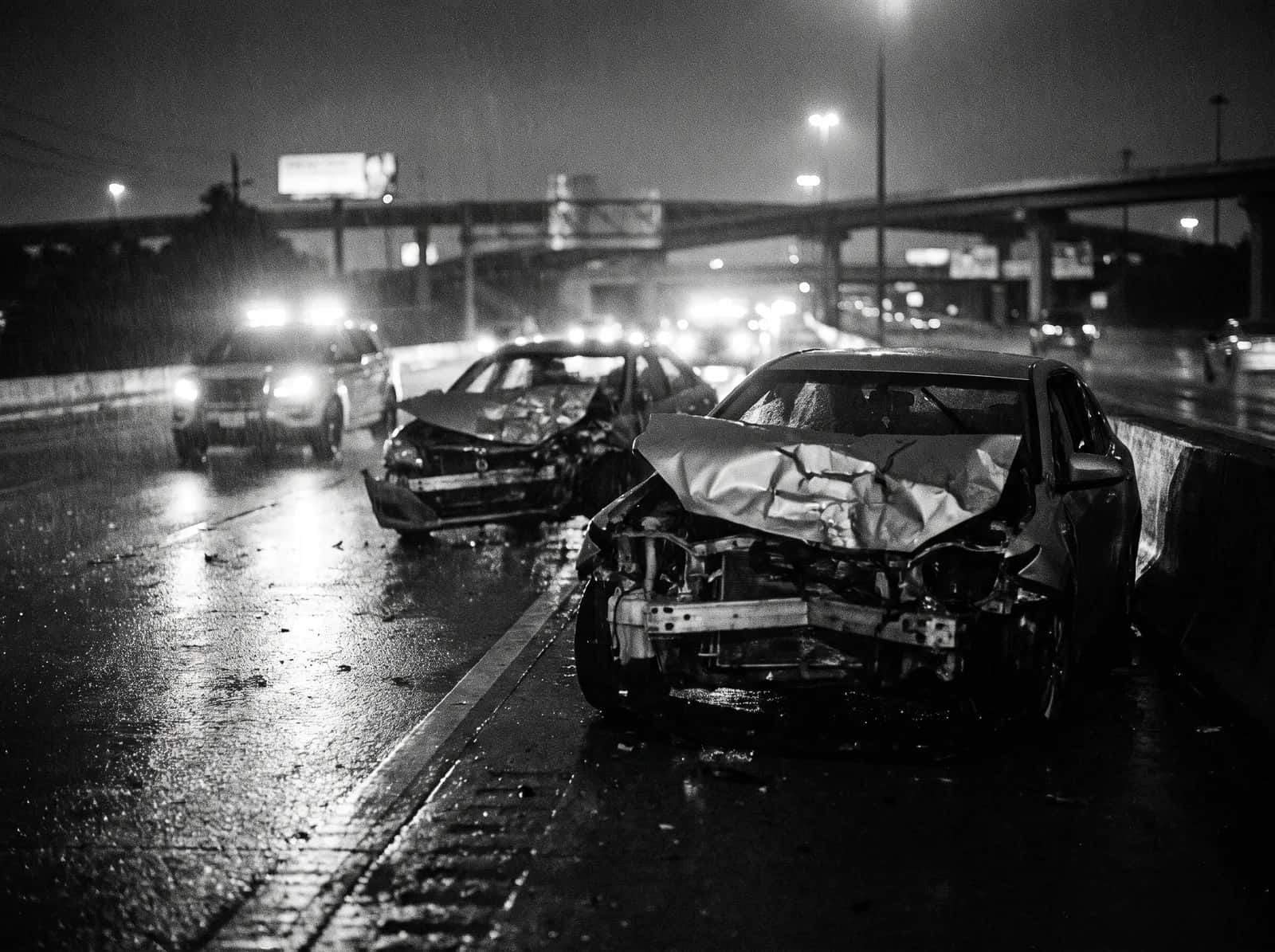

In Katy, a person hurt in a car accident caused by someone else can recover medical costs, lost income, and pain under Texas law. Owsley Law Firm handles Katy car accidents from its Houston offices, comes to you, and charges no fee unless it wins. Call before you speak with any insurer.
Car Accidents in Katy
Where do Katy car accidents happen?
Katy car cases begin on the Katy Freeway and its frontage roads, and at the Grand Parkway intersections. Venue depends on the crash location: Harris, Fort Bend, or Waller County.
Katy car crashes happen on the Katy Freeway and at the Grand Parkway. The freeway’s managed lanes, frontage roads, and closely spaced exits at Mason, Fry, and the Grand Parkway produce high-speed rear-end and lane-change crashes every rush hour, and the stacked I-10 and SH-99 interchange funnels Cinco Ranch traffic into the same lanes. FM 1093 through Cinco Ranch and Fulshear has become a commuter highway with intersection crashes at every signal. The firm’s Katy car cases most often begin on I-10 between Mason Road and the Grand Parkway.
Corridors where Katy car accidents cluster
- I-10 Katy Freeway at the Grand Parkway interchange
- I-10 at Mason Road and Fry Road
- Grand Parkway (SH-99) between I-10 and FM 1093
- Westpark Tollway at the Grand Parkway
- FM 1093 through Cinco Ranch and Fulshear
- FM 1463 and Katy-Flewellen Road
Cases from Katy
What does a Katy car accident case look like?
A commuter in Katy Freeway congestion at Mason Road is rear-ended by a driver looking at a phone; the neck injury needs months of treatment.
A driver exiting the Grand Parkway onto FM 1093 runs the light and T-bones a minivan carrying two children.
How many people are hurt in crashes around Katy?
Katy sits where three counties meet, and TxDOT's 2024 county crash table counts 579 traffic deaths in Harris County, 41 in Fort Bend County, and 11 in Waller County.
TxDOT publishes crash totals by county, not by city, so the honest way to describe Katy is through the three counties its city limits cross. In 2024, Harris County recorded 115,173 reportable crashes, 546 of them fatal, with 2,688 people suspected of serious injury. Fort Bend County recorded 13,217 crashes, 38 fatal crashes, and 313 suspected serious injuries. Waller County, the smallest of the three, recorded 1,445 crashes, 9 fatal crashes, and 102 suspected serious injuries.
Those numbers come from the crash reports officers file with TxDOT, the same reports that will describe your crash. They also show why the county line matters so much in Katy: the agency that responds, the hospital the ambulance chooses, and the courthouse where a lawsuit would be filed all follow the spot on the map where the vehicles came to rest.
Where do car crashes happen in and around Katy?
Mostly on the Katy Freeway (I-10) and its frontage roads, at the Grand Parkway (SH 99) interchange, along the Westpark Tollway, and on the farm-to-market roads that now carry subdivision traffic, such as FM 1463 and FM 1093.
I-10 is the spine of Katy. Commuters headed east toward the Energy Corridor, the office district that stretches along I-10 from Kirkwood Road to west of Barker Cypress Road, share the main lanes with interstate traffic bound for San Antonio. Stop-and-go conditions between Katy and the Energy Corridor set up the classic Katy crash: a driver looking down at a phone runs into a line of stopped cars at highway speed.
The frontage roads produce a different crash. Drivers come off the freeway fast, meet signals at Mason Road and Fry Road, and either run the light or turn left across traffic that is closer and faster than it looks. Those are T-bone and left-turn cases, and the fight is usually over who had the green.
The Grand Parkway, State Highway 99, loops through Fort Bend and Harris Counties and crosses I-10 in Katy. Its ramps and the Westpark Tollway carry high-speed traffic from Cinco Ranch, Fulshear, and the developments south of the freeway onto the same corridor. On FM 1463 and FM 1093, roads that once served farms now carry subdivision commuters, and rear-end and turning crashes at their signals are a regular result.
Older routes matter too. US-90, the older highway west from Houston toward Sealy, carries local traffic through Katy, and its intersections and driveways produce lower-speed but still serious side-impact crashes.
- I-10 Katy Freeway main lanes, east toward the Energy Corridor
- Frontage-road signals at Mason and Fry Roads
- Grand Parkway (SH 99) ramps at I-10
- Westpark Tollway feeding traffic from the south
- FM 1463, FM 1093, and US-90
Which county is a Katy crash in, and why does it matter?
The City of Katy's own police department describes the city limits as falling in Harris, Fort Bend, and Waller Counties. The county where the crash happened, not your mailing address, usually decides which sheriff, which records, and which courthouse.
A Katy mailing address covers far more ground than the City of Katy. Many homes with a Katy address are in unincorporated Harris County or Fort Bend County, and a few miles west the line runs into Waller County near Brookshire. Two drivers can live on the same street and have crashes a mile apart that belong to two different courthouses.
Under Civil Practice and Remedies Code section 15.002, a suit can generally be filed in the county where all or a substantial part of the events happened, in the county where an individual defendant lived when the crash happened, or in the county of a company defendant's principal office in Texas. That means a Fort Bend crash involving a driver who lives in Harris County may be filed in either county. The choice changes the jury pool and the court's docket, so it is made on purpose after the facts are known.
The three courthouses are far apart. Harris County civil cases are filed with the Harris County District Clerk at 201 Caroline Street in downtown Houston. Fort Bend County's district clerk is at the Justice Center, 1422 Eugene Heimann Circle in Richmond. Waller County's 506th Judicial District Court and its district clerk are at the Waller County Justice Center, 400 Sheriff R. Glenn Smith Drive in Hempstead.
If the case qualifies for federal court, all three counties belong to the Houston Division of the U.S. District Court for the Southern District of Texas, so a removed Katy case is heard in Houston regardless of which side of the county line the crash was on.
Who investigates a Katy car crash, and how do you get the report?
Inside the City of Katy it is usually the Katy Police Department. Outside the city limits it may be the Harris County, Fort Bend County, or Waller County Sheriff's Office, a constable precinct, or a DPS trooper on a state highway. Every agency files the same state report.
The officer who responds should give you a card or slip with the agency name and a report or case number. Write it down before you leave the scene, because in Katy the agency is not obvious. A wreck on the I-10 frontage road can fall to the city police on one side of an intersection and to a county agency on the other.
Transportation Code section 550.062 requires an officer who investigates a crash causing injury, death, or at least $1,000 in property damage to file a written report, electronically, with TxDOT no later than the tenth day after the crash. That report, the Texas Peace Officer's Crash Report or form CR-3, can then be purchased through the TxDOT Crash Report Online Purchase System using the date, county, and a name or report number. Katy Police also has a records unit that handles open records requests for its own files.
When you read the report, look at the diagram, the contributing factors, and the narrative. Officers in Katy often arrive after the cars have been moved to the shoulder or a parking lot, and the report may be built on whichever driver was still standing there. Mistakes can be corrected or challenged with photos, dashcam footage, nearby business video, and the vehicles' event data recorders.
Which hospitals treat serious crash injuries near Katy?
Memorial Hermann Katy Hospital is a state-designated Advanced (Level III) trauma facility. The closest Comprehensive (Level I) centers are in the Texas Medical Center: Memorial Hermann-Texas Medical Center and Harris Health Ben Taub Hospital.
The Texas Department of State Health Services keeps the official list of designated trauma facilities, current as of October 1, 2026. On that list, Memorial Hermann Katy Hospital is Level III, and Memorial Hermann Cypress Hospital, north of Katy, is also Level III. HCA Houston Healthcare West and Memorial Hermann Memorial City Medical Center are Basic (Level IV) facilities, and Texas Children's Hospital West Campus is listed at Level IV on probationary status. Not every emergency room near Katy is on the list at all; Houston Methodist West, for example, does not appear on it.
For the most serious injuries, paramedics may bypass the closest emergency room and take a patient to a Level I center in the Medical Center, where Memorial Hermann-Texas Medical Center and Ben Taub are both designated Level I. Texas Children's Hospital in the Medical Center is listed at Level I with contingent status.
If you were not taken by ambulance, get seen the same day or the next morning. Tell the provider you were in a car crash and describe every symptom, including headaches, numbness, and back pain that seemed minor at the scene. A gap in treatment is the first thing an adjuster looks for.
What if a City of Katy vehicle or a school bus hit you?
The City of Katy's charter requires a sworn written notice of claim within six months, directed to the City Secretary. Claims against school districts, counties, and the state run under the Texas Tort Claims Act, which has its own six-month notice rule and damages caps.
Article XII, section 4 of the Katy Home Rule Charter requires a person injured by the city to give written notice, verified by affidavit, within six months after the injury. The notice must say when, where, and how the injury happened, its apparent extent, the amount of damages, the claimant's residence, and the names and addresses of witnesses. The charter says failing to give that notice in time and in the required manner excuses the city from liability, so a city claim should not wait.
Civil Practice and Remedies Code section 101.101 sets the general Tort Claims Act rule: written notice within six months that describes the injury, the time and place, and the incident, and it ratifies city charter notice provisions like Katy's. The formal notice requirement does not apply when the government already has actual notice of the injury, but whether a police report alone is enough is a fight best avoided by sending notice early.
The Tort Claims Act allows claims for injuries caused by a government employee's operation of a motor vehicle. Under Civil Practice and Remedies Code section 101.051, motor vehicles are the only part of the Act that applies to a school district, and that is the part that covers a Katy ISD bus. The caps in section 101.023 are $250,000 per person and $500,000 per occurrence for a city or the state, and $100,000 per person and $300,000 per occurrence for other local units, such as a school district or a county. A private driver who shared fault can still be pursued without those caps.
- City of Katy vehicle: sworn written notice to the City Secretary within six months
- Katy ISD bus: Tort Claims Act notice, generally within six months
- Harris, Fort Bend, or Waller County vehicle: Tort Claims Act notice and caps
- TxDOT or another state vehicle on I-10: Tort Claims Act notice and state caps
Which insurance pays after a Katy car accident?
Usually the at-fault driver's liability insurance, your own Personal Injury Protection (PIP) first for medical bills and lost income, and your own uninsured or underinsured motorist coverage if the other driver had too little or none.
Texas minimum liability limits under Transportation Code section 601.072 are $30,000 per injured person, $60,000 per crash, and $25,000 for property damage. After a hospital stay and follow-up care, those limits often run out early.
Insurance Code section 1952.152 requires every Texas auto policy to include PIP unless an insured rejected it in writing. PIP pays without regard to fault under section 1952.155. The required amount is $2,500 per person under section 1952.153, and higher limits can be purchased, which is why the firm reads the declarations page instead of assuming. Your PIP insurer generally cannot recover what it paid from the other driver's insurer.
Uninsured and underinsured motorist coverage under Insurance Code section 1952.101 steps in when the at-fault driver's coverage is missing or too small. A claim on that coverage is a contract claim against your own insurer, and the Texas Supreme Court held in Franco v. Allstate (1974) that the four-year contract limitations period applies to it, though the policy still requires prompt notice. For a hit-and-run by an unknown driver, Insurance Code section 1952.104 requires actual physical contact between the unknown driver's vehicle and you or your vehicle, so a driver who forced you off the Grand Parkway without touching your car raises a harder coverage question.
If the other driver was working, for example a contractor's pickup headed to a new subdivision or a delivery van leaving a warehouse, the employer's commercial policy may also apply, with limits well above the state minimum.
How is fault decided in a Katy crash?
Under Chapter 33 of the Civil Practice and Remedies Code, the jury assigns each person a percentage of responsibility. You recover if your share is 50 percent or less, reduced by that share, and nothing if it is 51 percent or more.
Insurers in Katy cases work to move a few percentage points onto the injured driver: a lane change near the Grand Parkway ramps, a yellow light at a frontage-road signal, a sudden stop in Katy Freeway traffic. Each point reduces the recovery, and crossing 50 percent ends it, so the percentages are where the case is won or lost.
A rear-end collision does not settle fault automatically. Transportation Code section 545.062 requires a safe following distance, but Texas courts treat a violation as evidence for the jury rather than negligence as a matter of law, and there is no presumption that the rear driver was at fault. The evidence still usually favors the person who was hit from behind in stopped traffic, but it has to be proven with photos, vehicle damage, and data rather than assumed.
When more than one driver or company caused the crash, Civil Practice and Remedies Code section 33.013 generally makes each defendant pay only its own percentage of the damages, unless that defendant is found more than 50 percent responsible. That is one reason every possible source of fault, including a company whose driver was working, is identified early.
How do hospital liens and health insurance affect a Katy settlement?
A hospital that treated you within 72 hours can claim a lien on your injury claim under Texas Property Code chapter 55, and a health plan or Medicaid that paid your bills may have reimbursement rights. Each is reviewed before money is distributed.
Property Code section 55.002 creates the lien when you were admitted within 72 hours of the crash, and section 55.0015 counts emergency room care as an admission. Section 55.004 limits the hospital's lien to its charges for the first 100 days, can add emergency physician charges for the first seven days, caps the total at 50 percent of what you recover, and excludes charges above a reasonable and regular rate. Those limits give room to negotiate.
Health plans are different. Chapter 140 of the Civil Practice and Remedies Code limits reimbursement for many insured plans, but it does not apply to self-funded employer plans governed by federal ERISA law. Texas Medicaid recovers under Human Resources Code section 32.033. Knowing which kind of plan paid changes how much of the settlement you keep.
What are the deadlines after a Katy car crash?
Generally two years to file a lawsuit for personal injury under Civil Practice and Remedies Code section 16.003, six months for notice to the City of Katy or another government body, and four years for a contract claim on your own uninsured motorist coverage, with prompt notice still required.
The two-year deadline runs from the date of the crash. Missing it usually ends the claim regardless of how strong it was. Government notice deadlines are much shorter and are the ones people miss most often, because a claim against the city or a school district can look like an ordinary insurance claim at first.
Waiting has a practical cost even when no deadline is close. Business video near the I-10 frontage roads is often recorded over within days or weeks, vehicles are repaired or salvaged, and witnesses move. The first week is when the evidence is easiest to collect.
How does the firm handle Katy car accident cases, and what does it cost?
The firm handles Katy cases from its two Houston offices, at 601 Sawyer Street and 3535 Westheimer Road. There is no fee unless we win, and clients may be responsible for case expenses, such as court costs, as set out in the written fee agreement.
Katy clients can work with the firm by phone, video, and mail, meet at either Houston office, or arrange a meeting at home or in the hospital when travel is not realistic. The first steps are letters of representation to every insurer so adjusters stop calling you, a request for the crash report, preservation requests for video and vehicle data, and a review of every policy that may pay.
Value depends on the injury, the treatment, lost income, fault, the evidence, and the insurance available. Texas allows recovery of medical expenses actually paid or incurred under Civil Practice and Remedies Code section 41.0105, lost earnings, pain, mental anguish, physical impairment, and disfigurement. The firm does not quote averages because no two Katy crashes have the same injuries or the same coverage.
The fee is a percentage of the recovery under a written contingent fee agreement, with no fee if there is no recovery. Clients may be responsible for case expenses, such as court costs, as set out in the written fee agreement.
Katy's three counties at a glance
| County | 2024 traffic deaths (TxDOT) | Where civil cases are filed |
|---|---|---|
| Harris County | 579 | Harris County District Clerk, 201 Caroline St, Houston |
| Fort Bend County | 41 | Fort Bend County Justice Center, 1422 Eugene Heimann Circle, Richmond |
| Waller County | 11 | 506th Judicial District Court, Waller County Justice Center, 400 Sheriff R. Glenn Smith Dr, Hempstead |
| Federal (any of the three) | Not applicable | U.S. District Court, Southern District of Texas, Houston Division |

What to do now
What should you do after a car accident in Katy?
- Get examined the same day. Houston Methodist West Hospital and Memorial Hermann Katy Hospital handle the serious car accident injuries from Katy; an urgent care visit the same day is enough to start the record if you are not transported.
- Photograph the vehicles, the road, and your injuries where it happened, especially on I-10 (Katy Freeway) and Grand Parkway (SH-99), where scenes are cleared within minutes.
- Get the Katy crash report. Katy Police, Harris County Sheriff, and Fort Bend County Sheriff reports are all available through the TxDOT Crash Report Online Purchase System, usually within 10 days. The firm obtains it for clients at no charge.
- Report the crash to your own insurer, but give no recorded statement to the other driver's carrier until you have counsel.
- Know where the case goes. Katy car accidents suits are filed in the Harris County Civil District Courts, downtown Houston (most of Katy), or Fort Bend County District Courts, Richmond (Cinco Ranch and south Katy) depending on the crash location.
- Call the firm. About 35 minutes west of the firm’s Houston offices. The firm comes to you. The consultation is free.
Go deeper
More on car accident claims in Katy and Texas.
Common questions
Katy car accident questions
Which Katy roads have the most car accidents?
I-10 Katy Freeway and its frontage roads, the Grand Parkway, FM 1093, and Mason and Fry Roads at their freeway intersections.
Where is a Katy car accident case filed?
It depends on the county where the crash occurred. Most of Katy is Harris County; Cinco Ranch and south Katy are largely Fort Bend County; northwest Katy is Waller County. The firm files in the right court.
Can a Katy crash case be filed in Harris County if it happened in Fort Bend?
Possibly. Texas venue rules allow filing in the county where the crash happened or in the county where the at-fault driver lives. So a Cinco Ranch crash involving a Houston driver may be filed in Harris County or in Fort Bend County. The choice affects the courthouse and the jury, and it should be made deliberately.
What if a Katy ISD school bus hit my car?
A school district is a governmental unit, so the claim runs under the Texas Tort Claims Act. Districts can be liable for injuries caused by an employee driving a district vehicle, but written notice is generally due within six months and the damages are capped. If another driver shared fault, that driver can be pursued without a cap.
Does the firm have an office in Katy?
No. The firm's offices are in Houston, at 601 Sawyer Street and 3535 Westheimer Road. Katy clients work with the firm by phone, video, and mail, at either Houston office, or at home or the hospital by arrangement.
My address says Katy, but I live outside the city limits. Does that change my case?
It can change who wrote the crash report and where a suit is filed, but not your rights. What matters is the county where the crash happened and where the at-fault driver lives, not the city name on your mail.
What if a City of Katy vehicle caused my crash?
The Katy charter requires written notice of the claim, verified by affidavit, to the City Secretary within six months, with specific details about the injury, damages, residence, and witnesses. Damages against a city are capped under the Tort Claims Act.
Is Memorial Hermann Katy a trauma center?
Yes. The DSHS list current as of October 1, 2026 designates Memorial Hermann Katy Hospital as an Advanced (Level III) trauma facility. The nearest Level I centers are Memorial Hermann-Texas Medical Center and Ben Taub Hospital in the Medical Center.
A driver on the Grand Parkway ran me off the road without touching my car and drove away. Am I covered?
That is harder. Texas uninsured motorist coverage for an unknown driver requires actual physical contact under Insurance Code section 1952.104. Your PIP still pays regardless of fault, and any witness or video identifying the driver changes the analysis.
How long do I have to make an uninsured motorist claim?
A claim on your own uninsured or underinsured motorist coverage is a contract claim with a four-year limitations period under Franco v. Allstate (1974), but your policy requires prompt notice, and the two-year deadline still applies to the lawsuit against the other driver.
The other driver's insurer says I stopped too suddenly on I-10. Does that put me at fault?
Not automatically. Texas has no presumption against either driver in a rear-end crash; the jury weighs the evidence under Chapter 33. You recover as long as your share is 50 percent or less, reduced by that share.
Sources
Sources this page relies on
- Texas DSHS designated trauma facilities list (current as of October 1, 2026)
- TxDOT, Crashes and Injuries by County, 2024
- City of Katy Home Rule Charter, Article XII, section 4 (notice of claims)
- Katy Police Department (city limits in Harris, Fort Bend, and Waller Counties)
- Fort Bend County District Clerk, locations
- Waller County District Clerk
- Texas Civil Practice and Remedies Code, chapter 101 (Tort Claims Act notice and caps)
- Texas Civil Practice and Remedies Code, chapter 33 (proportionate responsibility)