
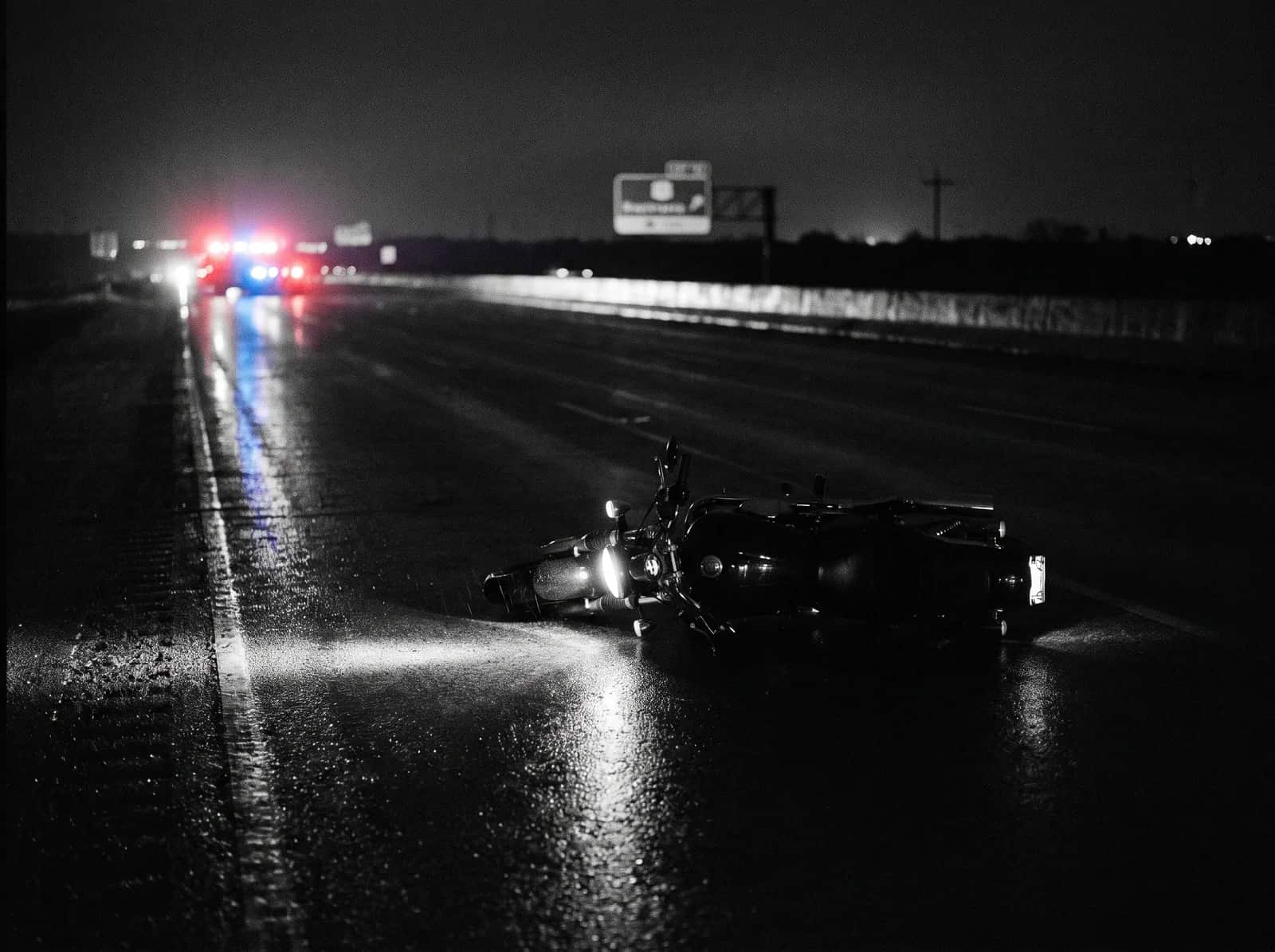
In San Antonio, a person hurt in a motorcycle accident caused by someone else can recover medical costs, lost income, and pain under Texas law. Owsley Law Firm handles San Antonio motorcycle accidents from its Houston offices, comes to you, and charges no fee unless it wins. Call before you speak with any insurer.
Motorcycle Accidents in San Antonio
Where do San Antonio motorcycle accidents happen?
San Antonio riders are hit on Bandera Road, Culebra, and the Loop 410 frontage roads, and on the Hill Country routes north of Loop 1604 on weekends.
San Antonio riders are hit on the West Side arterials, Bandera and Culebra, and on the Loop 410 frontage roads where drivers exit at speed. Weekend rides into the Hill Country north of Loop 1604 produce single-rider crashes on the curves of Highway 46 and FM 3351 that often involve a driver who crossed the center line. Fort Sam Houston, Lackland, and Randolph have large riding communities, and the firm’s San Antonio motorcycle cases frequently involve active-duty riders whose claims coordinate with military medical care.
Corridors where San Antonio motorcycle accidents cluster
- I-10 and Loop 410 interchange on the Northwest Side
- Loop 1604 at US-281 and the Stone Oak corridor
- I-35 between downtown and the Loop 410 north interchange
- I-37 and I-10 downtown interchange
- Culebra Road and Bandera Road on the West Side
- Loop 410 South at US-90 and Military Drive
Cases from San Antonio
What does a San Antonio motorcycle accident case look like?
An 18-wheeler on I-35 near Loop 410 jackknifes on a wet morning and takes out four cars; the carrier is based in Laredo and its insurer disputes everything.
Why do San Antonio motorcycle crashes end in such serious injuries?
A rider has no frame, airbag, or seat belt between their body and the pavement, so a crash a car driver walks away from can mean fractures, road rash, or a brain injury for a rider.
Bexar County recorded 215 traffic deaths in 2024, according to TxDOT's county crash table, and its 48,522 total crashes were the second-highest count in Texas after Harris County. Riders make up a small share of the traffic and a much larger share of the people seriously hurt, because nothing absorbs the impact for them.
That gap shapes the claim. A rider's medical care usually runs longer than a driver's, the bike is often a total loss, and gear such as a helmet, jacket, and boots is damaged in ways that tell the story of the crash. Each of those losses is part of what the at-fault driver owes.
Where do riders get hurt in and around San Antonio?
Inside the city, on the loops and the arterials that feed them. Outside it, on the Hill Country ranch roads that draw riders from across Texas on weekends.
Loop 410 and Loop 1604 move traffic at highway speed onto frontage roads with signals, and riders are hit by drivers who change lanes without checking a mirror or turn across them at an intersection. I-10 west toward Boerne and US-281 north toward the Hill Country carry the same riders out of town on Saturday mornings.
Northwest of the city, Ranch to Market Roads 335, 336, and 337 near Leakey, Vanderpool, and Camp Wood are some of the best-known riding roads in the state. They are narrow, steep, and full of blind curves, and a driver who drifts across the center line on one of them leaves a rider almost nowhere to go.
- Loop 410 and Loop 1604 frontage roads at signalized intersections
- I-10 west toward Boerne and US-281 north toward the Hill Country
- Bandera Road and Culebra Road on the West Side
- Ranch to Market Roads 335, 336, and 337 in the Hill Country
Does the Texas helmet law affect a San Antonio rider's claim?
Texas requires riders under 21 to wear a helmet, and riders 21 and older can ride without one if they completed a safety course or carry qualifying health coverage. The same rule covers passengers.
Under Transportation Code section 661.003, a rider who follows the helmet law is riding legally whether or not a helmet was on. Not wearing one does not make the rider responsible for the crash itself, because the helmet has nothing to do with the driver who turned left in front of the bike.
Insurers still raise helmets when a head injury is involved, arguing that the injury would have been less severe. Whether that argument goes anywhere depends on the medical evidence and on how the court treats it, which is why the firm gathers the helmet itself, the treating physicians' opinions, and the crash data early instead of letting the insurer frame the question first.
Is lane splitting legal in San Antonio traffic?
No. Since September 1, 2023, Texas law prohibits riding between lanes of traffic moving in the same direction, and it also gives a motorcycle the right to the full use of a lane.
Transportation Code section 545.0605 does two things. It bans lane splitting, and it protects the rider's lane, so a driver who squeezes a motorcycle out of its lane on Loop 410 is the one breaking the rule.
When an insurer claims the rider was splitting lanes, the answer is usually in the evidence: where the bike sat in the lane, the damage pattern on both vehicles, dash or helmet camera footage, and the statements of other drivers. Texas reduces a rider's recovery only by the share of fault a jury actually assigns, and bars it only above 50 percent, under Chapter 33 of the Civil Practice and Remedies Code.
What if I ride and serve at Joint Base San Antonio?
Your claim against the driver who hit you proceeds like any other. Military status adds a few rules about deadlines and medical bills that work in your favor if they are handled correctly.
Joint Base San Antonio includes Fort Sam Houston, Lackland, Randolph, and Camp Bullis, and the area has a large community of service members who ride. When military care treats a rider hurt by someone else, the United States can recover the reasonable value of that care from the at-fault party, and that recovery has to be coordinated with your own settlement.
Federal law can also pause civil deadlines while a service member is on active duty, which matters if a deployment interrupts a case. If the driver who hit you was a federal employee on duty, the claim runs against the United States under the Federal Tort Claims Act and starts with a written claim to the agency within two years.
Who pays when the driver who hit you has only minimum coverage?
The at-fault driver's liability policy pays first, and in Texas it can be as low as $30,000 per person. Your own uninsured and underinsured motorist coverage is what fills the gap.
Texas requires at least 30/60/25 liability coverage under Transportation Code section 601.072. A rider with surgery and months off work can exceed $30,000 quickly, which is why the firm reviews the rider's own motorcycle policy at the first meeting.
Uninsured and underinsured motorist coverage is included in a Texas auto or motorcycle policy unless it was rejected in writing, and Personal Injury Protection pays medical bills and lost income regardless of fault unless it was rejected in writing. Riders who rejected those coverages to lower the premium often discover after a crash how much they were worth.
What evidence wins a San Antonio motorcycle case?
Proof of where each vehicle was and how fast it was moving, plus medical records that tie every injury to the crash.
The San Antonio Police or Bexar County Sheriff's crash report is the starting point, but it is often written from the driver's account while the rider is in an ambulance. Photographs of the scene, the final position of the bike, skid and gouge marks, and any helmet camera footage carry more weight than the first officer's summary.
On a Hill Country road, the scene changes fast and witnesses are few. Photographs of the curve, the shoulder, any gravel on the road, and the sight distance around the bend should be taken within days, and the firm sends preservation requests for any nearby business or home cameras before footage is recorded over.
- Helmet, jacket, gloves, and boots, kept as they are
- Helmet or dash camera footage
- Photos of the bike, the other vehicle, and the road surface
- Names and numbers of every witness
- All medical records from University Hospital or the treating hospital
Where is a San Antonio motorcycle case filed, and how long do you have?
A crash inside Bexar County is usually filed in the Bexar County Civil District Courts at 100 Dolorosa. The deadline to file suit is generally two years from the crash.
Texas venue rules generally allow a suit in the county where the crash happened or the county where the defendant lives. A crash on a Hill Country ranch road outside Bexar County may belong in that rural county instead, unless the at-fault driver's home county is a better fit, and that choice deserves thought because the courthouse and jury pool change with it.
Civil Practice and Remedies Code section 16.003 sets the two-year limit for an injury suit. A claim against a city or county for a road defect or a government vehicle carries a much shorter notice requirement: generally six months under the Texas Tort Claims Act, and 90 days in writing for the City of San Antonio under its charter.
How does the firm handle a San Antonio rider's case?
From the Houston offices, by phone, video, and in person when it counts, with meetings by appointment at 9901 I.H. 10 West, Suite 800.
The team answers calls 24/7, gathers the crash report and medical records, sends preservation letters, and deals with every insurer so you can focus on recovery. There is no fee unless the firm wins your case.
Clients may be responsible for case expenses, such as court costs, as set out in the written fee agreement. The agreement is in writing before any work begins, and the firm explains it line by line.
Who pays a San Antonio rider's medical bills while the claim is open?
Usually a mix of your own coverage and your health insurance at first, with the at-fault driver's insurer paying at the end through the settlement or verdict.
The at-fault driver's insurer does not pay bills as they come in. Personal Injury Protection on your own motorcycle or auto policy pays medical bills and lost income regardless of fault unless you rejected it in writing, and health insurance or military coverage pays the rest of the early bills.
A hospital that treats you within 72 hours of the crash, including in the emergency room, which Property Code section 55.0015 counts as an admission, can file a lien against your claim under section 55.002, and health insurers usually expect repayment from the recovery. Those claims are negotiated before any money is distributed, and they are part of why the net amount a rider receives matters more than the headline number.
What makes a San Antonio motorcycle claim worth more or less?
The injury, the treatment it required, lost income, the fault evidence, and the insurance available all move the value. No honest lawyer can quote a number before reviewing the records.
Surgery, permanent restrictions, and scarring raise the value of a claim, and so does clear proof that the driver caused the crash. Gaps in medical care, a disputed account of the crash, and a driver with only minimum coverage push it down.
The firm's guides to motorcycle accident settlement value and to settlements by injury explain the factors in more detail. In every case, the first step is gathering the evidence that supports the strongest version of the claim.
City crash or Hill Country crash: what changes in the claim
| Issue | City crash (Loop 410, I-10, US-281) | Hill Country ranch road crash |
|---|---|---|
| Who writes the report | San Antonio Police or the Bexar County Sheriff | Usually a state trooper or the county sheriff where it happened |
| Where suit is filed | Bexar County Civil District Courts, 100 Dolorosa | The county of the crash or the defendant's home county |
| Medical care | University Hospital or Brooke Army Medical Center, both Level I trauma centers | Longer transport before reaching trauma care |
| Evidence risk | Traffic and business cameras that are recorded over quickly | Few witnesses and road conditions that change |
| Insurer's usual argument | The rider was speeding or splitting lanes | The rider took the curve too fast |
What to do now
What should you do after a motorcycle accident in San Antonio?
- Get examined the same day, even for road rash. University Hospital (Level I trauma) and Brooke Army Medical Center (Level I trauma) handle the serious rider injuries from San Antonio.
- Keep your helmet, jacket, gloves, and boots as they are. Do not wash, repair, or throw them away; the damage shows where you were hit and how hard.
- Photograph the bike, the other vehicle, skid marks, gravel or potholes, and the sight lines, especially at crashes on I-10 and I-35.
- Get the San Antonio crash report. San Antonio Police Department and Bexar County Sheriff reports are available through the TxDOT Crash Report Online Purchase System, usually within 10 days. The firm obtains it for clients at no charge. Read it closely: reports sometimes assume the rider was speeding or lane splitting without evidence, and errors can be corrected.
- Expect the other driver's insurer to look for reasons to blame the rider. Report the crash to your own insurer, but give no recorded statement to the other carrier until you have counsel.
- Know where the case goes. San Antonio motorcycle accidents suits are filed in the Bexar County Civil District Courts, Bexar County Courthouse, 100 Dolorosa, or Bexar County Courts at Law depending on the crash location.
- Call the firm. San Antonio clients are handled from Houston by phone, video, and mail, and the firm travels to San Antonio for meetings, depositions, and court. The consultation is free.
Go deeper
More on motorcycle accident claims in San Antonio and Texas.
Common questions
San Antonio motorcycle accident questions
Where do San Antonio motorcycle accidents happen most?
Bandera Road, Culebra Road, the Loop 410 frontage roads, and the Hill Country routes north of Loop 1604 on weekends.
What if I am active-duty military and was hit while riding?
The claim against the at-fault driver proceeds normally. Military medical care and TRICARE have reimbursement rights the firm handles as part of the settlement.
What if loose gravel from a work zone caused my San Antonio motorcycle crash?
Gravel and debris are far more dangerous to a motorcycle than to a car. A contractor that left loose material across a lane on Loop 1604 or US-281 without warning can be responsible, though a contractor on a TxDOT project that followed its contract documents has a defense under Civil Practice and Remedies Code section 97.002. If the hazard was on a state or city road with no contractor involved, the claim falls under the Texas Tort Claims Act, with short notice deadlines.
How is a motorcycle valued after a total loss in Bexar County?
Insurers pay actual cash value, which is what the motorcycle was worth just before the crash. Aftermarket parts like custom exhausts, seats, and paint are often missed unless you document them with receipts and photos. A comparable sales search for the same model in the San Antonio market is the strongest evidence of value.
Can I recover if I was not wearing a helmet in San Antonio?
Yes, if the other driver caused the crash. Riding without a helmet is legal for riders 21 and older who meet Texas requirements, and it does not cause a crash. Insurers may still argue about how much a helmet would have reduced a head injury, which is a medical and legal question to answer with evidence.
Who pays if a deer or loose gravel caused my Hill Country crash?
A deer strike with no other vehicle involved is usually a claim under your own policy. Gravel left by a contractor or a road defect can support a claim against the party responsible for the road, but claims against a government entity carry short notice deadlines.
Can my passenger make a claim against me?
Yes. A passenger hurt on your bike can claim against any driver who caused the crash and, if you shared fault, against your own liability coverage. That is one reason to tell the firm about every person on the bike at the first call.
How is my motorcycle valued after a total loss?
The insurer pays the actual cash value before the crash. Aftermarket parts, custom paint, and gear are often undervalued, so receipts and photos of the bike before the crash matter.
Does it matter that I was riding to or from the base?
Usually not for the claim against the other driver. It can matter if the other driver was a federal employee on duty, because that claim runs against the United States under the Federal Tort Claims Act.
What if the driver who hit me left the scene?
Report it to police immediately. Your own uninsured motorist coverage can pay for a hit-and-run, and Texas requires actual physical contact with the unidentified vehicle for that coverage to apply.
Sources