
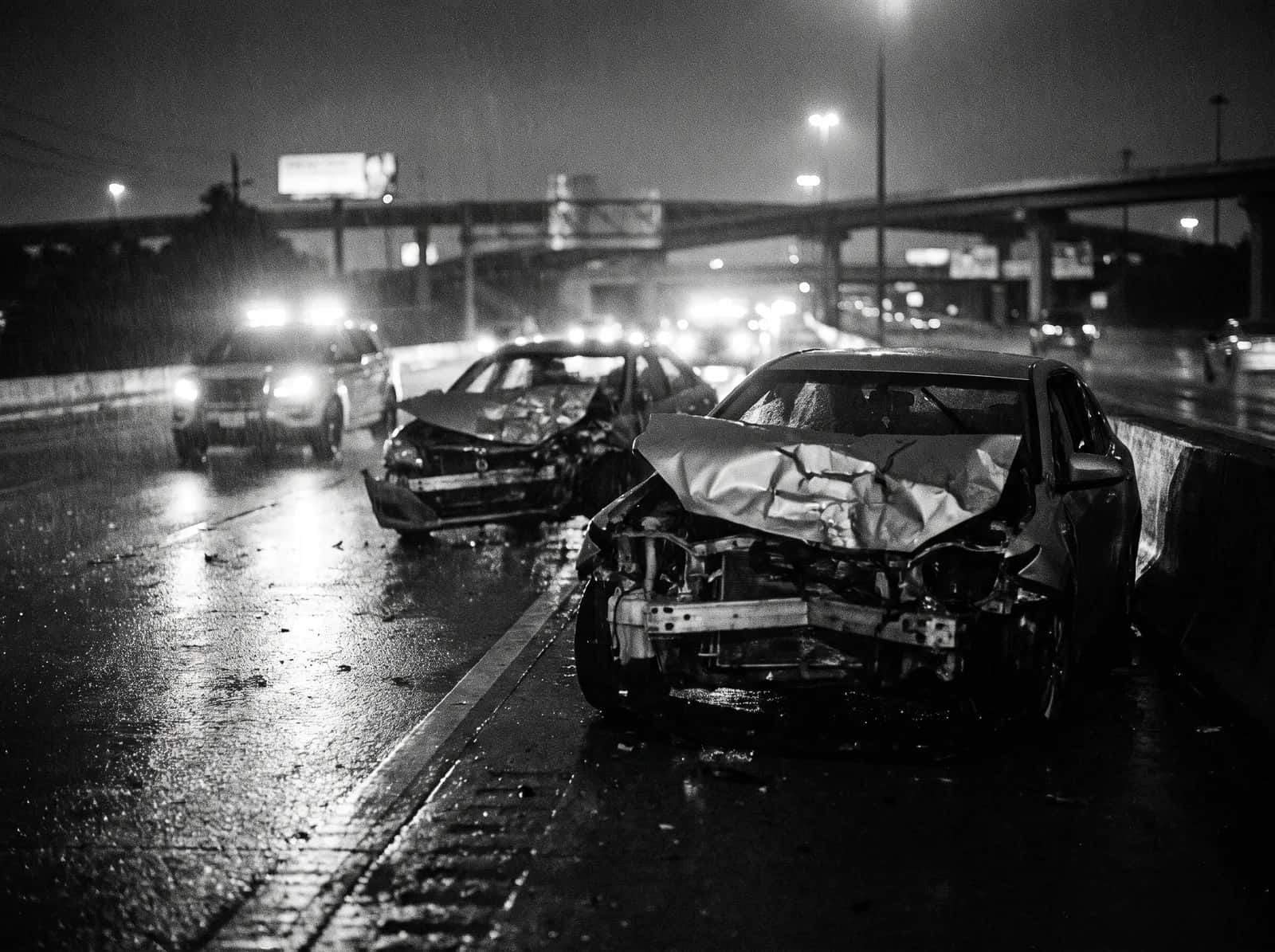

In San Antonio, a person hurt in a car accident caused by someone else can recover medical costs, lost income, and pain under Texas law. Owsley Law Firm handles San Antonio car accidents from its Houston offices, comes to you, and charges no fee unless it wins. Call before you speak with any insurer.
Car Accidents in San Antonio
Where do San Antonio car accidents happen?
San Antonio car cases most often begin on the loops and their frontage roads, where drivers exit at speed into surface-street intersections. Bexar County civil cases are filed at the Bexar County Courthouse, 100 Dolorosa.
San Antonio’s car crashes follow the loops. Loop 410 and Loop 1604 ring the city with frontage roads that feed high-speed traffic into signalized intersections, and the Northwest Side interchange at I-10 and 410 is one of the most crash-prone crossings in South Texas. Loop 1604’s long reconstruction on the north side produces daily lane-shift collisions near Stone Oak. The firm’s San Antonio car cases most often begin on those loops, on I-35 through the city, or on the West Side arterials like Culebra and Bandera.
Corridors where San Antonio car accidents cluster
- I-10 and Loop 410 interchange on the Northwest Side
- Loop 1604 at US-281 and the Stone Oak corridor
- I-35 between downtown and the Loop 410 north interchange
- I-37 and I-10 downtown interchange
- Culebra Road and Bandera Road on the West Side
- Loop 410 South at US-90 and Military Drive
Cases from San Antonio
What does a San Antonio car accident case look like?
An 18-wheeler on I-35 near Loop 410 jackknifes on a wet morning and takes out four cars; the carrier is based in Laredo and its insurer disputes everything.
How common are serious car crashes in Bexar County?
Very common. TxDOT's 2024 county crash table lists 48,522 crashes in Bexar County, with 205 fatal crashes that killed 215 people and 773 crashes that caused suspected serious injuries.
Bexar County is second only to Harris County for crash volume in Texas, and the numbers come from the same place every claim starts: the officer's crash report. Each report filed by San Antonio Police, the Bexar County Sheriff, a suburban department, or a DPS trooper flows into TxDOT's crash records system, and TxDOT publishes the county totals every year.
Those totals matter for one practical reason. Insurers that handle San Antonio claims see a lot of them, and they price them by pattern: a rear-end collision on Loop 410 with a soft tissue injury gets a formula, and a case only escapes the formula when the evidence and the medical record make it specific. The rest of this page is about building that record.
- 48,522 total crashes in Bexar County in 2024 (TxDOT)
- 205 fatal crashes and 215 deaths
- 773 crashes with suspected serious injuries
Who writes the crash report in San Antonio, and how do you get it?
Inside city limits it is usually San Antonio Police; in unincorporated Bexar County it is often the Sheriff's Office; suburban cities like Schertz, Converse, and Helotes have their own departments; DPS works some state highways.
Texas law requires the investigating officer to file the crash report electronically with TxDOT no later than the tenth day after a crash that causes injury, death, or at least $1,000 in property damage. Once it is filed, you can buy the Texas Peace Officer's Crash Report (form CR-3) through the TxDOT Crash Report Online Purchase System with the date, county, and a name or report number. The firm pulls it for clients at no charge.
Read the diagram and the contributing factors closely. On the loops and their frontage roads, officers often arrive after the cars are moved and record one driver's version while the other is on the way to the hospital. A wrong diagram can be corrected with photos, dash camera video, witness statements, and the data stored in the vehicles themselves, but only if someone gathers that evidence early.
Where should you get treated after a San Antonio crash?
For serious injuries, University Hospital and Brooke Army Medical Center are both state-designated Level I trauma centers. For everything else, an urgent care or your own doctor the same day starts the medical record.
The first doctor's note is the foundation of the claim. If you walked away from the scene, go to an urgent care or emergency room the same day or the next morning, say you were in a car crash, and describe every place that hurts. Adjusters treat a gap of even a week or two as evidence that the crash did not cause the pain.
Paying for care while the claim is open is a real worry. Personal Injury Protection on your own policy pays medical bills and lost income regardless of fault, unless you rejected it in writing. Health insurance can pay, and a plan with a right to reimbursement is repaid from the settlement. Some San Antonio providers treat crash patients under a letter of protection and are paid from the recovery instead of up front.
Keep every appointment you are given. Missed therapy and long breaks in treatment are the details insurers use to cut a claim, and they are far easier to avoid than to explain later.
What if a VIA bus or a city vehicle caused the crash?
VIA Metropolitan Transit and the City of San Antonio are governmental units, so the Texas Tort Claims Act controls the claim: notice is generally due within six months, the City of San Antonio's charter requires written notice within 90 days, and the damages a government body can be made to pay are capped by statute.
Under the Texas Tort Claims Act, a governmental unit can be liable for injuries caused by an employee operating a motor vehicle in the course of employment. The catch is notice. Section 101.101 generally requires written notice of the claim within six months of the crash, describing the damage, the injury, and the time, place, and manner of the incident. The City of San Antonio's charter requires written notice within 90 days, so the notice should go out early.
The caps in section 101.023 depend on the type of government involved. When a private driver also contributed to the crash, that driver can be pursued separately with no statutory cap, which is why the firm looks at every vehicle involved, not only the bus.
- Write down the bus number, route, and time while you remember them
- Photograph the bus, the stop, and the intersection
- Do not wait on a government claim; the notice clock starts at the crash
What happens if a military driver from Joint Base San Antonio hit you?
It depends on whether the driver was on duty. A service member or federal employee driving within the scope of the job makes it a Federal Tort Claims Act claim against the United States; an off-duty driver in a personal car is handled like any other driver.
Joint Base San Antonio includes Fort Sam Houston, Lackland, Randolph, and Camp Bullis, and military and civilian federal employees drive government vehicles on San Antonio roads every day. When one of them causes a crash while on the job, federal law makes a claim against the United States the exclusive remedy, and the government is substituted for the individual driver.
A federal claim follows its own rules. It must be presented in writing to the right federal agency within two years after it accrues, before any lawsuit, and the agency has six months to decide it; if it does not, the claim can be treated as denied and a suit filed. The United States is liable like a private person under Texas law, but not for punitive damages or interest before judgment.
If the driver was off duty in a personal vehicle, none of that applies. The claim goes to the driver's own auto insurer, and if the coverage is too small, your own underinsured motorist coverage can step in.
Which insurance pays after a San Antonio car accident?
Usually several policies in layers: the at-fault driver's liability coverage, your own PIP, and your own uninsured or underinsured motorist coverage when the other driver has too little or none.
Texas requires at least $30,000 per injured person, $60,000 per crash, and $25,000 in property damage liability under Transportation Code section 601.072. In a crash with real injuries, that minimum is often exhausted by the hospital bill alone. The next layer is usually your own policy: uninsured and underinsured motorist coverage under Insurance Code section 1952.101 must be offered with every Texas auto policy and applies unless you rejected it in writing.
Commercial policies change the picture. A delivery van, a contractor's pickup, or a company car on the way to a job site usually carries far more coverage than a personal policy, and the employer may be responsible for the driver's negligence. The firm identifies every policy before valuing the case, because the coverage often decides what is collectible.

How is fault decided, and what if you were partly to blame?
Texas uses proportionate responsibility under Chapter 33 of the Civil Practice and Remedies Code. You can recover if you are 50 percent or less at fault, and your damages are reduced by your share.
On the loops, fault fights are often about lane changes and frontage-road merges: who had the right of way, who signaled, and who was speeding into the intersection. Insurers push even a small percentage of blame onto the injured driver because every point reduces what they pay, and at 51 percent the claim is barred entirely.
Evidence beats argument. The firm looks for business and traffic camera video, dash camera footage, the vehicles' event data recorders, and witnesses who saw the light, then pairs that with the physical damage on both cars to show how the crash actually happened.
What is a San Antonio car accident case worth?
It depends on the injury, the treatment, lost income, any fault assigned to you, and the insurance that can actually pay. No honest lawyer can give you a number before seeing your records.
Texas allows recovery of medical expenses, lost earnings and earning capacity, physical pain, mental anguish, physical impairment, and disfigurement. Medical expenses are limited to what was actually paid or incurred by or for you, which is why the billing records matter as much as the treatment notes.
The value drivers are the same in every Bexar County case: how clearly the other driver was at fault, how serious and well documented the injury is, whether treatment was consistent, and how much coverage exists. Our settlement guides walk through those factors by crash type and by injury, without invented averages.
Where is a San Antonio car accident case filed, and could it go to federal court?
Most Bexar County car cases are filed in the Bexar County Civil District Courts at the Bexar County Courthouse, 100 Dolorosa. A case against an out-of-state driver or company worth more than $75,000 can sometimes be moved to the federal court in San Antonio.
Texas venue rules usually allow filing in the county where the crash happened or where the defendant lives, so a crash on I-35 just north of the county line may belong in Comal County, and the crash location on the report matters. The general deadline to file suit is two years from the crash under Civil Practice and Remedies Code section 16.003.
When the parties are from different states and more than $75,000 is at stake, the defense may remove the case to the U.S. District Court for the Western District of Texas, whose San Antonio Division covers Bexar County. Texas law still decides fault and damages there, but federal procedure applies. A claim against the United States for a federal driver is always heard in federal court.
How does the firm handle San Antonio cases from Houston?
By phone, video, and mail from the Houston offices, with meetings by appointment at 9901 I.H. 10 West, Suite 800, and travel to San Antonio for depositions and court.
Most of a car accident case happens on paper and on the phone: gathering the report and records, dealing with the insurers, documenting treatment, and negotiating. The team answers calls 24/7, and the firm meets San Antonio clients by appointment at the Regus Colonnade I meeting space on I-10 West near the South Texas Medical Center.
The free case review is the place to start. There is no fee unless the firm wins your case, and clients may be responsible for case expenses, such as court costs, as set out in the written fee agreement.
Who pays in common San Antonio crash situations
| Situation | First source of payment | What to check |
|---|---|---|
| Another driver at fault, ordinary car | That driver's liability policy | Policy limits; your UM/UIM if limits are low |
| Driver had no insurance or fled | Your uninsured motorist coverage | Whether you rejected UM in writing |
| VIA bus or city vehicle | Claim under the Texas Tort Claims Act | Six-month notice, 90 days for the City of San Antonio; statutory caps |
| On-duty federal or military driver | Federal Tort Claims Act claim | Written claim to the agency within two years |
| Company vehicle on the job | Employer's commercial policy | Whether the driver was working at the time |
| Any crash, any fault | Your PIP for medical bills and lost income | Whether PIP was rejected in writing |
What to do now
What should you do after a car accident in San Antonio?
- Get examined the same day. University Hospital (Level I trauma) and Brooke Army Medical Center (Level I trauma) handle the serious car accident injuries from San Antonio; an urgent care visit the same day is enough to start the record if you are not transported.
- Photograph the vehicles, the road, and your injuries where it happened, especially on I-10 and I-35, where scenes are cleared within minutes.
- Get the San Antonio crash report. San Antonio Police Department and Bexar County Sheriff reports are available through the TxDOT Crash Report Online Purchase System, usually within 10 days. The firm obtains it for clients at no charge.
- Report the crash to your own insurer, but give no recorded statement to the other driver's carrier until you have counsel.
- Know where the case goes. San Antonio car accidents suits are filed in the Bexar County Civil District Courts, Bexar County Courthouse, 100 Dolorosa, or Bexar County Courts at Law depending on the crash location.
- Call the firm. San Antonio clients are handled from Houston by phone, video, and mail, and the firm travels to San Antonio for meetings, depositions, and court. The consultation is free.
Go deeper
More on car accident claims in San Antonio and Texas.
Common questions
San Antonio car accident questions
Which San Antonio roads have the most car accidents?
Loop 410, Loop 1604, I-35, and I-10, particularly the I-10 and 410 interchange and the 1604 construction zones. Culebra and Bandera Roads lead the surface streets.
Where is a San Antonio car accident case filed?
In the Bexar County Civil District Courts at the Bexar County Courthouse, 100 Dolorosa.
Is a crash on Loop 1604 or US-281 north of the city still a Bexar County case?
If the crash happened inside Bexar County, yes, and the suit is usually filed at the Bexar County Courthouse, 100 Dolorosa. Texas venue rules also allow filing in the county where the at-fault driver lives. A crash north of the county line on I-35 or US-281 may belong in Comal County instead, so the exact crash location on the report matters.
Who pays if a VIA bus hit my car in San Antonio?
VIA Metropolitan Transit is a public transit authority, so the claim falls under the Texas Tort Claims Act. Notice of the claim is generally due within six months, and the damages VIA can be made to pay are capped by statute. Any private driver who also caused the crash can be pursued separately, with no cap.
How many crashes happened in Bexar County in 2024?
TxDOT's 2024 county table lists 48,522 crashes in Bexar County, including 205 fatal crashes that killed 215 people and 773 crashes with suspected serious injuries.
Can I make a claim if a soldier driving a government vehicle hit me?
Yes, if the driver was acting within the scope of federal employment. The claim is against the United States under the Federal Tort Claims Act and must be presented in writing to the right agency within two years before any lawsuit.
Do I have to go to Houston to hire the firm for a San Antonio case?
No. The firm handles San Antonio cases by phone, video, and mail, meets clients by appointment at 9901 I.H. 10 West, Suite 800, and travels for depositions and court.
What if the crash happened in New Braunfels or Boerne?
The case usually follows the crash location, so a wreck in Comal or Kendall County is normally filed there unless Texas venue rules allow filing where the at-fault driver lives. The law and the two-year deadline are the same.
Is a crash in the Loop 1604 construction zone handled differently?
The claim is still against the driver who caused it, but Texas raises traffic fines in work zones when workers are present, and a contractor whose traffic control helped cause the crash can share fault. Request the contractor's records early, before the zone changes.
Can I still recover if I was not wearing a seat belt?
Possibly. Texas allows evidence of seat belt nonuse when it is relevant to how you were hurt, but it does not automatically bar your claim. Under Nabors Well Services v. Romero (Tex. 2015), if the defense proves that not wearing a belt caused or added to the injury, the jury weighs that when it assigns percentages of responsibility under Civil Practice and Remedies Code chapter 33, and your percentage reduces the recovery and counts toward the 51 percent bar.
Sources