
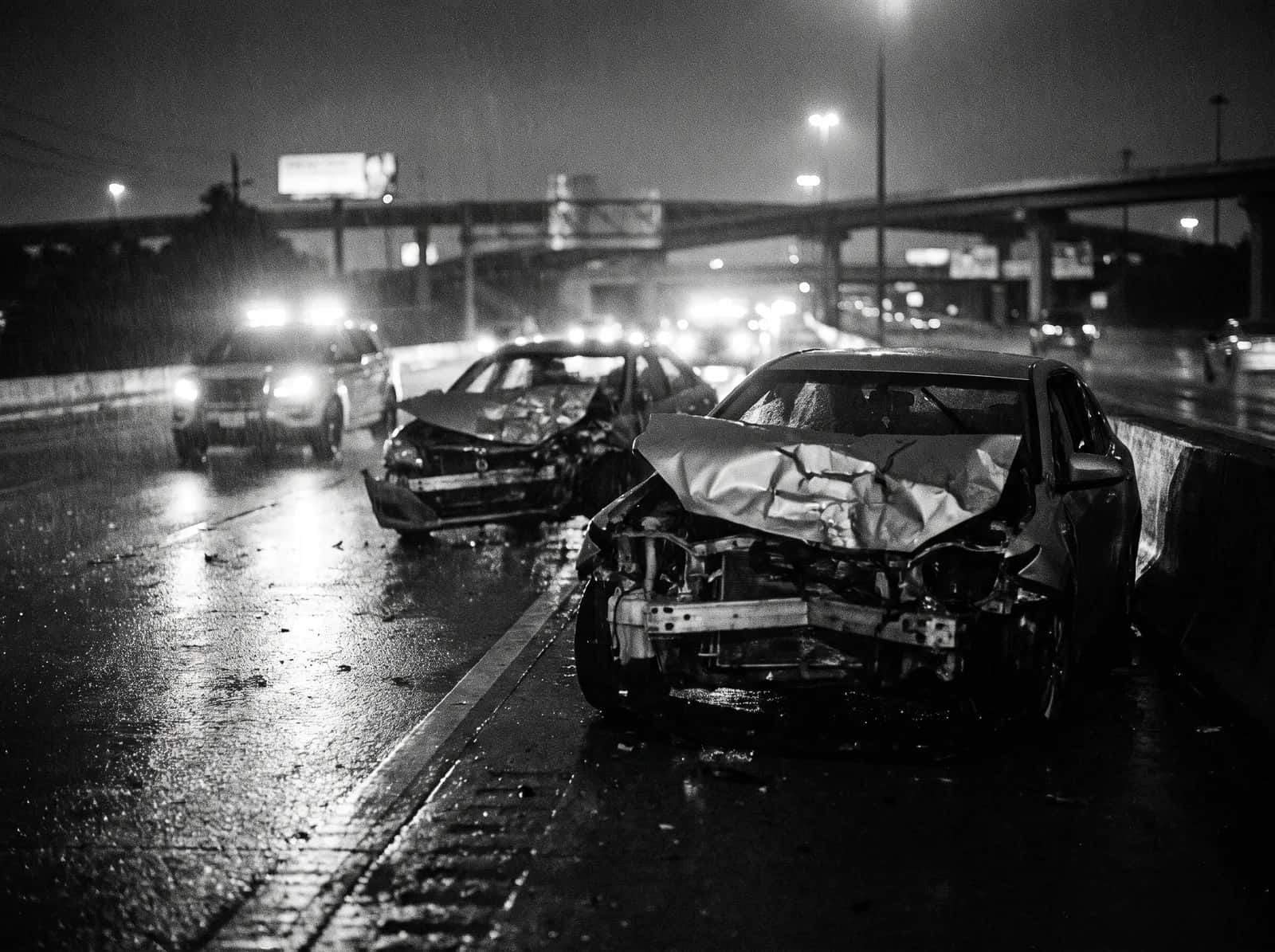

Texas Transportation Code section 545.053 says a driver passing another vehicle shall pass on the left at a safe distance and may not move back to the right until safely clear. The driver being passed shall, on audible signal, move or stay right and may not accelerate until completely passed. In a crash claim, these duties help decide fault.
Texas Transportation Code, Chapter 545 (Legislature text). Find section 545.053 in the chapter and read its three subsections in full.
Section 545.053 of the Texas Transportation Code is the basic passing rule. It has two sides. One part tells the driver who is passing what to do. The other part tells the driver being passed what to do.
Crashes happen when either driver falls short. A pass that cuts back too soon can sideswipe a car. A driver who speeds up during a pass can cause a head-on or run-off crash. This page explains the text of the section and how it can matter in a motor vehicle injury claim. It is general information, not legal advice.
What does Texas Transportation Code 545.053 say?
The section is titled "Passing to the left; return; being passed." It sets duties for the driver who passes and for the driver who is passed.
Subsection (a) covers an operator passing another vehicle. That operator shall pass to the left of the other vehicle at a safe distance, and may not move back to the right side of the roadway until safely clear of the passed vehicle.
Subsection (b) covers an operator being passed. That operator shall, on audible signal, move or remain to the right in favor of the passing vehicle, and may not accelerate until completely passed by the passing vehicle. Subsection (c) says subsection (b) does not apply when passing to the right is permitted.
- Passing driver: pass on the left at a safe distance
- Passing driver: do not return to the right until safely clear
- Driver being passed: move or stay right on audible signal
- Driver being passed: do not accelerate until completely passed
- Exception: subsection (b) does not apply when passing to the right is permitted

What is the Texas passing law in plain English?
In general, Texas drivers pass on the left, leave room, and wait to move back until they are clear. The driver being passed keeps to the right and does not speed up.
Section 545.053 does not give a number of feet for a safe distance. Whether a pass kept a safe distance depends on the facts, such as speed, road width, traffic and where the vehicles ended up after the crash.
The section also does not define "safely clear" with a measurement. In a claim, that question turns on what the evidence shows about the two vehicles' positions at the moment of the move back to the right.
When must the driver being passed move to the right?
Subsection (b) says the driver being passed shall, on audible signal, move or remain to the right in favor of the passing vehicle. The duty is tied to an audible signal.
The text also says the driver being passed may not accelerate until completely passed. A driver who speeds up mid-pass can turn a safe pass into a crash.
Subsection (c) removes this duty when passing to the right is permitted. Another section of the chapter, section 545.057, is titled "Passing to the right." A lawyer can help sort out which rule fits a given crash.
How does this rule relate to other passing and lane rules?
Section 545.053 sits next to other passing sections in the same chapter. Those sections cover safe distance, passing zones and passing on the right.
Section 545.054 is titled "Passing to the left: safe distance." Section 545.055 is titled "Passing to the left: passing zones." Section 545.057 is titled "Passing to the right." A crash can involve more than one of these sections, so each should be read in full.
Moving back into a lane after a pass can also raise lane change questions, which are covered under a separate section of the Transportation Code. This page stays on section 545.053.
How is fault decided when a passing crash causes injuries?
Fault is decided by looking at what each driver did. Texas law has the fact finder assign each person a percentage of responsibility.
Under Civil Practice and Remedies Code section 33.003, the trier of fact determines the percentage of responsibility, stated in whole numbers, for each claimant, each defendant, each settling person and each designated responsible third party. In a passing crash, both drivers' conduct can be reviewed.
Under section 33.001, a claimant may not recover damages if his percentage of responsibility is greater than 50 percent. If the claimant is not barred, section 33.012 has the court reduce the damages by a percentage equal to the claimant's percentage. Chapter 33 has its own page on this site with more detail.

What evidence may help show a passing violation?
Evidence that shows where each vehicle was, how fast it moved and what each driver did may help. What matters depends on the crash.
For the passing driver's duties, items that may help include scene photos, vehicle damage, lane position and video. For the passed driver's duties, items that may help include witness accounts of a horn or other signal and any video or vehicle data showing a speed-up.
Evidence can be lost quickly. Video may be overwritten and witnesses may be hard to find later, so it helps to note details soon after the crash.
- Photos of the road, lane markings and vehicle damage
- Dash camera or nearby camera footage
- Witness names and contact details
- The crash report, once available
- Your own notes on signals, speeds and lane positions
What if both drivers broke part of the rule?
Section 545.053 sets duties for both drivers, so both can be reviewed. Chapter 33 then lets the fact finder assign percentages.
For example, one driver may have returned to the right before being safely clear, while the other may have accelerated during the pass. Each action can be weighed separately.
How those facts affect a particular claim is a question to raise with a lawyer after a crash.
Section 545.053: duties and how each may be shown after a crash
| Duty in the statute | Who it applies to | How it may be shown after a crash |
|---|---|---|
| Pass to the left of the other vehicle at a safe distance | Driver passing | May include scene photos, vehicle damage, lane position, video, witness statements |
| Do not move back to the right side until safely clear of the passed vehicle | Driver passing | May include point of impact, damage on the passed vehicle, video, witness statements |
| On audible signal, move or remain to the right in favor of the passing vehicle | Driver being passed | May include witness accounts of a horn or signal, video with sound, statements from both drivers |
| Do not accelerate until completely passed | Driver being passed | May include vehicle data if available, video, witness accounts |
| Subsection (b) does not apply when passing to the right is permitted | Driver being passed | May include road layout and lane markings, plus section 545.057 on passing to the right |
How it is proven after a crash
- Photos and video of the road, lane markings, vehicles and damage
- Dash camera or nearby camera footage, saved early
- Names and contact details of witnesses, including passengers
- The crash report and the officer's name, once available
- Notes on the horn, signals, speeds and lane positions, written soon after the crash
- Medical records and bills that show your injuries
Mistakes that cost people money
- Guessing about speed or distance in a statement to an insurer
- Waiting too long to save video that may be overwritten
- Overlooking the duty of the driver being passed, which can affect the percentages of responsibility
- Reading only one passing section when several may apply
Related Texas laws
- All Texas laws explained
- Texas Reckless Driving Law: Transportation Code 545.401
- Texas Transportation Code 545.101: Turning at Intersections
- Texas Transportation Code 545.153: Stop and Yield Signs
- Texas Transportation Code 545.155: Leaving a Driveway
- How to get a Texas crash report
- Car accident lawyer
- Houston injury lawyer
Where this fits in your claim
- 1. The crash: what to do at the scene and in the first days
- 2. The report: how to get your Texas crash report (CR-3)
- 3. The insurance claim: claims phone numbers and first calls
- 4. Treatment: how PIP pays medical bills
- 5. Liens: hospital liens on a settlement
- 6. The demand: what a demand letter does
- 7. The lawsuit: the two-year deadline to sue
Frequently asked questions
Does section 545.053 give a number of feet for a safe distance?
No. The text says to pass "at a safe distance" and gives no measurement. The facts of the crash show whether the distance was safe.
Does the driver being passed have duties too?
Yes. Subsection (b) says the driver being passed shall, on audible signal, move or remain to the right and may not accelerate until completely passed.
When does the duty of the driver being passed not apply?
Subsection (c) says subsection (b) does not apply when passing to the right is permitted.
Can I still recover if I share some blame for a passing crash?
Under Civil Practice and Remedies Code section 33.001, a claimant may not recover damages if his percentage of responsibility is greater than 50 percent. Otherwise, under section 33.012, the damages are reduced by the claimant's percentage.
Does this page cover passing in a no-passing zone?
Not in detail. That topic falls under other sections in the chapter, such as section 545.055. A lawyer can help review which sections fit your crash.
This page is general information about Texas law and is not legal or medical advice. Every case depends on its own facts. Contact the firm for a free review of yours.
Keep reading


Sources