
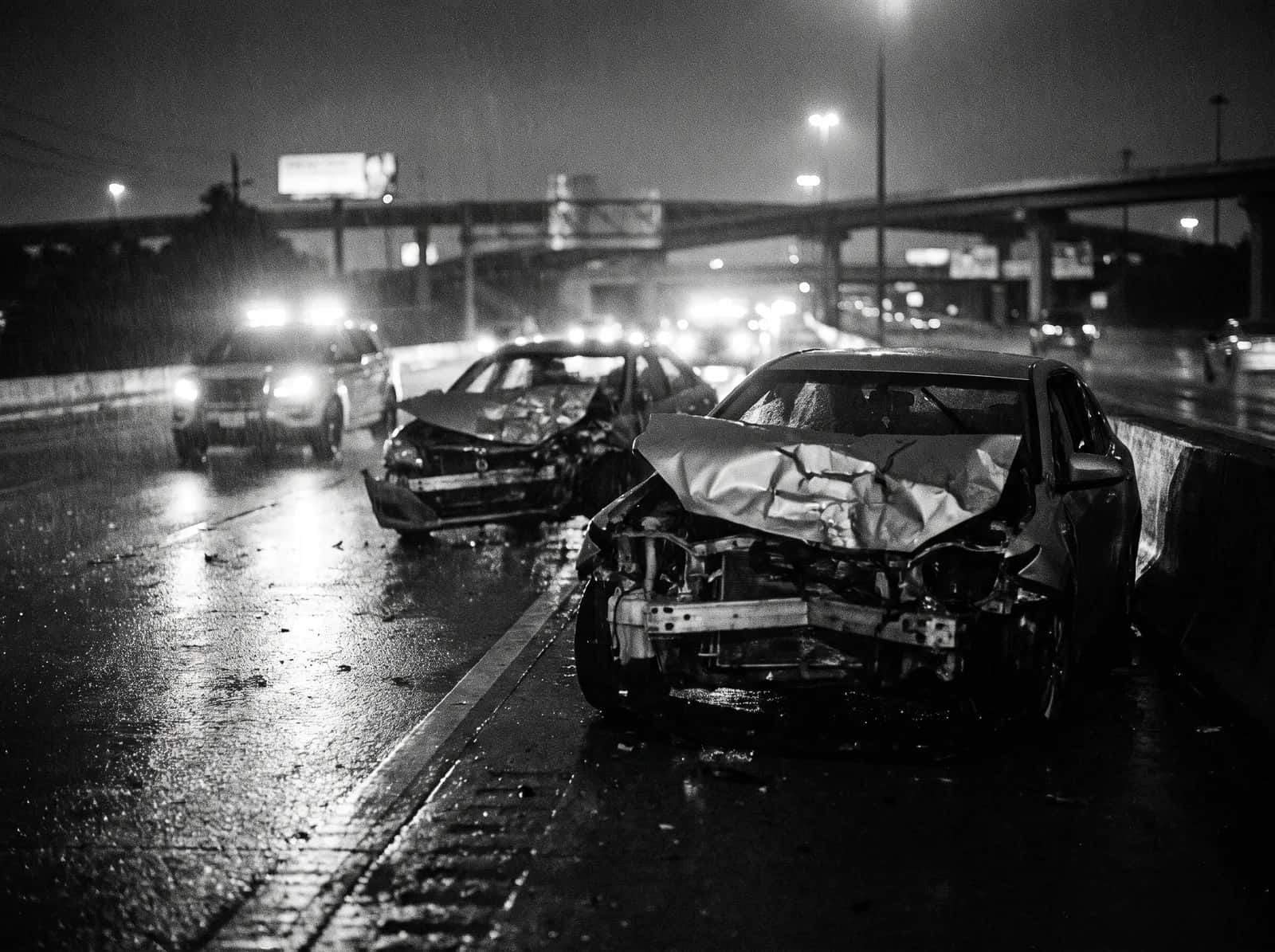
Texas Transportation Code section 545.156 says that when a covered emergency vehicle immediately approaches, a driver shall yield the right-of-way, drive as close as possible to the right-hand edge or curb clear of any intersection, and stop until it has passed. A police officer's directions can change this. In a crash claim, breaking the rule can affect who is at fault.
Texas Transportation Code, Chapter 545 (Legislature text). Find section 545.156 and read the full text, including the list of vehicles it covers.
Section 545.156 is the Texas rule about what drivers do when an emergency vehicle is coming up behind or toward them with its signals on. It is one short section, but it gets argued often after crashes that involve an ambulance, fire truck or police car.
This page explains what the section says, which vehicles it covers, and how it can show up in a motor vehicle injury claim. It describes the law in general terms. It is not advice about your case, and a lawyer can look at the facts of your crash.
What does Texas law say about yielding to emergency vehicles?
Section 545.156 says that when a covered emergency vehicle immediately approaches, a driver shall yield the right-of-way, pull to the right, and stop until it passes.
The statute states that on the immediate approach of a covered vehicle, an operator, unless otherwise directed by a police officer, shall yield the right-of-way. The operator must also immediately drive to a position parallel to and as close as possible to the right-hand edge or curb of the roadway clear of any intersection. Then the operator must stop and remain standing until the authorized emergency vehicle has passed.
The section was first enacted in 1995 and has been amended since, most recently in 2023 according to the Legislature's text. Read the current text before relying on any summary, including this one.

Which emergency vehicles does section 545.156 cover?
It applies only to the vehicles listed in subsection (a): authorized emergency vehicles with qualifying signals, certain medical examiner and justice of the peace vehicles, and police vehicles using a signal.
The statute says it applies only to four kinds of vehicles. An authorized emergency vehicle is covered when it uses audible and visual signals that meet the requirements of Transportation Code sections 547.305 and 547.702. A medical examiner vehicle is covered when it lawfully uses a visual signal under section 547.751. A vehicle operated by a justice of the peace for a purpose described in section 547.752 is covered when it lawfully uses a visual signal. A police vehicle is covered when it lawfully uses only an audible or visual signal.
This matters in a claim because the duty to yield depends on the vehicle and its signals. A vehicle that does not fit the list, or one without the required signals, may not trigger the rule.
- Authorized emergency vehicle with audible and visual signals that meet sections 547.305 and 547.702
- Medical examiner vehicle lawfully using a visual signal
- Justice of the peace vehicle used for a purpose in section 547.752, with a lawful visual signal
- Police vehicle lawfully using only an audible or visual signal
What must a driver do when an emergency vehicle approaches?
The statute lists three duties: yield the right-of-way, immediately move parallel to and as close as possible to the right-hand edge or curb clear of any intersection, and stop and stay stopped until the emergency vehicle passes.
The first duty is to yield the right-of-way. The second is to move right, and the statute adds that this must be clear of any intersection. The third is to stop and remain standing until the emergency vehicle has passed.
The duties apply on the immediate approach of the vehicle. The statute also says they apply unless a police officer directs otherwise. For example, an officer at a scene may wave traffic through. In a claim, what the officer directed can become a key fact.
- Yield the right-of-way
- Drive immediately to the right-hand edge or curb, clear of any intersection
- Stop and remain standing until the emergency vehicle has passed
- Follow a police officer's direction if the officer directs otherwise
Does the emergency vehicle driver have to drive carefully too?
Yes. Subsection (b) says the section does not exempt the operator of a covered vehicle from the duty to drive with due regard for the safety of all persons using the highway.
Other drivers yielding does not give the emergency vehicle operator a free pass. The statute keeps the duty of due regard for safety. If an emergency vehicle driver enters an intersection or changes lanes carelessly, that conduct can be part of the fault picture.
Whether a particular emergency vehicle driver met that duty is a fact question. Other laws may also apply to government vehicles and employers. Check with a lawyer about how they apply to a specific crash.
How does this rule affect fault in a Texas crash claim?
Fault can be shared. Under Civil Practice and Remedies Code chapter 33, the fact finder assigns a percentage of responsibility, and that percentage can reduce or bar recovery.
Chapter 33 says the trier of fact determines the percentage of responsibility for each claimant, each defendant, each settling person and each responsible third party designated under section 33.004. It says a claimant may not recover damages if his or her percentage of responsibility is greater than 50 percent. If the claimant is not barred, the court reduces the damages by a percentage equal to the claimant's percentage of responsibility.
In a yielding case, an insurer may say a driver failed to pull over and share blame. Or the other side may say the emergency vehicle driver did not use due regard. Each side's percentage affects the result. Chapter 33 has more rules than are summarized here, so read the chapter or talk with a lawyer.
Is breaking section 545.156 negligence per se?
It can be argued that way. Negligence per se is the idea that breaking a safety law can count as negligence, but a court decides whether it applies.
In general terms, a lawyer may argue that a driver who ignores a traffic safety statute was negligent because of that violation. Whether the doctrine applies to section 545.156, and how, is a legal question for the court. This page does not state how Texas courts have ruled.
Even if the rule is treated as a standard of care, the claim still needs proof that the violation helped cause the harm. That ties back to fault and the percentage of responsibility.
How do you prove a driver failed to yield to an emergency vehicle?
Proof usually comes from the crash report, video, witnesses, vehicle records and signal evidence, matched to each duty in the statute.
Each duty in the statute can be tested with evidence. The table below pairs the statute's duties with the kinds of proof that often matter. Which proof exists depends on the crash.
Evidence can disappear quickly. Video may be overwritten and vehicle data may be lost. Ask a lawyer early about preserving it.
Does a ticket or no ticket matter for the injury claim?
A ticket is not the same as a finding of fault in the injury claim. No ticket does not end the claim either.
A citation shows an officer's view at the scene. The civil claim is a separate process with its own proof. Whether a ticket, a plea or a lack of a citation can be used in the civil case is a legal question for a lawyer.
The statute makes a violation of the subtitle an offense, and a misdemeanor unless another provision says otherwise (Transportation Code section 542.301). Section 545.156 itself does not set its own penalty in the text opened for this page, so check the statute for any penalty.
Section 545.156 duties and how each is proven after a crash
| Element or duty | What the statute says | How it is often shown in a claim |
|---|---|---|
| Covered vehicle | Subsection (a) lists authorized emergency vehicles with qualifying audible and visual signals, medical examiner vehicles, justice of the peace vehicles, and police vehicles using a signal | Agency records, vehicle photos, dashcam or bystander video, witness statements about lights and siren |
| Immediate approach | The duties apply on the immediate approach of the vehicle | Video timing, 911 or dispatch records, witness estimates of distance and time |
| Yield the right-of-way | The operator shall yield the right-of-way | Crash report diagram, scene photos, vehicle positions, driver statements |
| Move to the right, clear of an intersection | Drive immediately to a position parallel to and as close as possible to the right-hand edge or curb, clear of any intersection | Photos of lanes and curb, skid marks, video showing where the vehicle was |
| Stop and remain standing | Stop and remain standing until the authorized emergency vehicle has passed | Video, witness statements, vehicle data on speed, if available |
| Police officer direction | Duties apply unless otherwise directed by a police officer | Officer report, body camera or dashcam video, witness statements |
| Due regard by the emergency vehicle operator | Section 545.156 does not exempt the operator from the duty to drive with due regard for the safety of all persons using the highway | Emergency vehicle video, speed and route records, driver and agency statements |
How it is proven after a crash
- The crash report number and the names of the officers at the scene.
- Photos and video of the road, lanes, curb and intersection, taken as soon as it is safe.
- Names and contact details of witnesses who saw or heard the emergency vehicle.
- Dashcam, doorbell, traffic or business camera video, saved quickly.
- Notes on what you saw and heard: lights, siren, directions from any officer.
- Medical records and bills tied to the crash.
Mistakes that cost people money
- Assuming the other driver is fully at fault without checking the emergency vehicle's duties.
- Giving a recorded statement to an insurer before knowing how fault is argued.
- Waiting too long to ask for video that gets overwritten.
- Treating a missing ticket as proof you have no claim.
- Relying on a summary instead of reading the current statute text.
Related Texas laws
- All Texas laws explained
- Texas Reckless Driving Law: Transportation Code 545.401
- Texas Transportation Code 545.101: Turning at Intersections
- Texas Transportation Code 545.153: Stop and Yield Signs
- Texas Transportation Code 545.155: Leaving a Driveway
- How to get a Texas crash report
- Car accident lawyer
- Houston injury lawyer
Where this fits in your claim
- 1. The crash: what to do at the scene and in the first days
- 2. The report: how to get your Texas crash report (CR-3)
- 3. The insurance claim: claims phone numbers and first calls
- 4. Treatment: how PIP pays medical bills
- 5. Liens: hospital liens on a settlement
- 6. The demand: what a demand letter does
- 7. The lawsuit: the two-year deadline to sue
Frequently asked questions
What does Texas Transportation Code 545.156 require?
On the immediate approach of a covered vehicle, an operator shall yield the right-of-way, immediately drive parallel to and as close as possible to the right-hand edge or curb clear of any intersection, and stop and remain standing until the vehicle has passed.
Does the law apply to police cars?
Yes, when a police vehicle is lawfully using only an audible or visual signal, according to subsection (a)(4).
Can an officer's directions change what a driver does?
Yes. The statute says the duties apply unless otherwise directed by a police officer.
Does the emergency vehicle driver have to be careful?
Yes. Subsection (b) says the section does not exempt the operator from the duty to drive with due regard for the safety of all persons using the highway.
If I share blame, can I still recover?
Under Civil Practice and Remedies Code section 33.001, a claimant may not recover if his or her percentage of responsibility is greater than 50 percent. Otherwise the damages are reduced by that percentage.
How is this different from the move over law?
Section 545.156 is about drivers yielding to an approaching emergency vehicle. The move over law, section 545.157, is a separate rule about passing certain vehicles.
This page is general information about Texas law and is not legal or medical advice. Every case depends on its own facts. Contact the firm for a free review of yours.
Keep reading


Sources