

Transportation Code section 550.022 covers a crash that damages only a vehicle. The driver must stop at or near the scene, return if they left, and stay until they meet the duties in section 550.023. On a metropolitan freeway, drivers whose vehicles can be driven normally and safely must move them. A crash with injury falls under a different section.
Texas Transportation Code, Chapter 550 (Legislature text). Read section 550.022 and the sections around it, including 550.021 and 550.023, in the Legislature's own text.
Section 550.022 of the Texas Transportation Code sets the duties of a driver after a collision that damages only a vehicle. It is part of Chapter 550, titled "Collisions and Collision Reports." It tells a driver to stop, to stay, and in some freeway crashes to move the vehicle.
The section is written for crashes with property damage only. Many crashes that start that way turn out to involve injuries, because pain often shows up later. This page explains the text of the section and how it can sit alongside a Texas motor vehicle injury claim. It is general information, not legal advice.
What does Texas Transportation Code 550.022 say?
It says the driver of a vehicle in a crash that damages only a vehicle must stop, return if they left, and remain until they comply with section 550.023.
Subsection (a) begins "Except as provided by Subsection (b), the operator of a vehicle" involved in a collision resulting only in damage to a vehicle that is driven or attended by a person. That driver must immediately stop the vehicle at the scene or as close as possible to it, without obstructing traffic more than is necessary.
If the vehicle is not stopped at the scene, the driver must immediately return to the scene of the collision. The driver must then remain at the scene until the operator complies with the requirements of Section 550.023.
- Stop at the scene, or as close as possible
- Do not block traffic more than necessary
- Return right away if you did not stop
- Stay until the duties in section 550.023 are done
What must a driver do after a crash that damages only a vehicle?
The driver must stop, stay, and carry out the duties in section 550.023, which include giving name, address, vehicle registration number and insurer name.
Section 550.022 points to section 550.023, titled "Duty to give information and render aid." That section has the driver give the driver's name and address, the vehicle registration number, and the name of the motor vehicle liability insurer to the other people involved. If requested and available, the driver shows a driver's license.
Section 550.023 also covers reasonable assistance to anyone injured, including arranging transportation to a physician or hospital in some cases. Read the full text of section 550.023 for the exact list.
What does the freeway move-your-vehicle rule require?
On a freeway in a metropolitan area, drivers whose vehicles can be normally and safely driven must move them as soon as possible to a suitable spot.
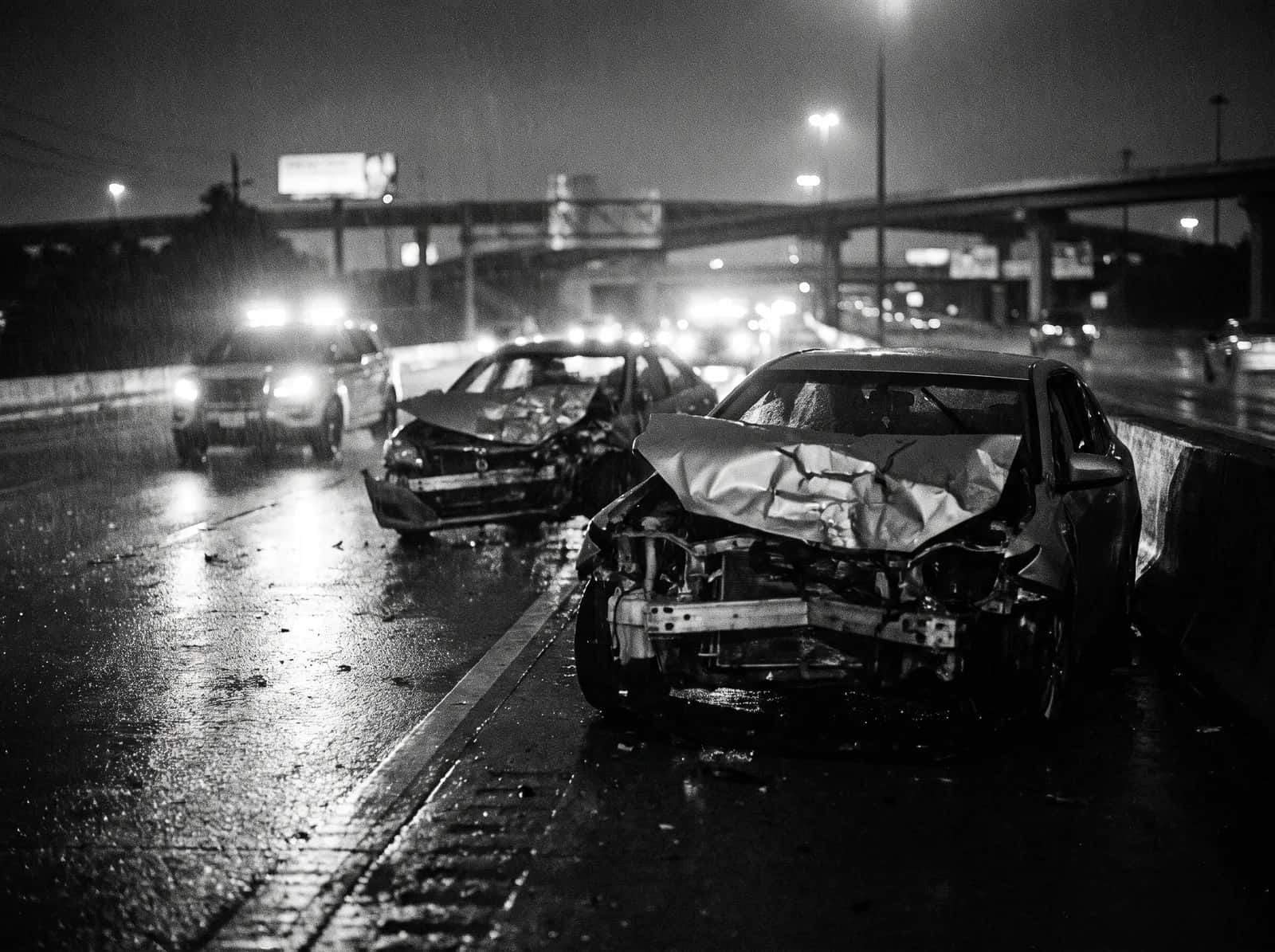
Subsection (b) applies if a collision happens on a main lane, ramp, shoulder, median, or adjacent area of a freeway in a metropolitan area, and each vehicle can be normally and safely driven. Each operator then moves the vehicle as soon as possible to a designated collision investigation site, if available, to a location on the frontage road, to the nearest suitable cross street, or to another suitable location.
Subsection (b) adds a separate freeway rule. Subsection (a) is written to apply "except as provided by Subsection (b)."
What does normally and safely driven mean?
Under subsection (d), a vehicle qualifies if it does not require towing and can run under its own power in its usual manner.
The definition also says the vehicle must be drivable without additional damage or hazard. A vehicle that needs a tow, or that cannot move under its own power, does not meet the definition.
Because the freeway move rule depends on this definition, facts such as tow records, repair estimates and photos of the vehicle can matter when drivers disagree about whether a car could have been moved.
Does section 550.022 apply when someone is hurt?
No. Subsection (a) applies only to a collision resulting only in damage to a vehicle.
Chapter 550 has a separate section, 550.021, titled "Collision involving personal injury or death." Section 550.023, the duty to give information and render aid, is the section 550.022 points to, and it also covers injury collisions.
If you start a crash thinking it was damage only and later feel pain, the injury is still a matter for a medical visit and, if you choose, a talk with a Texas lawyer.
How does section 550.022 fit into a car accident injury claim?
It is about what a driver does after impact. It does not say who caused the crash.
An injury claim usually turns on whether a driver was negligent in causing the collision, such as by speeding or following too closely. Section 550.022 does not answer that question. Fault for the crash itself is decided on the facts of the crash.
How a driver's conduct after impact would matter in a particular claim depends on the facts. A Texas lawyer can explain how it would apply to your situation.
How is fault shared when more than one driver is involved?
Texas Civil Practice and Remedies Code chapter 33 has the fact finder assign a percentage of responsibility, and a claimant over 50 percent cannot recover.
Section 33.003 has the trier of fact determine a percentage of responsibility for each claimant, defendant, settling person and designated responsible third party. Under section 33.001, a claimant may not recover damages if the claimant's percentage of responsibility is greater than 50 percent.
If the claimant is not barred, section 33.012(a) has the court reduce the damages by a percentage equal to the claimant's percentage of responsibility. Sharing of fault is decided on evidence, so a clear record of what happened matters.
What evidence shows whether a driver met these duties?
Photos, video, witness accounts, the crash report, and records of tow and repair usually show where vehicles stopped and what was exchanged.
Each duty in the section is a fact question: did the driver stop, did the driver stay, was information exchanged, and could the vehicle be driven. The table below pairs each duty with common kinds of proof.
Gather this early. Memories fade, and video can be overwritten.
- Photos and video of the scene
- Witness names and phone numbers
- The crash report number
- Tow and repair records
- Texts or photos showing information exchanged
Section 550.022 duties and how each can be shown after a crash
| Duty in the section | What the text says | How it can be shown |
|---|---|---|
| Stop at or near the scene | Immediately stop at the scene or as close as possible, without obstructing traffic more than necessary | Witness statements, video, the crash report, photos showing where the vehicles ended up |
| Return if not stopped | Immediately return to the scene if the vehicle is not stopped at the scene | Witness accounts, video, timing shown in the report or 911 records |
| Remain until section 550.023 is met | Stay until the operator complies with section 550.023 | Whether name, address, registration number, insurer name and license were exchanged: texts, photos of documents, the report, witness accounts |
| Move vehicles on a metropolitan freeway | If each vehicle can be normally and safely driven, move as soon as possible to a suitable location | Photos of vehicle condition, tow records, video, the report |
| Vehicle can be normally and safely driven | Does not require towing and can operate under its own power in its usual manner without added damage or hazard | Tow records, repair estimates, photos, officer notes |
How it is proven after a crash
- Photos and video of the vehicles, the road, and where each came to rest
- Names, phone numbers and insurer names for every driver, and any witnesses
- The crash report number and a copy of the report once it is available
- Tow and repair records, which show whether a vehicle could be driven
- Notes written the same day on what each driver said and did
Mistakes that cost people money
- Leaving the scene before exchanging information, even after a minor impact
- Stopping in a lane of traffic when the vehicle could safely be moved
- Skipping a medical visit because the crash looked like damage only
- Posting about the crash online before talking with a lawyer
Related Texas laws
- All Texas laws explained
- Texas Transportation Code 550.024: Hitting a Parked Car
- Transportation Code 550.062: Officer Crash Report Rule
- Transportation Code 550.065: Who Can Get a Texas Crash Report
- Transportation Code 550.026: How a Crash Must Be Reported
- How to get a Texas crash report
- Car accident lawyer
- Houston injury lawyer
Where this fits in your claim
- 1. The crash: what to do at the scene and in the first days
- 2. The report: how to get your Texas crash report (CR-3)
- 3. The insurance claim: claims phone numbers and first calls
- 4. Treatment: how PIP pays medical bills
- 5. Liens: hospital liens on a settlement
- 6. The demand: what a demand letter does
- 7. The lawsuit: the two-year deadline to sue
Frequently asked questions
Does section 550.022 apply when someone is hurt?
No. It applies to a collision resulting only in damage to a vehicle. Chapter 550 has a separate section, 550.021, titled "Collision involving personal injury or death."
What information must a driver give after a crash?
Section 550.023 has the driver give name, address, vehicle registration number and the name of the motor vehicle liability insurer. A driver's license is shown if requested and available.
What does it mean that a vehicle can be normally and safely driven?
Under subsection (d), it must not require towing and must run under its own power in its usual manner, without additional damage or hazard.
Does the freeway rule apply on any road?
No. Subsection (b) applies to a main lane, ramp, shoulder, median, or adjacent area of a freeway in a metropolitan area.
Can this section be used to assign fault for the crash?
It covers conduct after impact. Fault for causing the crash is decided on other facts, and under Civil Practice and Remedies Code chapter 33 each person's percentage of responsibility is determined.
This page is general information about Texas law and is not legal or medical advice. Every case depends on its own facts. Contact the firm for a free review of yours.
Keep reading

Sources