
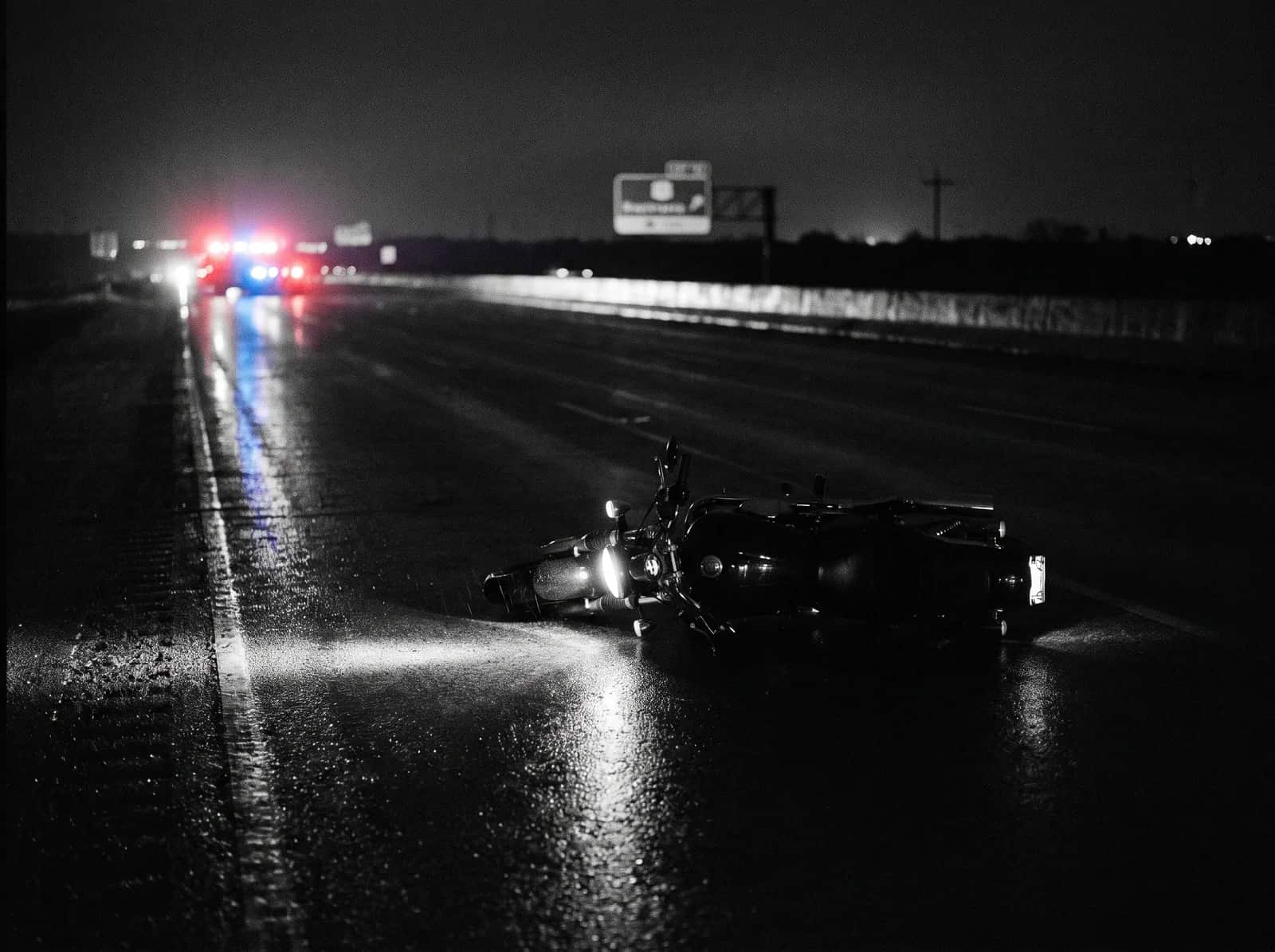

In Cypress, a person hurt in a motorcycle accident caused by someone else can recover medical costs, lost income, and pain under Texas law. Owsley Law Firm handles Cypress motorcycle accidents from its Houston offices, comes to you, and charges no fee unless it wins. Call before you speak with any insurer.
Motorcycle Accidents in Cypress
Where do Cypress motorcycle accidents happen?
Cypress riders are hit on the US-290 frontage roads and on Barker Cypress and FM 529, usually by a driver turning left or changing lanes.
Cypress riders ride long, fast arterials. Barker Cypress, Fry, Mason, and FM 529 run for miles between signals, and the US-290 frontage roads carry traffic that is always merging. The firm’s Cypress motorcycle cases most often involve a driver turning left across a rider at a subdivision entrance or a driver changing lanes on a frontage road without seeing the bike. Construction trucks add loose gravel and debris to the roads near new building sites, which can cause a crash on its own. The firm’s Cypress motorcycle cases are filed in Harris County downtown, and nearby business and traffic cameras, the bike’s damage, and witness accounts usually decide how fault is split.
Corridors where Cypress motorcycle accidents cluster
- US-290 at the Grand Parkway interchange
- US-290 at Barker Cypress Road and Fry Road
- Grand Parkway at Bridgeland Creek Parkway and Cypress Rosehill
- FM 1960 between US-290 and Telge Road
- Barker Cypress at West Road and Tuckerton
- Mason Road at Clay Road and Longenbaugh
Cases from Cypress
What does a Cypress motorcycle accident case look like?
A driver merging onto US-290 from the Barker Cypress feeder is sideswiped by a pickup changing lanes without looking.
Why do Cypress roads produce so many serious rider injuries?
Cypress mixes long, fast county arterials with freeway frontage roads and constant subdivision traffic. A rider has no margin when a driver misjudges a gap, and the numbers for riders statewide show it.
TxDOT's 2024 motorcyclist table counts 585 riders and passengers killed in Texas that year and 2,532 with suspected serious injuries. Harris County, where Cypress sits, recorded 579 traffic deaths of all kinds in 2024, the most of any Texas county. TxDOT does not publish a Cypress-only count, because Cypress is not a city, but the crashes on Barker Cypress, Fry, Mason, Spring Cypress, and the US-290 frontage roads are part of that county total.
Of the 585 motorcyclists killed in Texas in 2024, 348 were wearing a helmet. That figure is worth keeping in mind when an adjuster suggests a rider's injuries came from what the rider wore rather than what the driver did. A helmet protects the head. It does nothing for a shattered wrist, a broken pelvis, or a leg pinned under a bike by a turning SUV.
Rider injuries are also slower to heal and harder to see on a crash report. A report may list a rider as having a possible injury when the rider later needs surgery. The claim is built on the medical records that follow, not on the box an officer checked at the scene.
What makes FM 529 west of the Grand Parkway risky for a rider?
TxDOT describes FM 529 between the Grand Parkway and FM 362 as a two-lane undivided road with four-foot shoulders and open ditches. That leaves little room to escape a driver who pulls out, passes badly, or drifts over the line.
FM 529 is a favorite ride out of Cypress because it opens up quickly into rural Harris and Waller County. TxDOT's Houston District project page describes the segment from SH-99 to FM 362 as one lane in each direction with four-foot outside shoulders and open ditches, and it proposes widening the road to six lanes with an 18-foot raised median as far as Katy Hockley Cut Off Road and to four lanes beyond it, with 12-foot shoulders and turn lanes.
Until that work is done, the common crashes on a road like this are head-on and sideswipe crashes when a driver passes into an oncoming rider, and broadside crashes when a driver pulls out of a driveway or a side road. Transportation Code section 545.155 requires a driver entering a highway from a private road or driveway to yield to vehicles approaching on that highway, and a motorcycle is one of them.
If widening begins, the road will carry lane shifts, temporary striping, and construction traffic for a period. A contractor that leaves an unmarked drop-off or loose material in the travel lane can share responsibility with a driver. Photos of the work zone signs and the road surface, taken before the layout changes, are often the only proof of how the zone looked that day.
- Two lanes, one each direction, with four-foot shoulders (TxDOT)
- Open ditches instead of curbs along the edges
- Runs through Harris and Waller Counties, which affects where a case is filed
- Proposed widening with a raised median and turn lanes
How do the Grand Parkway and US-290 frontage roads put riders at risk?
The Grand Parkway is a TxDOT toll road with intermittent frontage roads, and US-290 frontage roads carry traffic weaving to and from the main lanes. Both create lane changes and merges where drivers look for cars and miss motorcycles.
TxDOT describes Grand Parkway Segment F-1 as an existing 12.0-mile, four-lane, controlled-access toll road with intermittent frontage roads, running from US-290 near Cypress to SH-249 near Tomball, operated and maintained by TxDOT. South of US-290, Segment E runs to I-10 near Katy, and TxDOT has announced plans to widen it with an added lane in each direction and concrete barrier in place of the cable barrier, with construction estimated to begin in mid-2026.
Where frontage roads stop and start, traffic funnels onto cross streets such as Bridgeland Creek Parkway and Cypress Rosehill, and drivers change lanes late to reach an exit or a ramp. A motorcycle is narrow and easy to lose in a mirror. Transportation Code section 545.0605 gives a motorcycle full use of its lane, and a driver who moves into that lane is taking space the rider is entitled to.
Because TxDOT operates the Grand Parkway, a crash caused by a road defect or a TxDOT vehicle there is a claim against the state under the Texas Tort Claims Act, not an ordinary negligence claim. That changes the notice deadline and the damage limits, as explained below.
Who investigates a Cypress motorcycle crash, and who reconstructs a serious one?
Usually the Harris County Sheriff's Office, the Harris County Precinct 4 Constable's Office, or DPS. Precinct 4, which serves north Harris County including Cypress, has an Accident Investigation Section that responds to crashes with fatalities or major injuries.
The Precinct 4 Constable's Office says it serves north Harris County, including Cypress, Tomball, and Jersey Village, and describes itself as the largest constable's office in the nation. Its Accident Investigation Section is made up of trained crash investigators who respond to scenes involving fatalities or major injuries, collect evidence, reconstruct the crash, and prepare court-ready data books. In a serious rider crash, that reconstruction file can be the most detailed record of speeds, sight lines, and points of impact.
TxDOT's 2024 table of crashes by investigating agency shows the scale of the work. Harris County Constable Precinct 4 investigated 7,160 crashes that year, with 29 people killed and 112 suspected serious injuries. The Harris County Sheriff's Office investigated 27,379 crashes, with 158 people killed and 723 suspected serious injuries.
Under Transportation Code section 550.062, the investigating officer must file the crash report with TxDOT within 10 days when someone is hurt or killed or property damage reaches $1,000. The report can be bought through TxDOT's Crash Report Online Purchase System. A reconstruction file or data book usually takes longer and may have to be requested from the agency directly. The firm requests both for its clients.
Can an insurer blame a Cypress rider for not wearing a helmet?
It can try, but only within limits. Riders 21 and older may ride without a helmet if they meet the state's exception, and a missing helmet can affect a claim only if the medical proof shows it caused or added to a specific injury.
Transportation Code section 661.003 requires operators and passengers to wear approved protective headgear, except riders 21 and older who have completed an approved motorcycle operator training and safety course or who carry qualifying health insurance coverage. A rider who meets the exception is riding lawfully.
If the insurer argues that a helmet would have prevented or reduced a head injury, that argument goes to the rider's percentage of responsibility under Chapter 33 of the Civil Practice and Remedies Code. It is not a separate cut in damages, and it applies only if the defense proves the missing helmet caused or added to that injury. The Texas Supreme Court set that framework for seat belts in Nabors Well Services v. Romero (2015), and defendants raise the same reasoning for helmets. It has nothing to say about a broken ankle, road rash on the arms, or a back injury.
Lane position is the other common argument. Since September 1, 2023, Texas has prohibited riding between lanes of traffic moving in the same direction, and two motorcycles may ride side by side in one lane. If an insurer claims a rider was splitting lanes on a stopped US-290 frontage road, the damage pattern, the final positions, and nearby video usually answer the question.
Which hospitals treat riders hurt in Cypress?
Cypress has two state-designated Level III trauma centers. A badly injured rider may be taken to a Level II center on FM 1960 or flown to a Level I center in the Texas Medical Center.
On the Texas Department of State Health Services list of designated trauma facilities, current as of October 1, 2026, HCA Houston Healthcare North Cypress and Memorial Hermann Cypress Hospital are Advanced (Level III) trauma facilities. HCA Houston Healthcare Northwest is a Major (Level II) facility, and Harris Health Ben Taub Hospital and Memorial Hermann Texas Medical Center are Comprehensive (Level I) centers. Houston Methodist Cypress Hospital does not appear on the designated trauma list.
Rider injuries often lead to transfers: a first stop at a nearby emergency room, then a move to a higher-level center for surgery. Each hospital keeps its own records and sends its own bills, and each may claim a lien. Keep a list of every facility, ambulance, and air transport, because each one is part of the medical picture and part of the claim.
- Level III: HCA Houston Healthcare North Cypress; Memorial Hermann Cypress Hospital
- Level II: HCA Houston Healthcare Northwest
- Level I: Ben Taub Hospital; Memorial Hermann Texas Medical Center
Which insurance pays a Cypress rider?
The at-fault driver's liability coverage pays first. The rider's own uninsured and underinsured motorist coverage fills the gap when that coverage is missing or too small, and an employer's policy may apply if the driver was working.
Texas requires drivers to carry at least $30,000 per person, $60,000 per crash, and $25,000 for property damage under Transportation Code section 601.072. A rider who needs surgery can exceed $30,000 quickly. Insurance Code section 1952.101 requires insurers to offer uninsured and underinsured motorist coverage, and it stays on the policy unless the rider rejected it in writing. Finding the declarations page, and any signed rejection, is one of the first steps.
A hit-and-run claim under uninsured motorist coverage requires actual physical contact between the unidentified vehicle and the rider or the bike, under Insurance Code section 1952.104. A driver who cuts a rider off on the Grand Parkway frontage road and keeps going without touching the motorcycle leaves a harder claim, so witnesses and video matter.
Motorcycle policies differ in whether they include medical payments or Personal Injury Protection coverage, so check the policy rather than assuming. Cypress roads also carry landscaping crews, delivery vans, and builders' trucks. When the at-fault driver was working, the employer's commercial policy may apply, and its limits are usually much higher than a personal policy's.
What if a county vehicle, a Cy-Fair ISD bus, or a TxDOT truck hit you?
The Texas Tort Claims Act applies. Notice is generally due within six months, damages are capped, and a City of Houston vehicle carries a shorter 90-day charter deadline.
Civil Practice and Remedies Code section 101.021 allows claims for injuries caused by a government employee's negligent operation of a motor vehicle on the job. In and around Cypress that includes Harris County sheriff and constable units, county road crews, Cy-Fair ISD school buses, and TxDOT maintenance trucks on the Grand Parkway. Under section 101.051, school districts can be sued under the Act only for motor vehicle claims, which is what a bus crash is.
Section 101.101 requires notice within six months describing the injury, the time and place, and what happened, unless the unit already had actual notice. Damages are capped under section 101.023 at $100,000 per person and $300,000 per occurrence against a county or school district, and at $250,000 per person and $500,000 per occurrence against the state or a city. A crash with a City of Houston vehicle requires notice under the city charter within 90 days, and a vehicle from another city, such as Jersey Village, may fall under that city's own charter, since city charters can require notice sooner than six months.
A private driver who shared fault with a government driver can still be pursued without those caps. When a public vehicle is involved, the safest course is to put the notice in writing within weeks, not months.
What is a Cypress motorcycle claim made of?
Medical expenses, lost income, pain, mental anguish, impairment, scarring, and the bike and gear. The total is reduced by any share of fault a jury assigns to the rider.
Texas allows recovery of past and future medical expenses, limited to amounts actually paid or incurred under Civil Practice and Remedies Code section 41.0105, along with lost earnings and earning capacity, physical pain, mental anguish, physical impairment, and disfigurement. Road rash that scars and fractures that limit grip or walking are common rider injuries, and they are documented best by photos taken over weeks and by the treating doctors' notes.
The motorcycle, helmet, jacket, boots, and any camera are property damage. Keep the gear as it is, unwashed and unrepaired, because scuffs and impact marks help show how the crash happened. Do not let the bike be salvaged before it is photographed and, in a serious case, inspected.
Under Civil Practice and Remedies Code section 33.001, a rider found more than 50 percent responsible recovers nothing, and a rider found 50 percent or less recovers a reduced amount. Under section 33.013, each defendant generally pays only its own share of the damages unless it is found more than 50 percent responsible.
- Medical bills, paid or incurred
- Lost wages and future earning capacity
- Pain, mental anguish, and impairment
- Scarring and disfigurement
- Motorcycle, helmet, and riding gear
How are hospital liens and health plan claims handled for Cypress riders?
A hospital that treated you within 72 hours, including in the emergency room, can claim a lien, and health plans may seek reimbursement. Both are limited by law and checked before any money is paid out.
Property Code section 55.002 gives a hospital a lien on the injured person's claim when the person was admitted within 72 hours of the crash, and section 55.0015 treats care in any department, including the emergency room, as an admission. Section 55.004 limits the lien to reasonable and regular charges for the first 100 days of hospital services, plus emergency physician charges from the first seven days, and caps it at half of the recovery.
Health plan reimbursement depends on the kind of plan. A self-funded employer plan under ERISA follows its plan terms rather than Chapter 140 of the Civil Practice and Remedies Code, and Texas Medicaid recovers under Human Resources Code section 32.033. Sorting out each claim is part of closing every case, because the amount the rider keeps is the number that matters.
Where is a Cypress motorcycle case filed, and what does the firm charge?
Most Cypress crashes are Harris County cases filed at 201 Caroline Street downtown. A crash west of the county line on FM 529 or US-290 can be a Waller County case. There is no fee unless the firm wins.
Texas venue rules generally allow suit in the county where the crash happened or where a defendant lives. A Harris County case goes to the Harris County Civil District Courts at the Civil Courthouse, 201 Caroline Street. TxDOT's FM 529 project runs through both Harris and Waller Counties, so a crash on the western stretch may belong in the Waller County district court in Hempstead. If every defendant is from out of state and more than $75,000 is at stake, the defense may try to remove the case to federal court, but that removal is not allowed when a properly joined and served defendant is a Texas citizen.
The deadline to file suit is generally two years from the crash under Civil Practice and Remedies Code section 16.003, and a claim involving a government vehicle needs written notice far sooner.
Owsley Law Firm handles Cypress motorcycle cases from its Houston offices at 601 Sawyer Street and 3535 Westheimer Road, about 35 minutes from Cypress on US-290 without traffic. Riders work with the firm by phone, video, and mail, and the firm meets clients at home or in the hospital when they cannot travel. There is no fee unless the firm wins your case. Clients may be responsible for case expenses, such as court costs, as set out in the written fee agreement.
Common Cypress rider crashes and the evidence that answers the insurer
| Where it happens | What the insurer argues | Evidence that answers it |
|---|---|---|
| Driver pulls out of a driveway on two-lane FM 529 | The rider was going too fast to stop | Sight distance, skid and gouge marks, and section 545.155's duty to yield |
| Left turn across a rider on Barker Cypress or Fry Road | The rider came out of nowhere | Impact points, nearby business video, and witness statements |
| Lane change into a rider on a US-290 or Grand Parkway frontage road | The rider was splitting lanes or in a blind spot | Damage pattern, final positions, and section 545.0605's full-lane rule |
| Head injury where the rider wore no helmet | The injuries were the rider's own fault | Section 661.003 exception and medical proof about each injury |
| Crash in a Grand Parkway work zone | The rider failed to adjust | Traffic control plans, daily work logs, and photos of the zone |
What to do now
What should you do after a motorcycle accident in Cypress?
- Get examined the same day, even for road rash. HCA Houston Healthcare North Cypress (Level III trauma) and Memorial Hermann Cypress Hospital (Level III trauma) handle the serious rider injuries from Cypress.
- Keep your helmet, jacket, gloves, and boots as they are. Do not wash, repair, or throw them away; the damage shows where you were hit and how hard.
- Photograph the bike, the other vehicle, skid marks, gravel or potholes, and the sight lines, especially at crashes on US-290 (Northwest Freeway) and Grand Parkway (SH-99).
- Get the Cypress crash report. Because Cypress is unincorporated, the report usually comes from the Harris County Sheriff’s Office, a Harris County constable precinct, or DPS on US-290 and the Grand Parkway. It is a Texas CR-3 report available through the TxDOT Crash Report Online Purchase System. The firm obtains it for clients at no charge. Read it closely: reports sometimes assume the rider was speeding or lane splitting without evidence, and errors can be corrected.
- Expect the other driver's insurer to look for reasons to blame the rider. Report the crash to your own insurer, but give no recorded statement to the other carrier until you have counsel.
- Know where the case goes. Cypress motorcycle accidents suits are filed in the Harris County Civil District Courts, 201 Caroline St, or Harris County Courts at Law depending on the crash location.
- Call the firm. Cypress clients are handled from Houston by phone, video, and mail, and the firm travels to Cypress for meetings, depositions, and court. The consultation is free.
Go deeper
More on motorcycle accident claims in Cypress and Texas.
Common questions
Cypress motorcycle accident questions
Where do motorcycle crashes happen most in Cypress?
On the US-290 frontage roads and on Barker Cypress, Fry, Mason, and FM 529.
What if gravel from a construction site caused my crash?
If debris was left on the road by a construction company or fell from a truck, that company may be responsible. Photographs of the road and any truck in the area matter.
Can I recover if I was not wearing a helmet?
Yes. Texas allows riders 21 and older to ride without a helmet if they meet the safety course or health coverage requirements, and not wearing one does not bar a claim, although if the insurer proves it caused or worsened an injury, a jury can weigh that when it assigns percentages of responsibility.
Where is a Cypress motorcycle accident case filed?
In the Harris County Civil District Courts at 201 Caroline Street.
Will the Precinct 4 crash reconstruction be in my crash report?
Usually not. The CR-3 crash report is filed with TxDOT within 10 days, while a reconstruction or data book from the Accident Investigation Section is a separate, longer file that may have to be requested from the agency.
Is Houston Methodist Cypress a trauma center?
It does not appear on the Texas Department of State Health Services designated trauma list current as of October 1, 2026. HCA Houston Healthcare North Cypress and Memorial Hermann Cypress Hospital are both designated Level III centers.
My crash was on FM 529 near the Waller County line. Where is my case filed?
It depends on which side of the line the crash happened and where the defendants live. A Harris County crash is usually filed at 201 Caroline Street, while a Waller County crash can be filed in the district court in Hempstead.
The driver who hit me drove off without touching my bike. Can I use my uninsured motorist coverage?
Texas requires actual physical contact for an unidentified hit-and-run driver under uninsured motorist coverage, so a no-contact crash is harder. Witnesses who saw the plate or nearby video can identify the driver and open other options.
Should I repair my motorcycle right away?
Photograph it first from every side, keep the helmet and gear as they are, and in a serious case have the bike inspected before it is repaired or salvaged. The damage often shows how the crash happened.
Does a TxDOT road defect claim on the Grand Parkway work like a normal claim?
No. TxDOT operates the Grand Parkway, so a claim against the state runs under the Texas Tort Claims Act, with notice generally due within six months and damages capped at $250,000 per person.
Do I have to come downtown to meet the firm?
No. The firm works with Cypress riders by phone, video, and mail and meets clients at home or in the hospital. Its offices are in Houston on Sawyer Street and Westheimer Road.
Sources
Sources this page relies on
- Texas DSHS designated trauma facilities (current as of October 1, 2026)
- TxDOT 2024 motorcyclist fatalities and injuries by age group and helmet use
- TxDOT 2024 crashes and injuries by investigating agency
- TxDOT, FM 529 from SH 99 to FM 362
- TxDOT, SH 99 Grand Parkway Segment F-1 (US 290 to SH 249)
- Harris County Precinct 4 Constable, Accident Investigation Section
- Texas Transportation Code, chapter 661 (motorcycle helmets)
- Texas Tort Claims Act, Civil Practice and Remedies Code chapter 101