
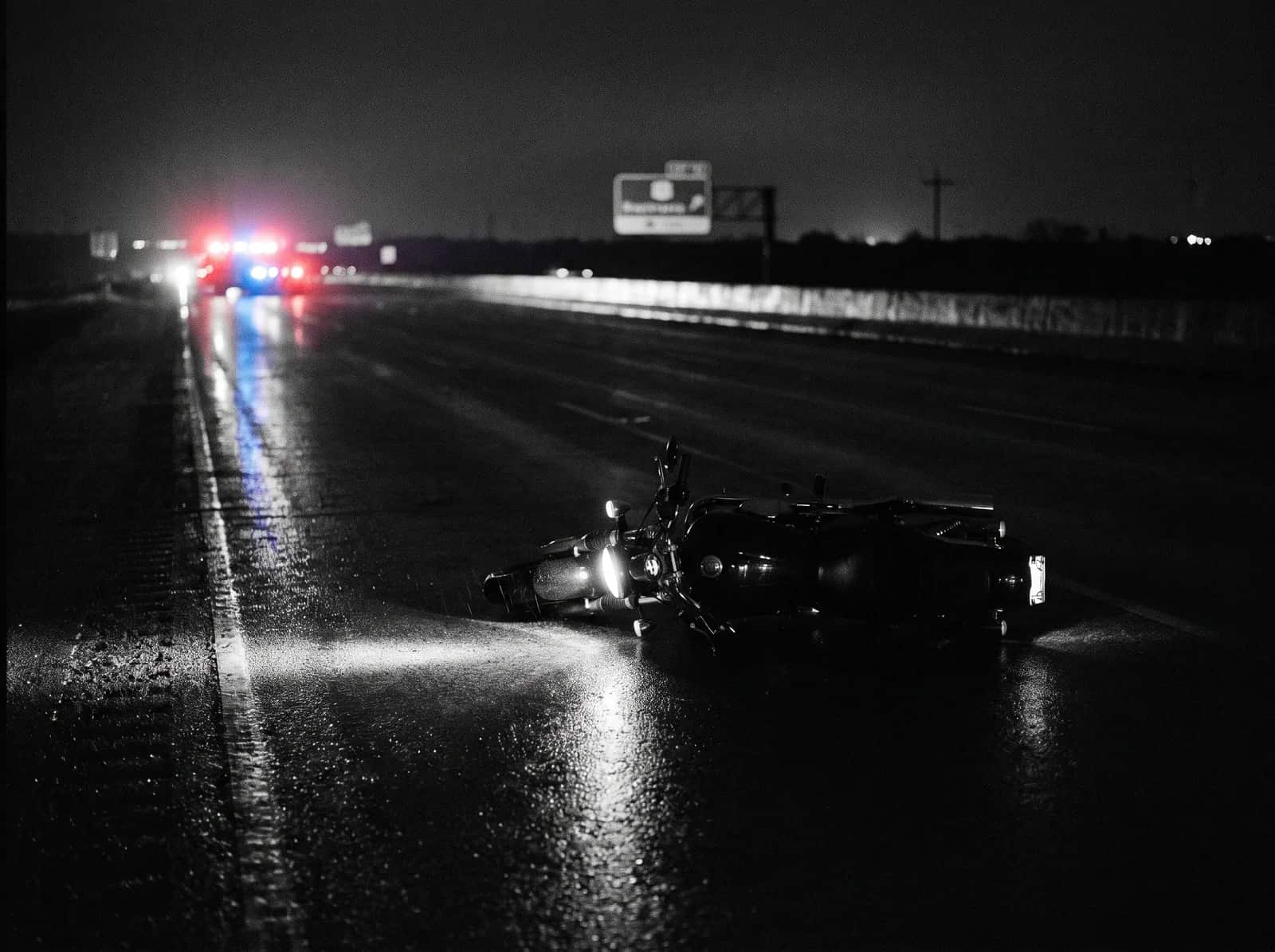

In El Paso, a person hurt in a motorcycle accident caused by someone else can recover medical costs, lost income, and pain under Texas law. Owsley Law Firm handles El Paso motorcycle accidents from its Houston offices, comes to you, and charges no fee unless it wins. Call before you speak with any insurer.
Motorcycle Accidents in El Paso
Where do El Paso motorcycle accidents happen?
El Paso riders are hit on Montana, Mesa, and the I-10 frontage roads, and on the Transmountain Road curves.
El Paso riders are hit on Montana Avenue, Mesa Street, and the I-10 frontage roads, and on the curves of Transmountain Road where drivers cross the center line. Fort Bliss has a large riding community, and the firm’s El Paso motorcycle cases frequently involve soldiers hit by drivers turning left on Montana or Dyer Street. Dust and sudden weather on I-10 add crashes where a driver could not see the rider in time.
Corridors where El Paso motorcycle accidents cluster
- I-10 through downtown and the Spaghetti Bowl interchange with US-54
- I-10 East at Loop 375 and Zaragoza Road
- Loop 375 Border Highway near the Ysleta port of entry
- US-54 Patriot Freeway at Fort Bliss
- Montana Avenue (US-62/180) on the East Side
- Mesa Street and Sunland Park Drive on the West Side
Cases from El Paso
What does a El Paso motorcycle accident case look like?
A Mexican-domiciled tractor-trailer leaving the Ysleta port of entry sideswipes a sedan on Loop 375; the carrier’s U.S. insurer and the trailer owner dispute coverage.
Where does an injured El Paso rider get treated, and why does it matter for the claim?
University Medical Center of El Paso is the region's only state-designated Level I trauma center, and the hospital that treats you becomes a central part of the evidence.
On the Texas Department of State Health Services list current as of October 1, 2026, University Medical Center of El Paso is the one Comprehensive (Level I) trauma facility in El Paso County. Del Sol Medical Center and The Hospitals of Providence East Campus are Major (Level II) centers, and Las Palmas Medical Center, The Hospitals of Providence Memorial Campus, and William Beaumont Army Medical Center at Fort Bliss are Advanced (Level III) centers. A rider with a serious head, chest, or pelvic injury is usually taken to UMC; a rider hurt on the far east side may first go to Providence East or Del Sol.
Wherever you are treated, the emergency record written in the first hours is the document the insurer reads first. Tell the triage nurse and the doctor everything that hurts, including your neck, wrists, and any blow to the head, even if the helmet took it. A symptom that is not written down that day is the symptom an adjuster later says came from something else.
- Ask which hospital you were taken to and keep every discharge paper
- Mention every symptom, including head strikes inside the helmet
- Photograph road rash before and during healing
- Leave the helmet and gear unwashed and unrepaired
- Do not give the other driver's insurer a recorded statement before getting advice
How dangerous are El Paso County roads for riders?
TxDOT counted 80 people killed in 76 fatal crashes and 311 suspected serious injuries in El Paso County in 2024. Most of the fatal crashes happened on city streets, not the freeway.
TxDOT's 2024 county table shows 18,344 reported crashes in El Paso County, and its road-type table shows that 44 of the county's 76 fatal crashes happened on city streets, compared with 16 on interstate highways. Inside the City of El Paso alone, TxDOT recorded 66 fatal crashes, 69 deaths, and 243 suspected serious injuries. Those totals cover every kind of vehicle, but riders take a disproportionate share of the serious outcomes because a motorcycle offers no protection in an impact.
For a rider, that pattern matters. The crashes that hurt El Paso motorcyclists most are often a driver turning left across the rider's path at a signal, pulling out of a driveway or shopping center, or changing lanes on a multi-lane arterial. Those are fault questions about what the driver saw, or should have seen, and they are answered with evidence from the scene rather than with assumptions about riders.
Which El Paso roads produce the hardest rider cases?
Transmountain Road, the Montana Avenue corridor, the I-10 and US-54 interchange downtown, and Loop 375 along the border each create a different kind of crash.
Loop 375 across the Franklin Mountains, known as Transmountain Road or Woodrow Bean Transmountain Road, draws riders for its grades and curves. TxDOT's own project page for the western segment, from I-10 to east of the Franklin Mountains State Park entrance, says rapid population and housing growth increased travel demand and caused safety concerns at intersections and driveways. A rider coming down the grade has little room when a driver pulls out or crosses the center line, and skid marks, debris fields, and the final rest positions disappear quickly on a road that busy.
Montana Avenue (US-62) is a different hazard. TxDOT studied the Montana corridor for 9 miles between Paisano Drive and Loop 375, past El Paso International Airport, as a major east-west connection with safety and traffic-operations needs. Signalized intersections and constant driveway access along that stretch create left-turn and pull-out crashes. Downtown, US-54 meets I-10, and TxDOT's I-10 Connect project describes congestion on the route to the Bridge of the Americas port of entry that spills back onto US-54 and the I-10 connector ramps, the kind of sudden slowdown where a rider is rear-ended or squeezed by a lane change.
How do the Texas helmet and lane rules play out in an El Paso claim?
Neither rule decides who caused the crash. Insurers raise both, so the facts and the medical proof decide how much they matter.
Transportation Code section 661.003 requires riders and passengers to wear a helmet, with an exception for riders 21 and older who completed an approved training course or carry health insurance covering crash injuries. A rider without a helmet is not at fault for being hit. The insurer can argue that a helmet would have reduced a head injury, and if the medical evidence supports that, it goes to the rider's share of responsibility under Chapter 33 of the Civil Practice and Remedies Code for that injury, not to the other injuries or to who caused the crash.
Transportation Code section 545.0605 gives a motorcycle full use of its lane and forbids driving a car in a way that takes that lane away; it also bars riding between lanes of traffic moving in the same direction. A driver who drifts into a rider's lane on Mesa Street or the I-10 frontage road broke the statute, not the rider. Under Civil Practice and Remedies Code section 33.001, a rider found partly responsible still recovers, reduced by that share, unless the share is more than 50 percent.
What if you are a Fort Bliss soldier hurt while riding?
An off-duty soldier hit by a civilian driver has the same Texas claim as anyone else, and federal law adds a few rules about medical care and deadlines.
Fort Bliss, home to the 1st Armored Division, puts a large military population on El Paso roads, including many riders. If a civilian driver caused the crash, the claim runs against that driver's insurance under Texas law, exactly as it would for a civilian rider. The difference is on the medical side: when the government provides or pays for care for an injury caused by someone else, the Federal Medical Care Recovery Act, 42 U.S.C. 2651, lets the United States recover the cost of that care from the person who caused it. That recovery right has to be accounted for in any settlement.
The Servicemembers Civil Relief Act, 50 U.S.C. 3936, excludes a servicemember's period of military service when computing the deadline to sue, so active-duty status can extend the usual two-year limit. Relying on that is risky, because evidence fades on its own schedule and other deadlines, such as notice to a city, are separate. A soldier injured on duty by a government vehicle is in a different position: under the Feres doctrine (Feres v. United States, 1950), service members generally cannot sue the United States for injuries incident to service, and military benefits apply instead.
What if a federal vehicle hit you on an El Paso road?
A crash with an on-duty federal driver, from an Army truck to a postal van, runs under the Federal Tort Claims Act, with its own claim form, deadline, and court.
El Paso's federal presence is large: Fort Bliss, the ports of entry, and the agencies that work the border all put government vehicles on I-10, Loop 375, and US-54. When a federal employee acting within the scope of the job causes a crash, the claim is against the United States, not the driver personally, under 28 U.S.C. 2679. Before any lawsuit, a written claim must be presented to the agency within two years under 28 U.S.C. 2401(b), and a lawsuit must follow within six months after the agency mails a final denial.
If the case is filed, it goes to the El Paso Division of the U.S. District Court for the Western District of Texas, and it is decided by a judge, not a jury, under 28 U.S.C. 2402. The United States is not liable for punitive damages under 28 U.S.C. 2674, and federal law caps attorney fees in these claims at 20 percent of an administrative settlement and 25 percent of a judgment or litigated settlement under 28 U.S.C. 2678. A soldier driving a personal vehicle off duty is not a federal driver for this purpose; that claim runs against the soldier's own insurance.
What if a Sun Metro bus or another City of El Paso vehicle was involved?
Written notice to the City is due within 90 days, or within six months for good cause shown. That is shorter than the general six-month state rule.
Sun Metro is a department of the City of El Paso, so a crash with a Sun Metro bus, a city service truck, or another city vehicle is a claim against the City. The City Attorney's claims page cites City Charter Section 1.5 and Municipal Code Chapter 3.28, which require written notice to the mayor within 90 days of the injury, or within six months for good cause shown, describing when and where the injury happened, how it happened, the injury, and the witnesses. Civil Practice and Remedies Code section 101.101 ratifies city charter notice periods like this one.
Claims against other local governments, such as El Paso County or a smaller city like Socorro or Horizon City, generally require notice within six months under section 101.101, and city charters can require notice sooner than six months. Under the Texas Tort Claims Act, a city's liability is capped at $250,000 per person and $500,000 per occurrence, and other local units at $100,000 and $300,000, under section 101.023. A private driver who shared fault with the bus can be pursued separately without those caps.
Which insurance pays an El Paso rider, and what if the driver had none?
The at-fault driver's liability policy pays first. Your own uninsured and underinsured motorist coverage fills the gap when that policy is too small or missing.
Texas minimum liability limits are $30,000 per person and $60,000 per crash for injuries under Transportation Code section 601.072. A rider admitted to UMC with fractures can pass $30,000 in the first days. Insurers must offer uninsured and underinsured motorist coverage under Insurance Code section 1952.101, and it stays on the policy unless the policyholder rejects it in writing. Personal Injury Protection under Insurance Code section 1952.152 pays medical bills and lost income regardless of fault, if the motorcycle policy includes it.
An uninsured motorist claim for a hit-and-run requires actual physical contact between the unknown vehicle and the rider or bike under Insurance Code section 1952.104. When the driver who caused the crash lives across the border or has an out-of-state policy, the first task is identifying which policy, if any, covers the crash in Texas, and that work is better started early than late. If the driver was working, an employer's commercial policy usually adds far more coverage.
How are UMC and other hospital bills handled in the settlement?
A hospital that treats you within 72 hours of the crash, including in the emergency room, can place a lien on your recovery. The lien is limited by statute and can often be negotiated.
Property Code section 55.002 gives the hospital a lien on the claim against the person who caused the crash, and section 55.0015 treats access to any department of the hospital, including the ER, as an admission. Under section 55.004, the hospital lien is for the lesser of its charges for the first 100 days of hospitalization or 50 percent of the amount recovered, and a treating physician's lien is limited to charges for the first seven days. Only reasonable and regular charges count.
Health insurance, TRICARE, or Medicaid may also have reimbursement rights. Medical expenses in the claim are limited to amounts actually paid or incurred under Civil Practice and Remedies Code section 41.0105, so the billing records matter as much as the treatment records. Sorting out liens before money changes hands is part of protecting the rider's net recovery.
Who is responsible for road hazards and work zones on El Paso highways?
Sometimes a contractor, sometimes a government body, and often a driver who reacted badly. TxDOT counted 963 work zone crashes in El Paso County in 2024.
Gravel, sand blown across the lanes, uneven pavement at a lane shift, and debris are far more dangerous on two wheels. TxDOT's 2024 work zone table shows 963 work zone crashes in El Paso County, with 20 suspected serious injuries. A contractor that leaves a lane shift poorly marked or debris in the travel lane can be responsible for a crash it caused, although on TxDOT projects Civil Practice and Remedies Code section 97.002 protects a contractor that was complying with the contract documents for that condition.
Claims against the state or a city for the condition of a road run under the Texas Tort Claims Act, which limits when a government body can be liable and requires early notice. Photograph the hazard before it is cleaned up or repaired, note the exact location and direction of travel, and photograph any work zone signs. A driver who sped through the work zone or followed too closely is responsible for that conduct regardless of the road condition.
Where is an El Paso motorcycle case filed?
Usually at the El Paso County Courthouse, 500 E. San Antonio Avenue, in a district court or one of the county courts at law, which in El Paso County share district court civil jurisdiction.
The El Paso County District Clerk's office is in Suite 103 of the courthouse, and several district courts, including the 41st, 205th, and 448th, hear civil cases only. El Paso County is unusual in that Government Code section 25.0732 gives its county courts at law the civil jurisdiction of a district court, so a crash case can also be filed in a county court at law. Texas venue rules can also allow filing where a defendant lives.
A defendant from another state may try to move a case worth more than $75,000 to the El Paso Division of the U.S. District Court for the Western District of Texas, which covers El Paso County under 28 U.S.C. 124. Federal law bars that removal when a properly served defendant is a Texas citizen. A claim against the United States goes to that federal court regardless.
What is an El Paso motorcycle claim worth, and how does the firm handle it from Houston?
Value comes from the injuries, treatment, lost income, scarring, and the coverage available, reduced by any share of fault. There is no fee unless the firm wins.
Texas law allows recovery of medical expenses, lost earnings and earning capacity, physical pain, mental anguish, physical impairment, and disfigurement. Rider cases often involve fractures, road rash that scars, and long rehabilitation, and the value depends on records no one has in the first weeks. Any number offered before treatment is complete is a guess, and a signed release ends the claim for good.
Owsley Law Firm handles El Paso motorcycle cases from its Houston offices by phone, video, and mail, and travels to El Paso for meetings, depositions, and court when the case requires it. There is no fee unless the firm wins your case. Clients may be responsible for case expenses, such as court costs, as set out in the written fee agreement.
El Paso motorcycle crash: who you may be claiming against and the deadline that applies
| Who caused the crash | Where the claim goes | Deadline to keep in mind |
|---|---|---|
| Private driver | That driver's liability insurer, then your UM/UIM coverage | Lawsuit generally within two years (Civil Practice and Remedies Code section 16.003) |
| Sun Metro bus or City of El Paso vehicle | Written notice to the mayor under the City Charter and Municipal Code Chapter 3.28 | 90 days, or six months for good cause shown |
| El Paso County or another local government vehicle | Tort Claims Act notice to that governmental unit | Generally six months; a city charter can be shorter |
| On-duty federal driver (Army, postal, border agencies) | Federal Tort Claims Act claim to the agency | Written claim within two years; suit within six months of denial |
| Commercial truck or working driver | The employer's commercial policy plus the driver's | Generally two years; preserve truck data immediately |
| Unidentified hit-and-run driver | Your uninsured motorist coverage, if there was physical contact | Policy notice terms; report promptly |
What to do now
What should you do after a motorcycle accident in El Paso?
- Get examined the same day, even for road rash. University Medical Center of El Paso (Level I trauma) and Del Sol Medical Center handle the serious rider injuries from El Paso.
- Keep your helmet, jacket, gloves, and boots as they are. Do not wash, repair, or throw them away; the damage shows where you were hit and how hard.
- Photograph the bike, the other vehicle, skid marks, gravel or potholes, and the sight lines, especially at crashes on I-10 and Loop 375 (Border Highway and Joe Battle).
- Get the El Paso crash report. El Paso Police Department reports are available through the TxDOT Crash Report Online Purchase System, usually within 10 days. The firm obtains it for clients at no charge. Read it closely: reports sometimes assume the rider was speeding or lane splitting without evidence, and errors can be corrected.
- Expect the other driver's insurer to look for reasons to blame the rider. Report the crash to your own insurer, but give no recorded statement to the other carrier until you have counsel.
- Know where the case goes. El Paso motorcycle accidents suits are filed in the El Paso County Civil District Courts, El Paso County Courthouse, or El Paso County Courts at Law depending on the crash location.
- Call the firm. El Paso clients are handled from Houston by phone, video, and mail, and the firm travels to El Paso for meetings, depositions, and court. The consultation is free.
Go deeper
More on motorcycle accident claims in El Paso and Texas.
Common questions
El Paso motorcycle accident questions
Where do El Paso motorcycle accidents happen most?
Montana Avenue, Mesa Street, Dyer Street, the I-10 frontage roads, and Transmountain Road.
What if I am stationed at Fort Bliss and was hit while riding?
The claim against the at-fault driver proceeds normally, and the firm handles the reimbursement rights of military medical care as part of the settlement.
What if I crashed avoiding a car that never touched me in El Paso?
If the driver is identified, you can claim against them even without contact, because the question is whether their driving caused the crash. If the driver drove off unidentified, Texas uninsured motorist coverage generally requires actual physical contact, which makes no-contact crashes harder. Witness names and any camera video from Montana or Dyer Street are critical.
Can I recover lost income if I ride for a delivery app in El Paso?
Yes. Lost income includes gig work, and it is proven with app earnings statements, 1099 forms, and bank deposits from before the crash. If your injuries limit how much you can ride in the future, that loss of earning capacity is part of the claim too. Keep a copy of your earnings history before the account changes.
Can I still recover if I crashed on Transmountain Road and the other car drove away?
If the car struck you or your bike, your uninsured motorist coverage can apply to an unidentified driver. If there was no contact, that coverage generally does not, which makes witnesses, dashcam footage, and quick reporting important.
The driver who hit me had Mexican plates. Can I still make a claim?
Yes. A driver who causes a crash in Texas can be held responsible here. Identifying insurance that covers the crash is the first step, and your own uninsured and underinsured coverage may pay if none exists.
I was hit by a Sun Metro bus three months ago. Is it too late?
Possibly not. The City's 90-day notice period can extend to six months for good cause shown, and in limited situations the City's actual notice of the injury can take the place of written notice. Get advice right away rather than waiting.
Does my military medical care at William Beaumont reduce what I can claim?
No. The reasonable cost of your care is still part of the claim. The government has a right to recover what it paid from the at-fault party, and that is handled as part of the settlement.
Will my case be heard in El Paso or in Houston?
A case about an El Paso crash is generally filed in El Paso County, not Harris County. The firm travels to El Paso for court and depositions.
What if I was riding on a learner's license or without a motorcycle endorsement?
Licensing does not decide who caused the crash. The insurer may raise it, but your recovery turns on how the crash happened and your share of responsibility, if any, under Chapter 33.
How long do I have to file an El Paso motorcycle lawsuit?
Generally two years from the crash under Civil Practice and Remedies Code section 16.003, with much shorter notice rules for city, county, and federal claims.
Sources
Sources this page relies on
- Texas DSHS, Texas Trauma Facilities (designations current as of October 1, 2026)
- TxDOT, Crashes and Injuries by County, 2024
- TxDOT, Loop 375 Transmountain West project
- City of El Paso, City Attorney: Filing a Claim (90-day notice)
- El Paso County District Clerk
- 28 U.S.C. 2401 (Federal Tort Claims Act deadlines)
- Texas Transportation Code, chapter 661 (motorcycle helmets)
- Texas Civil Practice and Remedies Code, chapter 101 (Tort Claims Act notice and caps)