
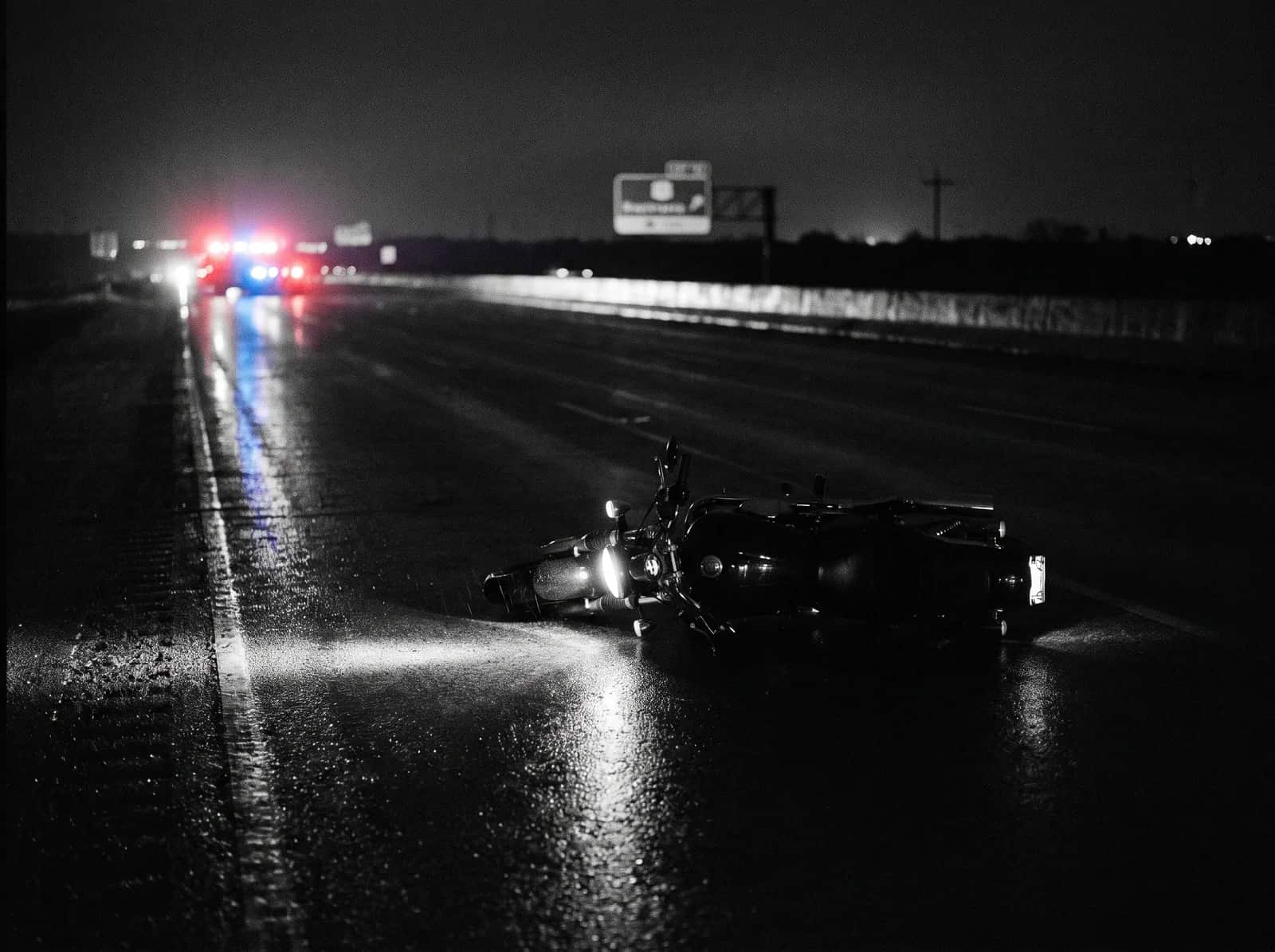
In Sugar Land, a person hurt in a motorcycle accident caused by someone else can recover medical costs, lost income, and pain under Texas law. Owsley Law Firm handles Sugar Land motorcycle accidents from its Houston offices, comes to you, and charges no fee unless it wins. Call before you speak with any insurer.
Motorcycle Accidents in Sugar Land
Where do Sugar Land motorcycle accidents happen?
Sugar Land riders are hit on SH-6 and the US-59 frontage roads.
Sugar Land riders are hit on SH-6 and the US-59 frontage roads, and at the left-turn intersections along University Boulevard and Lexington. Sugar Land’s arterials are wide, signalized, and busy, and the firm’s Sugar Land motorcycle cases most often involve a driver turning left across a rider on SH-6 near Town Center or a lane change on US-59 near the Grand Parkway.
Corridors where Sugar Land motorcycle accidents cluster
- US-59 Southwest Freeway at SH-6
- US-59 at the Grand Parkway
- SH-6 between US-90A and West Airport Boulevard
- US-90A through Sugar Land and Stafford
- Grand Parkway at West Bellfort and Sienna
- Westpark Tollway at SH-6
Cases from Sugar Land
What does a Sugar Land motorcycle accident case look like?
A left-turning driver on SH-6 fails to yield to a motorcycle near Town Center.
How many people are hurt in Sugar Land crashes, and where do riders fit in?
TxDOT counted 2,189 reported crashes inside Sugar Land in 2024, with 8 people killed and 34 suspected serious injuries. Statewide that year, 585 motorcyclists died and 2,532 suffered suspected serious injuries.
TxDOT's 2024 table of crashes by city lists 2,189 crashes in Sugar Land, including 7 fatal crashes that killed 8 people and 28 crashes that left 34 people with suspected serious injuries. Across Fort Bend County, the 2024 county table counts 13,217 crashes, 41 deaths, and 313 suspected serious injuries. Those tables do not separate motorcycle crashes by city, so nobody can honestly tell you how many of the Sugar Land numbers were riders.
The statewide motorcycle table fills in the picture. In 2024, TxDOT recorded 585 motorcyclists killed in Texas (557 operators and 28 passengers) and 2,532 with suspected serious injuries. Of the riders and passengers killed, 216 were reported as not wearing a helmet, which also means most riders who died were wearing one. A helmet helps, but it does not stop a driver from turning across a rider's path.
For a Sugar Land rider, the practical lesson is that the crash itself is rarely the hard part to explain. The hard part is proving what the driver could have seen, and showing how the injuries changed the rider's work and daily life over months, not days.
- Sugar Land, 2024: 2,189 crashes, 8 killed, 34 suspected serious injuries (TxDOT city table)
- Fort Bend County, 2024: 13,217 crashes, 41 killed, 313 suspected serious injuries
- Texas, 2024: 585 motorcyclists killed and 2,532 suspected serious injuries
Which Sugar Land roads create the most conflict points for riders?
The commercial arterials. SH-6, the US-59 frontage roads, US-90A, University Boulevard, and Lexington Boulevard are lined with driveways, turn bays, and U-turn lanes, and each one is a place where a driver can cross a rider's path.
A rider on SH-6 between US-90A and the US-59 interchange passes one shopping center entrance after another. Drivers waiting to turn left into those centers are looking for a gap in a stream of cars and trucks, and a single headlight in that stream is easy to misjudge. The same pattern repeats on the US-59 frontage roads, where drivers exit the freeway, cross lanes to reach a turn bay, and swing through U-turns under the overpasses.
US-90A is changing. TxDOT has studied a 6.8-mile stretch of US-90A in Fort Bend County from SH-6 to Loop 762, which today is a four-lane road. The proposed design would widen it to an eight-lane divided road with a raised median between SH-6 and the Grand Parkway, and to six lanes with a raised median between the Grand Parkway and Loop 762. Raised medians reduce some left turns across traffic, but construction brings lane shifts, uneven pavement, and loose material, all of which affect a two-wheeled vehicle far more than a car.
University Boulevard, Lexington Boulevard, and FM 1464 carry neighborhood and school traffic from Telfair, Riverstone, Sienna, and the newer subdivisions to the west and south. Those roads have lower speeds but more drivers pulling out of side streets, and a side-street driver who looks left, sees a car, and misses the motorcycle beside it is a familiar crash.
- SH-6 retail entrances and turn bays between US-90A and US-59
- US-59 frontage roads, exit ramps, and U-turn lanes
- US-90A from SH-6 west, where TxDOT has studied widening
- University Boulevard, Lexington Boulevard, and FM 1464 side-street junctions
- Grand Parkway and Westpark Tollway ramps
What does Texas law say about left turns, lane changes, and lane splitting?
A driver turning left must yield to oncoming traffic that is close enough to be an immediate hazard, a motorcycle is entitled to the full use of a lane, and riding between lanes of traffic has been illegal in Texas since September 1, 2023.
Transportation Code section 545.152 requires a driver turning left at an intersection, or into an alley, private road, or driveway, to yield to a vehicle approaching from the opposite direction that is in the intersection or close enough to be an immediate hazard. A motorcycle is a vehicle under that rule. When a driver turning into a Sugar Land shopping center says the rider came out of nowhere, the question becomes where the motorcycle was when the turn began, and that is answered with physical evidence, not with either side's estimate.
Transportation Code section 545.0605 gives a motorcycle operator the full use of a lane and says a motor vehicle may not be driven in a way that takes that away. Two motorcycles may ride side by side in one lane, but not three. The same section bars a rider from operating between lanes of traffic moving in the same direction and from passing a vehicle in the same lane. A driver who drifts into a rider's half of a lane on US-59 is violating the rider's right to it. A rider who was filtering between stopped cars on a frontage road will face that fact in the fault analysis.
A traffic violation by either side is evidence for the jury to weigh, not an automatic verdict. Texas juries assign each person a percentage of responsibility, and the evidence about speed, position, and visibility usually matters more than which statute either side cites.
Does Texas require a helmet, and can an insurer use a missing helmet against you?
Riders and passengers under 21 must wear one. At 21 and older, a rider who completed an approved safety course or has qualifying health coverage may ride without one. A missing helmet matters to the claim only if the defense proves it caused or added to a specific injury.
Transportation Code section 661.003 makes it an offense to operate or ride on a motorcycle without approved protective headgear, with an exception for a person at least 21 years old who has completed a motorcycle operator training and safety course or is covered by a health insurance plan that pays for injuries from a motorcycle collision. An officer may not cite a rider who is 21 or older and shows proof of either one. Sugar Land has no separate helmet rule; the state law applies.
Helmet nonuse is not a separate reduction in damages. Under the Texas Supreme Court's decision in Nabors Well Services v. Romero (2015), a defendant may raise a failure to use safety equipment as part of the injured person's share of responsibility under Chapter 33 of the Civil Practice and Remedies Code, but only with proof that it caused or added to the injury. That argument has nothing to say about a shattered ankle, a broken collarbone, or road rash, and it does not change who caused the crash.
If you were riding without a helmet, keep that out of any recorded statement to the other driver's insurer and talk to a lawyer first. The firm answers helmet arguments with the treating physicians' records and, when needed, medical testimony about how the injury actually happened.
Who writes the report on a Sugar Land motorcycle crash, and what should you check in it?
Sugar Land Police inside the city, the Fort Bend County Sheriff on unincorporated roads, and DPS on some state highways outside city limits. The report is filed with TxDOT and can be bought online, but riders should read it closely because they are often in an ambulance before the officer finishes.
Under Transportation Code section 550.062, an officer who investigates a crash causing injury, death, or at least $1,000 in apparent damage must file a written report with TxDOT within 10 days. That CR-3 report is available through TxDOT's Crash Report Online Purchase System. Stafford and Missouri City have their own police departments, so a crash on US-90A or SH-6 near the city line may carry another agency's report number.
Rider crashes create a particular problem. The injured rider is often taken from the scene before speaking to the officer, and the only account the officer hears is the driver's. Check the narrative, the diagram, the contributing factors, and the listed witnesses. If they are wrong, a supplemental statement to the agency, photos of the scene, and a witness's account can be used to correct the record, and the evidence can still prove what happened even if the report never changes.
Ask the agency on the report for body camera and dash camera video and scene photographs. Texas has prohibited local red-light camera enforcement since 2019, so a city traffic camera is not a reliable source of footage; business security cameras along SH-6 and the frontage roads, and the rider's own helmet camera, usually are.
Where are injured riders treated near Sugar Land?
Memorial Hermann Sugar Land Hospital and OakBend Medical Center in Richmond are designated Level IV trauma facilities. The most severe injuries are often taken to the Level I centers in the Texas Medical Center.
The Texas Department of State Health Services list of designated trauma facilities, current as of October 1, 2026, shows Memorial Hermann Sugar Land Hospital at Level IV (listed as contingent) and OakBend Medical Center in Richmond at Level IV (listed as probationary). Houston Methodist Sugar Land Hospital and St. Luke's Health Sugar Land are not on the designated list. The Level I (comprehensive) trauma centers for the region are Memorial Hermann-Texas Medical Center and Harris Health Ben Taub Hospital, with Texas Children's Hospital listed at Level I for children.
Riders with fractures, head injuries, or internal injuries are often stabilized in Sugar Land and transferred, or flown, to the Medical Center. Each hospital, ambulance service, and air transport bills separately, and a hospital that treats you within 72 hours of the crash can assert a lien on your claim under Chapter 55 of the Property Code. Emergency room treatment counts as an admission for that purpose. The lien generally covers the hospital's charges for the first 100 days and cannot take more than half of the recovery It can also include a physician's charges for emergency care in the first seven days.
Follow-up care is where many rider claims are won or lost. Orthopedic surgery, wound care for road rash, and physical therapy can run for months, and a gap of several weeks in treatment gives an insurer an argument that something else caused the problem. Keep every appointment and keep a simple record of what you could not do.
Which insurance pays a rider's claim?
The at-fault driver's liability coverage first, which can be as low as $30,000 per person. Your own uninsured and underinsured motorist coverage often decides whether a serious rider injury is fully paid.
Texas requires drivers to carry at least $30,000 per person and $60,000 per crash for bodily injury under Transportation Code section 601.072. A rider with surgery and months off work can exceed that quickly. Uninsured and underinsured motorist coverage, which Insurance Code section 1952.101 requires insurers to include unless it is rejected in writing, pays when the at-fault driver has no insurance or too little. That claim arises under your own policy as a contract claim, and it has its own, longer deadline.
A common rider crash involves no contact at all: a car swerves into the lane and the rider goes down avoiding it, and the car drives off. Uninsured motorist coverage for an unknown driver requires actual physical contact between the unknown vehicle and the insured or the insured's property under Insurance Code section 1952.104. If the driver who caused it can be identified through witnesses or video, the claim runs against that driver's insurance instead, which is why finding witnesses fast matters so much in a no-contact crash.
Check whether your motorcycle policy includes Personal Injury Protection or medical payments coverage, and whether your household auto policy says anything about motorcycles. Health insurance can also pay early bills, and a plan that pays usually has to be repaid from the recovery under rules that depend on the type of plan.
What if a city, county, or school vehicle hit you, or a road condition caused the crash?
Claims against the City of Sugar Land, Fort Bend County, or a school district fall under the Texas Tort Claims Act, with damage caps and notice generally due within six months. Road condition claims are harder and need early legal review.
Under Chapter 101 of the Civil Practice and Remedies Code, a governmental unit can be liable for injuries caused by an employee's negligent use of a motor vehicle on the job. Bodily injury damages are capped at $250,000 per person and $500,000 per occurrence for a city, and at $100,000 per person and $300,000 per occurrence for other local units such as Fort Bend County or a school district. Section 101.051 keeps school districts inside the Act only for motor vehicles, which is what a bus crash involves.
Section 101.101 requires notice to the governmental unit within six months of the crash unless it already had actual notice. The Sugar Land city charter, as published in the city's code, does not contain a separate damage-claim notice section, so the six-month rule is the usual outside limit for a City of Sugar Land vehicle. The city says liability claims start with a claim form from its Risk Management Division and are forwarded to the Texas Municipal League Intergovernmental Risk Pool, which assigns an adjuster.
Riders are also hurt by gravel, potholes, and uneven construction pavement. Those claims depend on who controlled the road (the city, the county, the Fort Bend County Toll Road Authority, TxDOT, or a private contractor) and on Texas rules that treat road defects differently from vehicle crashes. A contractor who left loose material or an unmarked drop-off is an ordinary defendant. A government road owner has more defenses, so photographs of the exact spot and early notice are essential.
How does the insurer try to put the blame on the rider, and how is that answered?
Usually by claiming the rider was speeding, weaving, or hidden in a blind spot. The answer is objective evidence: scene measurements, vehicle damage, video, and witnesses.
Texas uses proportionate responsibility. Under Civil Practice and Remedies Code section 33.001, an injured person who is more than 50 percent responsible recovers nothing, and one who is 50 percent or less has the recovery reduced by that percentage. Insurers know that a few percentage points of blame on the rider reduce what they pay, and they often build the case around speed.
Speed claims are tested with the motorcycle's final position, the crush pattern on the car, marks on the pavement, and video from nearby businesses that shows timing frame by frame. Visibility claims are tested with the sight lines at the intersection, the time of day, and whether the driver's view was blocked by a turning vehicle. A driver's phone use, which Transportation Code section 545.4251 prohibits for reading or sending messages while the vehicle is moving, can be shown through phone records once a suit is filed.
When two drivers share fault, for example a turning driver and a second driver who blocked the view, each pays only its own share unless it is found more than 50 percent responsible, under section 33.013. That makes it important to identify every driver involved, not only the one who made contact.
What can a rider recover, and how long do you have?
Medical expenses, lost earnings and earning capacity, pain, mental anguish, physical impairment, disfigurement, and the damage to the motorcycle and gear. The lawsuit deadline is generally two years from the crash.
Texas allows recovery of medical expenses actually paid or incurred, under Civil Practice and Remedies Code section 41.0105, along with lost income, reduced earning capacity, physical pain, mental anguish, physical impairment, and disfigurement. Scarring from road rash and the loss of the ability to ride, work with your hands, or keep up with your family are real parts of a rider's damages and need to be documented, not just described.
Property damage includes the motorcycle and the riding gear destroyed in the crash: helmet, jacket, boots, and gloves. Keep the damaged gear as it is; it is evidence of how the crash happened as well as a loss. Exemplary damages are available only on clear and convincing proof of gross negligence or worse, such as a drunk driver, and are generally capped under section 41.008.
The deadline to file suit is generally two years from the crash under section 16.003. A claim against a government vehicle requires notice much sooner, and the underinsured motorist claim has its own timeline. Waiting rarely helps: video is overwritten and witnesses scatter long before any deadline arrives.
Where is a Sugar Land motorcycle case filed, and how does the firm handle it?
Usually in the Fort Bend County district courts at the Justice Center in Richmond. The firm handles Sugar Land rider cases from its Houston offices, with no fee unless it wins.
Under Civil Practice and Remedies Code section 15.002, suit can generally be filed in the county where the crash happened or where a defendant lives. Sugar Land lies entirely in Fort Bend County, and Fort Bend civil cases are filed with the District Clerk at the Justice Center, 1422 Eugene Heimann Circle in Richmond. A rider hit after crossing into Harris County on the way to Houston may have a Harris County case instead. If every defendant is from another state and more than $75,000 is at stake, the defense may remove the case to the Houston Division of the federal court for the Southern District of Texas.
Owsley Law Firm has no office in Sugar Land. It handles Fort Bend County motorcycle cases from its Houston offices on Sawyer Street and Westheimer Road, works with clients by phone, video, and mail, and meets them at home or in the hospital when that helps. Steven Owsley has been licensed in Texas since 1985. There is no fee unless we win. Clients may be responsible for case expenses, such as court costs, as set out in the written fee agreement.
Common Sugar Land rider crashes and the evidence that answers the insurer
| Crash | Rule that usually applies | What the insurer argues | Evidence that answers it |
|---|---|---|---|
| Driver turns left across a rider into an SH-6 shopping center | Left-turn yield, Transportation Code section 545.152 | The rider was speeding | Final positions, crush pattern, business video |
| Driver changes lanes into a rider on US-59 or a frontage road | Full use of a lane, section 545.0605 | The rider was in a blind spot | Lane position, damage location, witnesses |
| Side-street driver pulls out on University or Lexington | Duty to yield when entering a through road | The rider was hard to see | Sight lines, time of day, headlight evidence |
| Rider goes down avoiding a car that never touched the bike | Uninsured motorist claim requires contact if the driver is unknown | No contact, no claim | Witnesses and video that identify the driver |
| Gravel or uneven pavement in a construction zone | Contractor negligence or Tort Claims Act rules | The rider should have slowed | Photos of the spot, traffic control plans, work logs |
| City or county vehicle at fault | Tort Claims Act caps and six-month notice | Late notice | Written notice sent early, crash report |

What to do now
What should you do after a motorcycle accident in Sugar Land?
- Get examined the same day, even for road rash. Houston Methodist Sugar Land Hospital and Memorial Hermann Sugar Land handle the serious rider injuries from Sugar Land.
- Keep your helmet, jacket, gloves, and boots as they are. Do not wash, repair, or throw them away; the damage shows where you were hit and how hard.
- Photograph the bike, the other vehicle, skid marks, gravel or potholes, and the sight lines, especially at crashes on US-59 / I-69 (Southwest Freeway) and SH-6.
- Get the Sugar Land crash report. Sugar Land Police Department and Fort Bend County Sheriff reports are available through the TxDOT Crash Report Online Purchase System, usually within 10 days. The firm obtains it for clients at no charge. Read it closely: reports sometimes assume the rider was speeding or lane splitting without evidence, and errors can be corrected.
- Expect the other driver's insurer to look for reasons to blame the rider. Report the crash to your own insurer, but give no recorded statement to the other carrier until you have counsel.
- Know where the case goes. Sugar Land motorcycle accidents suits are filed in the Fort Bend County District Courts, Fort Bend County Justice Center, Richmond, or Fort Bend County Courts at Law depending on the crash location.
- Call the firm. Twenty minutes from the firm’s Westheimer Road office. The firm comes to you. The consultation is free.
Go deeper
More on motorcycle accident claims in Sugar Land and Texas.
Common questions
Sugar Land motorcycle accident questions
Where do Sugar Land motorcycle accidents happen most?
SH-6, the US-59 frontage roads, US-90A, and University Boulevard.
Where is a Sugar Land motorcycle accident case filed?
In the Fort Bend County District Courts at the Justice Center in Richmond.
What if a driver turning left into a Sugar Land shopping center hit me?
Texas law requires a driver turning left to yield to oncoming traffic, including motorcycles. Left-turn crashes at retail entrances along SH-6 and near Town Center are among the most common motorcycle crashes. The usual defense is that the rider was speeding, which is tested with the motorcycle’s damage, skid marks, and any store or traffic camera video.
Does not wearing a helmet reduce my recovery in Fort Bend County?
Riding lawfully without a helmet is not negligence by itself. Insurers may still argue it made a head injury worse, which a jury could weigh when it assigns percentages of responsibility, but that argument has nothing to do with a broken leg, a shoulder injury, or road rash. It also does not change who caused the crash. The driver who turned or merged into you is still responsible.
A car forced me off the road on SH-6 and kept going. Do I have a claim?
Possibly. If witnesses or video identify the driver, you claim against that driver's insurance. If the driver cannot be identified, your uninsured motorist coverage applies to an unknown driver only if there was actual physical contact with you or your motorcycle, so finding the driver is usually the key.
I am under 21 and was not wearing a helmet. Can I still recover?
Yes, if the other driver caused the crash. Riding without a helmet under 21 is a traffic offense, but it does not cause a crash. The defense can raise it only to argue that it caused or added to a specific injury, which matters for a head injury and not for a broken leg.
We were riding two abreast in one lane. Is that legal in Texas?
Yes. Transportation Code section 545.0605 allows two motorcycles to ride side by side in a single lane, but not more than two. A driver who crowds either rider out of the lane is violating that rider's right to its full use.
My passenger was hurt too. Does my passenger have a separate claim?
Yes. A passenger has a claim against every driver whose fault caused the crash, which can include the other driver and, depending on the facts, the rider. Insurance limits are shared among everyone hurt in the crash, so the coverage review starts early.
Can I recover the cost of my helmet, jacket, and boots?
Yes. Riding gear damaged in the crash is part of the property damage claim along with the motorcycle. Keep the damaged gear as it is and photograph it, because it also shows where and how hard you hit.
Gravel from a dump truck caused my crash on FM 1464. Who is responsible?
Transportation Code section 725.021 requires vehicles carrying loose material to be equipped and maintained so the load does not blow or spill. The hauler, and sometimes the company that loaded the truck, can be responsible. Photograph the gravel and note any company name on the truck.
Will my health insurance be paid back from my settlement?
Usually, if it paid crash-related bills. How much depends on the plan: Texas limits recovery by many fully insured plans, but self-funded employer plans governed by federal law and Medicaid follow their own rules. Those claims are negotiated before the settlement is paid out.
Sources
Sources this page relies on
- Texas DSHS, Texas Trauma Facilities (designated facilities by level, current as of October 1, 2026)
- TxDOT, Crashes and Injuries, Cities and Towns, 2024 (Sugar Land)
- TxDOT, Motorcyclist Fatalities and Injuries by Age Group and Helmet Use, 2024
- Fort Bend County District Clerk, contact and location (Justice Center, Richmond)
- TxDOT, US 90A study (SH 6 to Loop 762, Fort Bend County)
- City of Sugar Land, filing a claim against the city (Risk Management FAQ)
- Texas Transportation Code, chapter 661 (motorcycle helmets)
- Texas Transportation Code, chapter 545 (sections 545.0605 and 545.152)