

In Sugar Land, a person hurt in a car accident caused by someone else can recover medical costs, lost income, and pain under Texas law. Owsley Law Firm handles Sugar Land car accidents from its Houston offices, comes to you, and charges no fee unless it wins. Call before you speak with any insurer.
Car Accidents in Sugar Land
Where do Sugar Land car accidents happen?
Sugar Land car crashes often begin on US-59 and SH-6. Fort Bend County cases are filed at the Justice Center in Richmond.
Sugar Land car crashes happen on US-59 and SH-6. The Southwest Freeway between Sugar Land and the 610 Loop is one of the busiest commutes in the region, and its interchange with SH-6 mixes freeway exits with a surface street carrying much of Fort Bend County’s local traffic. SH-6 between US-90A and West Airport is a string of signalized intersections with red-light crashes at each. The Grand Parkway and the Westpark Tollway add high-speed traffic from Richmond and Fulshear. The firm’s Sugar Land car cases most often begin at the US-59 and SH-6 interchange.
Corridors where Sugar Land car accidents cluster
- US-59 Southwest Freeway at SH-6
- US-59 at the Grand Parkway
- SH-6 between US-90A and West Airport Boulevard
- US-90A through Sugar Land and Stafford
- Grand Parkway at West Bellfort and Sienna
- Westpark Tollway at SH-6
Cases from Sugar Land
What does a Sugar Land car accident case look like?
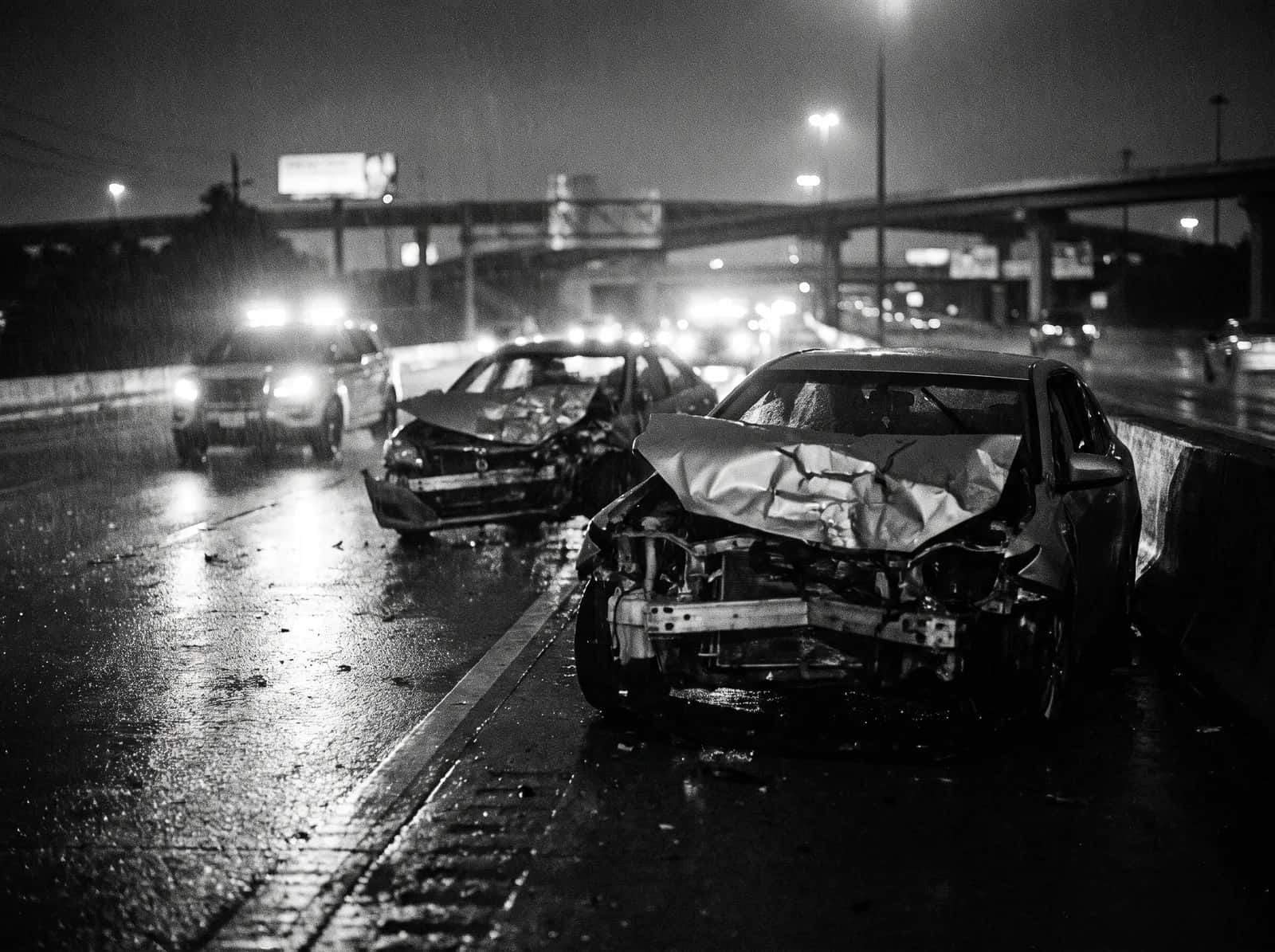
A driver exiting US-59 at SH-6 runs the light and T-bones a car turning into First Colony.
A commuter on US-59 near the Grand Parkway is rear-ended in stop-and-go traffic by a delivery van.
How common are serious car crashes in Sugar Land?
Common enough to plan for. TxDOT's 2024 city table lists 2,189 crashes in Sugar Land, including 7 fatal crashes and 28 crashes with suspected serious injuries.
TxDOT's crash tables are built from the CR-3 reports officers file after reportable crashes. For 2024, the city table shows 2,189 crashes inside Sugar Land, 8 people killed in 7 fatal crashes, and 34 people with suspected serious injuries in 28 crashes. Countywide, Fort Bend recorded 13,217 crashes, 38 fatal crashes, 41 deaths, and 313 suspected serious injuries.
Distraction is part of that story. TxDOT's 2024 table of distracted driver crashes counts 1,222 crashes in Fort Bend County in which a driver was distracted, including 3 fatal crashes and 25 suspected serious injuries. That figure only captures crashes where the officer identified distraction, so the real number is likely higher, and proving distraction in a particular case takes more than the report.
Behind each of those reports is an insurance claim handled by an adjuster who sees Fort Bend County crashes every day. What separates a fair result from a low offer is usually the quality of the proof: who caused the crash, what the injuries are, and what they cost.
- 2,189 crashes inside Sugar Land in 2024 (TxDOT city table)
- 8 deaths and 34 suspected serious injuries in the city
- 1,222 distracted driver crashes in Fort Bend County in 2024
What makes Sugar Land's road network hard on drivers?
A freeway, a state highway that doubles as an evacuation route, a widening US-90A, and three toll roads all meet in a city built around commuting to Houston.
US-59 (I-69) is the commuter spine. SH-6 crosses it and runs the length of the city, and TxDOT describes SH-6 as a designated hurricane evacuation route connecting I-45 near Bayou Vista to I-69 near Sugar Land. On an ordinary weekday it is a retail arterial with heavy turning traffic; in an evacuation it carries far more. US-90A runs parallel to US-59 through the older part of the city, and TxDOT has studied widening the 6.8 miles from SH-6 to Loop 762 from four lanes to eight, with a raised median, as far as the Grand Parkway.
The toll roads add speed. The Fort Bend County Toll Road Authority lists the Fort Bend Parkway, the Westpark Tollway, and the Grand Parkway among its toll roads, and drivers come off them into signalized arterials with little transition. Rear-end crashes at the bottom of ramps and lane changes at the tollway merges are common results.
Construction is constant in a growing county. Work zones shift lanes overnight, and when a crash happens in one, the contractor's traffic control plan and daily logs can matter as much as the other driver's conduct. Those records should be requested before the zone changes again.
Will a camera have recorded your crash?
Probably not a city red-light camera, because Texas has banned them since 2019. Video usually has to come from businesses, other drivers' dashcams, and buses, and much of it is overwritten within days or weeks.
Transportation Code section 707.020, added in 2019, prohibits local authorities from operating photographic traffic signal enforcement systems. Drivers sometimes assume an intersection camera on SH-6 caught the crash; it may be a traffic-flow camera that does not record, or nothing at all.
The better sources are private. Gas stations, banks, restaurants, and apartment complexes along SH-6, US-90A, and the US-59 frontage roads often have cameras pointed at their driveways and the street beyond. Many systems record over themselves on a short cycle, so the request has to go out quickly and in writing. Other drivers' dashcams and the vehicles' own event data recorders, which can store speed and braking in the seconds before impact, round out the picture.
If you have a dashcam, save the file before you do anything else. If a witness stopped, their name and phone number may be worth more than any camera.
Which agency handles the report, and what if it gets the facts wrong?
Sugar Land Police inside the city, the Fort Bend County Sheriff in unincorporated areas, and DPS on some state highways. The CR-3 report is filed with TxDOT and can be corrected only by the agency, but the evidence can prove what happened either way.
The officer who investigates a reportable crash must file the CR-3 with TxDOT within 10 days under Transportation Code section 550.062, and the report can then be purchased online. Neighboring Stafford and Missouri City have their own police departments, which matters on US-90A and SH-6 near the city lines. Write down the agency name and report number at the scene.
Reports are written fast, often from the account of whichever driver was still standing at the scene. If yours lists the wrong driver as at fault, records a wrong lane or direction, or leaves out a witness, contact the agency about a supplement and give the firm your photos and witness names. An insurer cannot treat the report as the last word if the physical evidence says otherwise.
Where should you get treated, and how do hospital bills affect the claim?
For serious injuries, the nearest designated trauma facilities are Level IV centers at Memorial Hermann Sugar Land and OakBend in Richmond, with Level I care in the Texas Medical Center. For everything else, a same-day visit to an emergency room, urgent care, or your own doctor starts the record.
On the Texas DSHS list of designated trauma facilities, current as of October 1, 2026, Memorial Hermann Sugar Land Hospital and OakBend Medical Center are both Level IV facilities, and Memorial Hermann-Texas Medical Center and Ben Taub Hospital are the region's Level I centers. Houston Methodist Sugar Land and St. Luke's Health Sugar Land do not appear on the designated list.
Neck, back, and shoulder injuries from a rear-end crash often feel worse the next morning than at the scene. Get checked the same day or the next, describe every symptom, and follow the treatment plan. A gap in care is the first thing an adjuster points to.
A hospital that treats you within 72 hours of the crash, including in the emergency room, can file a lien on your claim under Chapter 55 of the Property Code. Liens and health plan reimbursement claims are reviewed and negotiated before settlement money is paid, because what you keep depends on them as much as on the settlement figure.
Which insurance pays after a Sugar Land car accident?
The at-fault driver's liability policy, your own PIP for early medical bills and lost income regardless of fault, and your uninsured or underinsured motorist coverage when the other driver has too little.
Texas minimum liability limits are $30,000 per person, $60,000 per crash, and $25,000 for property damage under Transportation Code section 601.072. Many drivers carry only that. Your own underinsured motorist coverage under Insurance Code section 1952.101, unless you rejected it in writing, is often what pays the rest of a serious claim.
Personal Injury Protection is included in Texas auto policies unless rejected in writing under Insurance Code section 1952.152. It pays regardless of fault, and an insurer is not required to offer more than $2,500 per person, though higher limits can be bought. Your PIP insurer generally cannot recover what it paid you from the at-fault driver, except when that driver was uninsured.
Health insurance also pays early bills, and repayment rules depend on the plan. Chapter 140 of the Civil Practice and Remedies Code limits what many health plans can recover from a represented client, but it does not apply to self-funded employer plans governed by federal law, and Texas Medicaid recovers under the Human Resources Code.
Who is at fault in a stop-and-go rear-end crash on US-59?
Usually the following driver, but Texas has no automatic rule. The jury decides based on following distance, speed, attention, and whether the lead driver did anything unexpected.
Transportation Code section 545.062 requires a driver following another vehicle to keep an assured clear distance so the driver can stop safely. A violation is evidence of negligence, not automatic liability, and the Texas Supreme Court held in Louisiana-Pacific Corp. v. Knighten (1998) that there is no presumption against the rear driver. In practice the proof is usually strong: a driver who could not stop in rush-hour traffic on US-59 near SH-6 was usually too close, too fast, or not looking.
Distraction often explains it. Section 545.4251 prohibits reading, writing, or sending electronic messages while driving unless the vehicle is stopped, and section 545.424 bars drivers under 18 from using a wireless communication device at all while driving, hands-free included, except in an emergency. Phone records can be obtained in a lawsuit to show what the driver was doing.
The defense will look for a sudden stop, a cut-in, or brake lights that did not work. Dashcam video and the event data recorder in either vehicle usually settle that argument.
How is fault divided when several drivers are involved?
By percentages under Chapter 33 of the Civil Practice and Remedies Code. You can recover if your share is 50 percent or less, reduced by that share, and each defendant generally pays only its own percentage.
Chain-reaction crashes at the tollway ramps and T-bone crashes at SH-6 intersections often involve three or more vehicles. The jury assigns each driver a percentage. Under section 33.013, a defendant found more than 50 percent responsible is jointly and severally liable for the full damages; every other defendant pays only its own share. That is why each driver and each insurer has to be identified from the start.
Seat belt use comes up in many Fort Bend car cases. Not wearing one is not a separate damages reduction. Under Nabors Well Services v. Romero (Tex. 2015), it can be considered only as part of your share of responsibility and only if the defense proves it caused or added to your injuries.
What if the driver who hit you was drunk?
The driver is responsible, a bar or restaurant that kept serving an obviously intoxicated customer may be too, and exemplary damages may be available. The criminal case and the injury claim run separately.
Late-night crashes on US-59, SH-6, and the tollways often involve a driver coming home from a restaurant, bar, or event. Under Alcoholic Beverage Code section 2.02, a licensed seller can be liable when it was apparent that the customer was obviously intoxicated to the point of being a clear danger to himself and others, and the intoxication caused the injuries. Receipts, card records, and the business's own video show where the driver was served, and they are easiest to get in the first weeks.
The criminal case helps, but it does not decide the civil one. A guilty plea to a DWI charge can generally be used as evidence in the injury case. A misdemeanor DWI conviction after trial generally cannot be offered to prove fault under the Texas Rules of Evidence, because that rule admits prior judgments only for felonies, and a no-contest plea cannot be used either. The civil claim is proved with its own evidence: the officer's observations, test results, video, and witnesses.
Gross negligence can support exemplary damages, which are generally capped under Civil Practice and Remedies Code section 41.008. The cap does not apply when the conduct is a listed felony such as intoxication assault or intoxication manslaughter. A drunk driver's own policy is often small, so the firm also looks at your underinsured motorist coverage and any business that served the driver.
What if a City of Sugar Land vehicle, a county vehicle, or a school bus hit you?
The claim falls under the Texas Tort Claims Act, which caps damages and generally requires notice within six months. Sugar Land routes liability claims through its Risk Management Division and the Texas Municipal League risk pool.
Under Civil Practice and Remedies Code section 101.023, bodily injury damages against a city are capped at $250,000 per person and $500,000 per occurrence; against a county, a school district, or another local unit, at $100,000 per person and $300,000 per occurrence. Section 101.101 requires notice within six months unless the government already had actual notice. The published Sugar Land charter has no separate claim-notice section, so six months is the usual outside limit for a city vehicle, but notice should go in much sooner.
The City of Sugar Land says claimants should request a claim form from its Risk Management Division, that liability claims are forwarded to the Texas Municipal League Intergovernmental Risk Pool, which assigns an adjuster, and that claimants should not make repairs expecting the city to reimburse them. A private contractor's truck is different: that claim runs against the contractor and its insurer without the caps.
If a government employee was driving a personal car on personal business, the Tort Claims Act does not apply, and the claim goes against that driver's own insurer like any other.
Is a Sugar Land car accident case filed in Richmond or Houston?
Usually Richmond. Sugar Land lies entirely in Fort Bend County, but many Sugar Land drivers crash in Harris County on the way to work, and those cases can be filed in Houston.
Civil Practice and Remedies Code section 15.002 generally allows suit in the county where the crash happened or where a defendant lives. A crash on SH-6 or University Boulevard is a Fort Bend County case filed with the District Clerk at the Justice Center, 1422 Eugene Heimann Circle, Richmond. A crash after the commute crosses into Harris County is usually a Harris County case, filed at the civil courthouse at 201 Caroline Street downtown, unless a defendant lives in Fort Bend.
If every defendant is from out of state and the claim exceeds $75,000, the defense may remove the case to federal court in Houston. Removal is not allowed on that basis when a properly joined and served defendant is a Texas citizen.
What can you recover, how long do you have, and what does the firm charge?
Medical expenses, lost earnings and earning capacity, pain, mental anguish, impairment, and disfigurement, with suit generally due within two years. There is no fee unless we win.
Recoverable medical expenses are limited to amounts actually paid or incurred under Civil Practice and Remedies Code section 41.0105. Lost earning capacity can be a large part of a serious claim for a working commuter and needs proof from employment and tax records. Texas does not cap ordinary compensatory damages against a private driver; exemplary damages require clear and convincing proof of gross negligence and are generally capped under section 41.008.
The deadline to file suit is generally two years from the crash under section 16.003. If an injured child is involved, a court-approved settlement can place the money in a trust that may last until age 25 under Property Code section 142.005.
Owsley Law Firm handles Sugar Land car accident cases from its Houston offices at 601 Sawyer Street and 3535 Westheimer Road; it has no Sugar Land office. Steven Owsley has been licensed in Texas since 1985. There is no fee unless we win. Clients may be responsible for case expenses, such as court costs, as set out in the written fee agreement.
Sugar Land car crash: who investigates and who pays first
| Where or how it happened | Report usually from | Who pays first |
|---|---|---|
| Inside Sugar Land city limits (SH-6, University, Lexington) | Sugar Land Police | At-fault driver's liability policy; your PIP for early bills |
| Unincorporated Fort Bend County roads | Fort Bend County Sheriff | Same; your uninsured motorist coverage if the driver has none |
| US-90A or SH-6 near Stafford or Missouri City | The city police department where it happened | At-fault driver's policy |
| After crossing into Harris County on US-59 | The agency on the CR-3 | At-fault driver's policy; venue may shift to Harris County |
| City of Sugar Land vehicle | Sugar Land Police | City claim through Risk Management; Tort Claims Act caps |
| Fort Bend County vehicle or school bus | The investigating agency | Tort Claims Act claim, $100,000 per person cap |
What to do now
What should you do after a car accident in Sugar Land?
- Get examined the same day. Houston Methodist Sugar Land Hospital and Memorial Hermann Sugar Land handle the serious car accident injuries from Sugar Land; an urgent care visit the same day is enough to start the record if you are not transported.
- Photograph the vehicles, the road, and your injuries where it happened, especially on US-59 / I-69 (Southwest Freeway) and SH-6, where scenes are cleared within minutes.
- Get the Sugar Land crash report. Sugar Land Police Department and Fort Bend County Sheriff reports are available through the TxDOT Crash Report Online Purchase System, usually within 10 days. The firm obtains it for clients at no charge.
- Report the crash to your own insurer, but give no recorded statement to the other driver's carrier until you have counsel.
- Know where the case goes. Sugar Land car accidents suits are filed in the Fort Bend County District Courts, Fort Bend County Justice Center, Richmond, or Fort Bend County Courts at Law depending on the crash location.
- Call the firm. Twenty minutes from the firm’s Westheimer Road office. The firm comes to you. The consultation is free.
Go deeper
More on car accident claims in Sugar Land and Texas.
Common questions
Sugar Land car accident questions
Which Sugar Land roads have the most car accidents?
US-59 Southwest Freeway, SH-6, US-90A, and the Grand Parkway, with the US-59 and SH-6 interchange leading the count.
Where is a Sugar Land car accident case filed?
In the Fort Bend County District Courts at the Justice Center in Richmond.
Who investigates a car crash in Sugar Land?
It depends on where it happened. Inside city limits, Sugar Land Police write the report. On unincorporated Fort Bend County roads, the Fort Bend County Sheriff usually responds, and Texas DPS troopers often handle crashes on state highways outside city limits. The agency on the report decides where you request body camera video and witness statements.
What if my Sugar Land crash happened on the Westpark Tollway or Grand Parkway?
The claim is still against the driver who caused it, not the toll road. What changes is the county: the Westpark Tollway crosses from Fort Bend into Harris County, so the exact milepost decides whether the case goes to Richmond or downtown Houston. The crash report and your own photos of mile markers settle that question.
Can I get red-light camera footage of my Sugar Land crash?
No. Texas has prohibited local red-light camera enforcement since 2019 under Transportation Code section 707.020. Footage usually comes from nearby businesses, dashcams, and the vehicles' own data, so ask for it quickly.
The driver who hit me had no insurance. What now?
Your uninsured motorist coverage pays, unless you rejected it in writing. Your PIP pays early medical bills and lost income regardless of fault, and in this situation your PIP insurer may seek repayment from the uninsured driver, not from you.
A teenager on a phone rear-ended me. Does that matter?
It can. Drivers under 18 may not use a wireless device at all while driving except in an emergency, hands-free included, under Transportation Code section 545.424. Phone records obtained in a lawsuit can show the use, and a parent's policy may cover a teen driver in the household, depending on its terms.
My car was totaled. Do I wait for the injury claim to get paid?
No. The property damage claim usually moves separately and faster. Get the repair or total loss handled through the at-fault driver's insurer or your own collision coverage, and keep the injury claim open until treatment is complete.
Should I give a recorded statement to the other driver's insurer?
Not before getting advice. You are not required to give one to the other driver's insurer, and adjusters use early statements to lock in details before you know the full extent of your injuries.
My child was hurt in the crash. Is the claim handled differently?
Yes. A parent can bring the child's claim, but a settlement usually needs court approval, and the money can be placed in a protected account or a trust that may last until age 25. The deadline for a minor's own injury claim generally does not run until the child turns 18.
Does the firm have a Sugar Land office?
No. The firm's offices are in Houston, on Sawyer Street and Westheimer Road. It represents Fort Bend County clients by phone, video, and mail, and meets them at home or in the hospital when needed.
Sources
Sources this page relies on
- TxDOT, Crashes and Injuries, Cities and Towns, 2024 (Sugar Land)
- TxDOT, Distracted Driver Crashes and Injuries by County, 2024 (Fort Bend County)
- Texas DSHS, Texas Trauma Facilities (designated facilities by level, current as of October 1, 2026)
- Fort Bend County District Clerk, contact and location (Justice Center, Richmond)
- City of Sugar Land, filing a claim against the city (Risk Management FAQ)
- TxDOT, SH 6 access management study (SH 6 as a hurricane evacuation route to I-69 near Sugar Land)
- Texas Transportation Code, chapter 707 (photographic traffic signal enforcement prohibited)
- Texas Civil Practice and Remedies Code, chapter 33 (proportionate responsibility)