

In Dallas, a person hurt in a car accident caused by someone else can recover medical costs, lost income, and pain under Texas law. Owsley Law Firm handles Dallas car accidents from its Houston offices, comes to you, and charges no fee unless it wins. Call before you speak with any insurer.
Car Accidents in Dallas
Where do Dallas car accidents happen?
Dallas car cases most often begin at an interchange or on a construction-zone lane shift. The firm handles Dallas County cases from Houston today, and meets Dallas clients by appointment at 2550 Pacific Avenue in Deep Ellum.
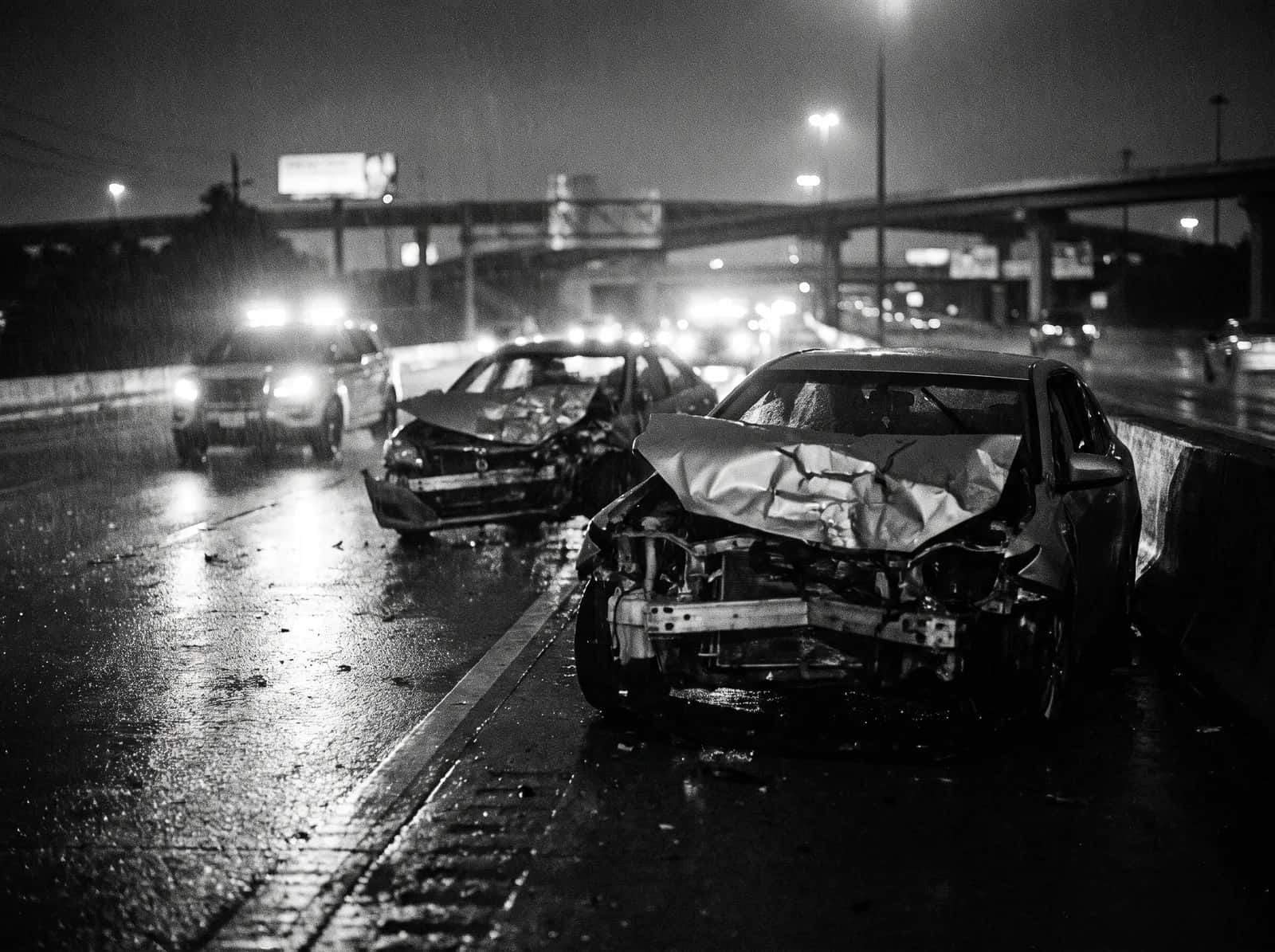
Dallas car crashes concentrate at the interchanges and in the construction zones. The High Five stacks five levels of ramps, and drivers unfamiliar with it change lanes late and hard. The Mixmaster downtown has been rebuilt and reworked repeatedly, and lane-shift crashes there are common. On LBJ, the express lanes exit into congested main lanes at a speed differential that turns a tap into a spinal injury. The firm’s Dallas car cases most often start at one of those three places or on Central Expressway between downtown and Richardson.
Corridors where Dallas car accidents cluster
- The High Five interchange at US-75 and I-635
- The Mixmaster at I-30 and I-35E downtown
- I-635 LBJ Freeway between the Dallas North Tollway and US-75
- I-30 East through Mesquite and Garland
- Loop 12 and Northwest Highway at Harry Hines
- I-20 at I-45 and US-175 in southern Dallas County
Cases from Dallas
What does a Dallas car accident case look like?
A driver merging from the LBJ express lanes into congested main lanes clips a family SUV at 60 miles per hour; the mother’s wrist and hip need surgery.
How dangerous are Dallas County roads?
Dallas County recorded 331 traffic deaths and 1,648 suspected serious injuries in 2024, according to TxDOT's crash data. Behind those numbers are thousands of injury claims every year.
TxDOT's 2024 county crash table counts 305 fatal crashes in Dallas County, with 331 people killed, and 1,648 people with suspected serious injuries. Only Harris County recorded more traffic deaths in Texas that year. Those figures come from the Texas Peace Officer's Crash Reports that every agency files with TxDOT, so they include crashes worked by Dallas Police, the Dallas County Sheriff's Office, suburban departments, and DPS troopers.
Most of those crashes happen on a short list of roads. The interchanges carry the worst of it: the High Five at US-75 and I-635, the Mixmaster at I-30 and I-35E downtown, and the merges along I-35E Stemmons and the Dallas North Tollway. Surface streets such as Northwest Highway and Loop 12 add intersection and left-turn crashes of their own.
The numbers matter to a claim for one practical reason. Insurers that handle Dallas County crashes see the same crash types over and over, and they have a playbook for each one. A Dallas car accident claim gets paid fairly when the evidence is gathered early and the damages are documented before the insurer frames the story.
Who investigates a Dallas car crash, and how do you get the report?
Inside the city it is usually Dallas Police; in the suburbs it is the local police department; on some highways outside city limits it can be the Sheriff's Office or a DPS trooper. Every report goes to TxDOT, where you can buy a copy.
Dallas County is one county with many police agencies. A crash on I-30 in Mesquite is a Mesquite Police report, a crash on LBJ in Garland is Garland's, and a crash on Stemmons inside the city is Dallas Police. The agency name, officer, and report number are printed on the card or paper the officer hands you at the scene. Keep it.
Texas requires the officer to file the Texas Peace Officer's Crash Report (form CR-3) with TxDOT within ten days when the crash causes injury, death, or at least $1,000 in property damage. Once it is filed, anyone involved can buy a copy through the TxDOT Crash Report Online Purchase System using the date, county, and a name or report number. The firm requests it for its clients at no charge.
Read the crash report, but do not treat it as final. Officers arrive after the crash and often take one driver's account while the other is on the way to Parkland. The diagram, contributing factors, and citation section can be challenged with photos, dashcam or traffic camera video, witness statements, and vehicle data.
- Inside Dallas city limits: usually Dallas Police
- Suburbs such as Mesquite, Garland, Irving, and Richardson: that city's police department
- Unincorporated areas and some highways: the Sheriff's Office or a DPS trooper
- Every CR-3 reaches TxDOT, where it can be purchased online
Where should you get treated after a Dallas car crash?
Wherever you can be seen first. For serious injuries, Parkland Memorial Hospital, Baylor University Medical Center, and Methodist Dallas Medical Center are all state-designated Level I trauma centers; for everything else, an urgent care or your own doctor the same day starts the record.
The most damaging fact in a Dallas injury claim is a gap between the crash and the first doctor visit. Adjusters read a two- or three-week delay as proof that the crash did not cause the pain. If you were not taken by ambulance, go to an urgent care or emergency room the same day or the next morning, tell them you were in a car crash, and describe every place that hurts.
Paying for treatment is a common worry. Personal Injury Protection (PIP) on your own policy pays first, whoever caused the crash, unless you rejected it in writing. Health insurance can also pay, and if the plan has a right to reimbursement it is repaid from the settlement, often at a reduced amount. When neither is available, many Dallas doctors and therapists treat crash patients under a letter of protection, which means they are paid from the recovery instead of up front.
Follow the plan you are given. Missed physical therapy, skipped imaging, and long breaks in care are what insurers use to cut a claim, and they are much harder to explain later than to avoid now.
What if a DART bus or train was involved?
Dallas Area Rapid Transit is a governmental unit under the Texas Tort Claims Act, so a claim against it follows different rules: written notice is generally due within six months, and the damages DART can be made to pay are capped by statute.
Texas Transportation Code section 452.0561 makes a transportation authority created to provide public transportation, like DART, a governmental unit under Chapter 101 of the Civil Practice and Remedies Code, the Texas Tort Claims Act. The Act allows claims for injuries caused by a government employee's operation of a motor vehicle, but it requires notice of the claim, generally within six months of the crash, and it limits the amount of damages.
The same statute reaches DART's contractors. A private company operating service for DART is liable only to the extent DART itself would be, so the same caps can apply even when the bus driver works for a contractor. That is why the first question in a DART crash is who employed the operator and under what contract.
Other drivers are not protected by those rules. If a private driver shared fault, for example by running a light in front of a DART bus, that driver can be pursued like any other driver, without a cap. Write down the bus or train number, route, and time while you still remember them.
How does a hospital lien affect a Dallas car accident settlement?
A hospital that treated you within 72 hours of the crash, including in the emergency room, can claim a lien on your injury claim under Texas Property Code chapter 55. The lien is paid from the settlement, but the statute limits it, and it can often be negotiated.
Dallas County's large hospital systems file liens routinely. Under Property Code section 55.002, the lien attaches to your claim against the person who caused the crash when you were admitted within 72 hours, and section 55.0015 treats care in any department of the hospital, including the emergency room, as an admission. Section 55.004 generally limits the lien to the lesser of the hospital's charges for the first 100 days of hospitalization or half of what you recover (or, after a trial, the jury's award for hospital charges less a share of attorney's fees), it can add emergency physician charges from the first seven days, and it does not cover charges above a reasonable and regular rate.
Liens are one reason the gross settlement number is not the number that matters. What matters is what you take home after fees, expenses, liens, and health insurer reimbursement. A careful lien review often moves that number more than another round of negotiation with the insurer.
Which insurance pays after a Dallas car accident?
Usually several policies, in a set order: the at-fault driver's liability coverage, your own PIP, and your own uninsured or underinsured motorist coverage when the other driver has too little or none.
Texas requires every driver to carry at least $30,000 per injured person, $60,000 per crash, and $25,000 in property damage under Transportation Code section 601.072. Those minimums run out fast after a hospital stay, which is why your own policy matters as much as the other driver's.
Uninsured and underinsured motorist coverage under Insurance Code section 1952.101 pays when the at-fault driver has no insurance or not enough. Texas insurers must offer it, and a rejection must be in writing. If a driver for a business hit you, that company's commercial policy may be available too, and those limits are usually far higher than a personal policy.
The firm reviews every policy at the first meeting, including yours. Many people do not know they bought UIM or PIP until someone reads the declarations page.
How is fault decided in a Dallas County car crash?
Texas uses proportionate responsibility. You can recover if you were 50 percent or less at fault, and your damages are reduced by your share; at 51 percent or more you recover nothing.
Chapter 33 of the Civil Practice and Remedies Code lets the jury assign a percentage of responsibility to everyone involved. Insurers know this rule well, so they look for any fact that shifts a few points of fault to you: a late brake, a lane change, a phone on the console, a speed estimate from a witness.
That is why the early evidence matters. Video from nearby businesses, traffic cameras, dashcams, and vehicle event data recorders can settle a fault dispute that would otherwise come down to two drivers' memories. Much of that video is recorded over within days.
What is a Dallas car accident case worth?
There is no average that fits your case. Value comes from the injury and its treatment, lost income, how clear fault is, the evidence, and the insurance available to pay.
Texas law allows recovery of medical expenses, lost earnings and earning capacity, physical pain, mental anguish, physical impairment, and disfigurement. Medical expenses are limited to amounts actually paid or incurred under Civil Practice and Remedies Code section 41.0105, so the billed amount on a hospital invoice is not the number a jury will see.
Our settlement guides explain how claims like yours are valued by crash type and injury, from rear-end collision settlements to herniated disc settlements and spinal fusion settlements. None of them quotes a dollar figure, because no honest guide can without your records.
Where is a Dallas car accident case filed, and can it end up in federal court?
Most Dallas County cases are filed in the Dallas County Civil District Courts at the George L. Allen Sr. Courts Building, 600 Commerce Street. A case against an out-of-state driver can sometimes be moved to the federal court in Dallas.
Texas venue rules generally allow a suit in the county where the crash happened or where the defendant lives. A crash in Plano is usually a Collin County case, and Grand Prairie spans Dallas, Tarrant, and Ellis Counties, so the exact location on the crash report decides which courthouse hears it.
If the at-fault driver or company is from another state and the claim is worth more than $75,000, the defense may remove the case to the U.S. District Court for the Northern District of Texas, whose Dallas Division covers Dallas County. Federal law blocks that removal when a properly joined and served defendant is a Texas citizen, which is one reason the firm names every responsible party at the start.
Wherever it is filed, the deadline is the same: a Texas injury suit generally must be filed within two years of the crash under Civil Practice and Remedies Code section 16.003, and claims against a government body can require written notice much sooner.
How does the firm handle Dallas cases, and what does it cost?
The firm handles Dallas County cases from its Houston offices, meets Dallas clients by appointment at Spaces Deep Ellum, 2550 Pacific Avenue, Suite 700, and travels to Dallas for depositions and court. There is no fee unless we win.
Most of a car case happens by phone, video, and secure document exchange: the first call, the records requests, the insurer letters, and the settlement conversations. When a face-to-face meeting helps, the firm meets Dallas clients by appointment in Deep Ellum or comes to you. Our team answers calls 24/7.
The fee is a percentage of the recovery set out in a written contingent fee agreement, and there is no fee if there is no recovery. Clients may be responsible for case expenses, such as court costs, as set out in the written fee agreement. You can read every step of the process, from the first call to the settlement check, in our guide to how a case works.
Which coverage pays for what after a Dallas crash
| Coverage | Whose policy | What it pays | Fault needed? |
|---|---|---|---|
| Liability (30/60/25 minimum) | At-fault driver | Your injuries and property damage | Yes, the other driver must be at fault |
| PIP ($2,500 minimum) | Yours | Medical bills and lost income | No |
| Uninsured motorist (UM) | Yours | Your injuries when the other driver has no insurance | Yes |
| Underinsured motorist (UIM) | Yours | The gap when the other driver's limits are too low | Yes |
| Commercial auto | The driver's employer | Injuries caused by a driver working at the time | Yes |
| DART claim (Tort Claims Act) | DART | Injuries caused by a DART vehicle, capped by statute | Yes, plus timely notice |

What to do now
What should you do after a car accident in Dallas?
- Get examined the same day. Parkland Memorial Hospital (Level I trauma) and Baylor University Medical Center (Level I trauma) handle the serious car accident injuries from Dallas; an urgent care visit the same day is enough to start the record if you are not transported.
- Photograph the vehicles, the road, and your injuries where it happened, especially on I-35E (Stemmons Freeway) and I-30, where scenes are cleared within minutes.
- Get the Dallas crash report. Dallas Police Department reports are available through the TxDOT Crash Report Online Purchase System, usually within 10 days. The firm obtains it for clients at no charge.
- Report the crash to your own insurer, but give no recorded statement to the other driver's carrier until you have counsel.
- Know where the case goes. Dallas car accidents suits are filed in the Dallas County Civil District Courts, George L. Allen Sr. Courts Building, or Dallas County Courts at Law depending on the crash location.
- Call the firm. Dallas clients are handled from Houston by phone, video, and mail, and the firm travels to Dallas for meetings, depositions, and court. The consultation is free.
Go deeper
More on car accident claims in Dallas and Texas.
Common questions
Dallas car accident questions
Which Dallas roads have the most car accidents?
I-635 LBJ Freeway, I-35E Stemmons, US-75 Central Expressway, and I-30, and the High Five and Mixmaster interchanges that connect them.
Do I have to come to Houston for a Dallas car accident case?
No. The firm handles Dallas County cases by phone, video, and mail and travels to Dallas for meetings, depositions, and court. Meetings are also available by appointment at 2550 Pacific Avenue.
What if a DART bus or train was involved in my Dallas car crash?
Dallas Area Rapid Transit is a governmental unit, so a claim against it runs under the Texas Tort Claims Act. That law covers injuries caused by a DART employee operating a vehicle, requires written notice within six months, and caps damages. Other drivers in the same crash have no cap. Keep the vehicle or train number and the time of the crash.
Can a construction company be responsible for a crash in a Dallas work zone?
Sometimes. In long work zones like the Mixmaster and the High Five, a contractor that sets up confusing lane shifts, missing signs, or bad barriers can share fault with the driver who hit you. Those claims depend on the traffic control plan and the contractor’s records, which should be requested early, before the zone changes again.
Do I need to meet the lawyer in Dallas?
No. The firm handles Dallas County cases by phone, video, and mail, and meets Dallas clients by appointment at Spaces Deep Ellum, 2550 Pacific Avenue, Suite 700, or comes to you.
How long do I have to file a Dallas car accident lawsuit?
Generally two years from the crash under Civil Practice and Remedies Code section 16.003. A claim against DART, a city, or another government body can require written notice much sooner, often within six months.
What if the driver who hit me in Dallas had no insurance?
Your own uninsured motorist coverage may pay, if you did not reject it in writing. PIP on your own policy can also pay medical bills and lost income regardless of fault.
Can I still recover if the police report says I was partly at fault?
Yes, as long as your share is 50 percent or less. Your recovery is reduced by your percentage, and the report's conclusions can be challenged with other evidence.
Will a Dallas hospital take part of my settlement?
It may. A hospital that treated you within 72 hours, including in the emergency room, can hold a lien under Property Code chapter 55, generally limited to the lesser of the first 100 days of hospital charges or half of the recovery, and it cannot include charges above a reasonable and regular rate. Liens can often be negotiated.
Can my Dallas case be moved to federal court?
Sometimes, if every defendant is from out of state and the claim is worth more than $75,000. Federal law does not allow that removal when a properly joined and served defendant is a Texas citizen.
Sources
Sources this page relies on
- TxDOT Crash Report Online Purchase System
- Texas Tort Claims Act, ch. 101
- Tex. Transp. Code § 452.0561
- Tex. Prop. Code ch. 55
- Tex. Prop. Code § 55.002
- Tex. Transp. Code § 601.072
- Tex. Ins. Code § 1952.101
- Tex. Civ. Prac. & Rem. Code ch. 33
- Tex. Civ. Prac. & Rem. Code § 41.0105
- Tex. Civ. Prac. & Rem. Code § 16.003