
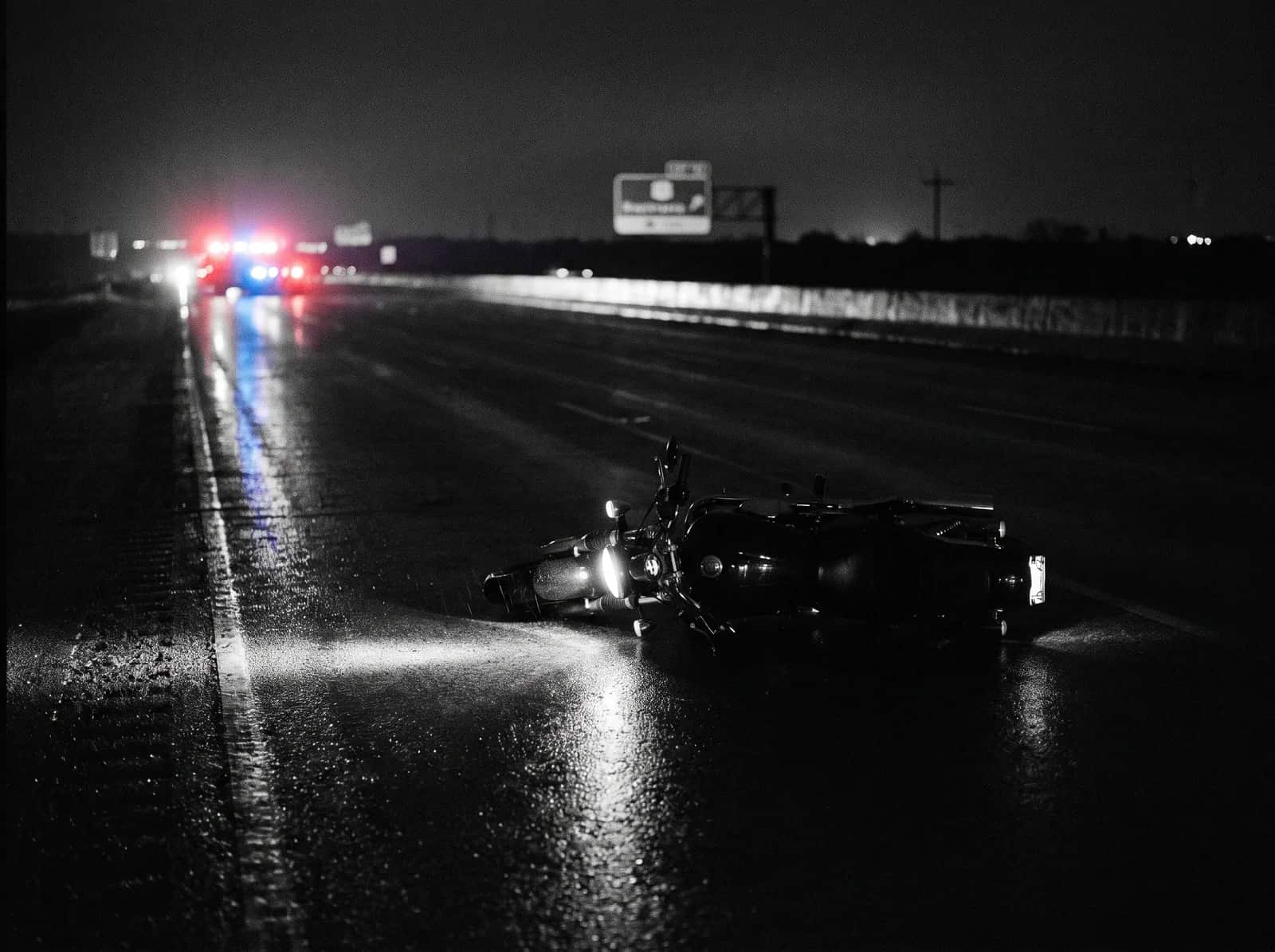
In Dallas, a person hurt in a motorcycle accident caused by someone else can recover medical costs, lost income, and pain under Texas law. Owsley Law Firm handles Dallas motorcycle accidents from its Houston offices, comes to you, and charges no fee unless it wins. Call before you speak with any insurer.
Motorcycle Accidents in Dallas
Where do Dallas motorcycle accidents happen?
Dallas riders are hit on Northwest Highway, Loop 12, and the LBJ frontage roads, and in the left-turn crashes that plague every metro. Parkland and Baylor treat the worst of it.
Dallas riders are hit on Northwest Highway, Loop 12, and the LBJ frontage roads, and in the left-turn crashes that plague every metro. Dallas has a large riding community and long stretches of high-speed arterial where drivers change lanes without signaling. The firm’s Dallas motorcycle cases most often involve a driver turning left across a rider at a signalized intersection, or a lane change into a rider on I-635 or Central Expressway. Parkland and Baylor treat the worst injuries, and Dallas County juries hear the cases downtown.
Corridors where Dallas motorcycle accidents cluster
- The High Five interchange at US-75 and I-635
- The Mixmaster at I-30 and I-35E downtown
- I-635 LBJ Freeway between the Dallas North Tollway and US-75
- I-30 East through Mesquite and Garland
- Loop 12 and Northwest Highway at Harry Hines
- I-20 at I-45 and US-175 in southern Dallas County
Cases from Dallas
What does a Dallas motorcycle accident case look like?
A driver merging from the LBJ express lanes into congested main lanes clips a family SUV at 60 miles per hour; the mother’s wrist and hip need surgery.
Why do Dallas motorcycle crashes cause such serious injuries?
A rider has no frame, airbag, or seat belt between their body and the road. On Dallas freeways and fast arterials, even a low-speed impact can end in fractures, road rash, or a brain injury.
Dallas County recorded 331 traffic deaths and 1,648 suspected serious injuries in 2024, according to TxDOT's county crash table. Riders are a small share of the vehicles on the road but carry a large share of the harm, because a crash that dents a car's door can throw a rider across two lanes.
The setups repeat. A driver turns left across a rider who had the right of way. A driver merges out of the LBJ express lanes or changes lanes on Central Expressway without seeing the bike in the mirror. A driver following too closely on a frontage road rear-ends a rider stopped at a light. In each one, the driver usually says the same thing to the officer: I never saw him.
That sentence is not a defense under Texas law. Drivers have a duty to keep a proper lookout for every vehicle on the road, motorcycles included. A Dallas motorcycle claim turns on proving what the driver should have seen, and how badly the rider was hurt as a result.
- Left turns across an oncoming rider at a signal
- Unsafe lane changes on I-635, US-75, and I-35E
- Rear-end crashes at frontage-road lights
- Doors opened into a rider's path in Uptown and Deep Ellum traffic
- Drivers pulling out of driveways and parking lots
Does the Texas helmet law hurt a Dallas rider's claim?
Not riding with a helmet does not make a rider at fault for the crash. Insurers may still argue it made a head injury worse, so the medical evidence matters.
Under Transportation Code section 661.003, riders and passengers under 21 must wear a helmet. A rider 21 or older may ride without one after completing an approved motorcycle safety course or while covered by a health plan that pays for injuries from a motorcycle crash. Many Dallas riders who go without a helmet are riding legally.
Fault for the crash is a separate question from the injury. A driver who turned left into a rider caused the crash whether or not the rider wore a helmet. Where a helmet comes up, an insurer may argue that a helmet would have prevented or reduced a particular head injury, and under Nabors Well Services v. Romero (Tex. 2015) that kind of evidence goes to the rider’s share of responsibility for the injury it caused. That argument does nothing to a broken leg, a shoulder injury, or road rash, and whether it works at all depends on the medical proof.
Keep the helmet if you wore one. A cracked or scraped helmet shows where the impact landed and how hard, and it is often the best evidence a rider has of the force involved.
Is lane splitting legal in Dallas, and does it matter if I was not doing it?
Since September 1, 2023, Texas law prohibits riding between lanes of traffic moving in the same direction. Most Dallas motorcycle crashes have nothing to do with lane splitting, and insurers sometimes raise it anyway.
Transportation Code section 545.0605 bars a motorcycle from passing between two lanes of traffic headed the same way, and it gives a motorcycle the right to the full use of a lane. That second part matters: a driver who crowds a rider within the lane, or merges into the space the rider occupies, is the one violating the rule.
Insurers know the lane-splitting rule exists and some adjusters suggest it in cases where the rider was simply in a lane. Witness statements, dashcam footage, and the damage pattern on both vehicles show where the bike was when it was hit. If the rider was lane splitting, Texas proportionate responsibility still applies: the rider's recovery is reduced by any share of fault, and only a share above 50 percent bars recovery under Chapter 33 of the Civil Practice and Remedies Code.
Why do insurers push back so hard on Dallas motorcycle claims?
Because motorcycle injuries are expensive and riders are easy to blame. The adjuster's first move is usually to suggest speed, aggressive riding, or that the rider came out of nowhere.
Bias against riders is real, and it shows up in recorded statements, in the first offer, and sometimes in the crash report. A Dallas rider should not give a recorded statement to the other driver's insurer before talking to a lawyer, and should not post about the ride, the crash, or recovery on social media.
The answer to rider bias is evidence gathered early. Many motorcycles and aftermarket systems store speed and throttle data. Businesses along Dallas arterials often have cameras that overwrite footage within days. Other riders in a group remember where everyone was. The firm sends preservation letters and requests footage quickly, before it disappears.
Where are seriously injured riders treated in Dallas, and how do hospital bills get paid?
Parkland Memorial, Baylor University Medical Center, and Methodist Dallas are Level I trauma centers. Their bills can become a hospital lien on the rider's claim.
Riders with serious injuries are usually taken to one of Dallas's Level I trauma centers. That care is the right care, and it is also expensive. Under Property Code section 55.002, a hospital that treats a crash patient admitted within 72 hours of the crash, which under section 55.0015 includes treatment in the emergency room, can claim a lien on the patient's recovery from the person who caused it.
The lien has limits. Under Property Code section 55.004, it covers only reasonable and regular charges and is capped at the lesser of the charges for the first 100 days or half of everything the patient recovers. Liens can often be negotiated down before a settlement is distributed, and a rider who has health insurance should give it to the hospital so the bills are processed under the plan.
Which insurance pays after a Dallas motorcycle crash?
The at-fault driver's liability coverage pays first. When that runs out or does not exist, the rider's own uninsured and underinsured motorist coverage is the next layer.
Texas requires drivers to carry at least $30,000 per person and $60,000 per crash for injuries, and $25,000 for property damage, under Transportation Code section 601.072. A serious rider injury can exceed $30,000 in the first week of hospital care, which is why the rider's own policy matters so much.
Insurers must offer uninsured and underinsured motorist coverage on Texas policies under Insurance Code section 1952.101, and it stays on unless the policyholder rejected it in writing. For a hit-and-run, Texas requires actual physical contact between the unknown vehicle and the rider or the bike. Check whether your motorcycle policy includes medical payments or Personal Injury Protection coverage; motorcycle policies vary more than car policies do.
What if a DART bus or a city vehicle hit you in Dallas?
Claims against DART and other government bodies run under the Texas Tort Claims Act, with an early written notice deadline and capped damages.
DART is a governmental unit for purposes of the Texas Tort Claims Act, and under Transportation Code section 452.0561 a contractor providing its service is liable only to the same extent DART would be. The Act generally requires written notice of the claim within six months of the crash under Civil Practice and Remedies Code section 101.101, and some city charters set shorter deadlines. Damages against a governmental unit are capped by statute.
If a private driver shared fault with the bus, that driver can be pursued separately without the government cap. Write down the bus or vehicle number, the route, and the time while you still remember them.
Where is a Dallas motorcycle case filed?
Usually in the Dallas County Civil District Courts at the George L. Allen Sr. Courts Building, 600 Commerce Street. Some cases end up in federal court in Dallas.
Texas venue rules generally allow a suit in the county where the crash happened or where the defendant lives. A crash inside Dallas County is normally filed at the George Allen courthouse downtown. Crashes in Collin, Denton, or Tarrant County suburbs follow those counties' courts.
When the at-fault driver or company is from another state and the claim exceeds $75,000, the defense may try to move the case to the Dallas Division of the U.S. District Court for the Northern District of Texas. Federal law bars that removal when a properly served defendant is a Texas citizen. Texas law still decides fault and damages either way.
What is a Dallas motorcycle accident case worth, and what does it cost to hire the firm?
The value comes from the injury, the treatment it requires, lost income, and the insurance available, reduced by any share of fault. There is no fee unless the firm wins.
Texas law allows recovery of medical expenses, lost earnings and earning capacity, physical pain, mental anguish, physical impairment, and disfigurement. Under Civil Practice and Remedies Code section 41.0105, medical expenses are limited to amounts actually paid or incurred. Rider claims often involve scarring from road rash and long rehabilitation, which weigh heavily in the noneconomic damages. Anyone quoting a number before seeing the records is guessing; our settlement guides explain the factors.
Owsley Law Firm handles Dallas motorcycle cases from its Houston offices, meets Dallas clients by appointment at 2550 Pacific Avenue in Deep Ellum, and works by phone and video the rest of the time. The team answers calls 24/7. There is no fee unless the firm wins your case. Clients may be responsible for case expenses, such as court costs, as set out in the written fee agreement.
Evidence after a Dallas motorcycle crash, and who has it
| Evidence | Who usually has it | Why it matters |
|---|---|---|
| Helmet, jacket, gloves, boots | The rider | Impact points and abrasion show the force and direction of the crash |
| Motorcycle and aftermarket parts | The rider, the tow yard, or the insurer | Damage pattern, speed data on some systems, and the value of custom parts |
| Crash report (CR-3) | The investigating agency and TxDOT | Officer's diagram, contributing factors, and witness names |
| Business and traffic camera video | Stores, gas stations, apartment complexes along the route | Shows the turn or lane change; often overwritten in days |
| The other driver's phone records | The driver's carrier, through a subpoena in the lawsuit | Shows texting or calls at the moment of the crash |
| Trauma and rehab records | Parkland, Baylor, Methodist Dallas, and treating doctors | Proves the injuries and the future care they require |
What to do now
What should you do after a motorcycle accident in Dallas?
- Get examined the same day, even for road rash. Parkland Memorial Hospital (Level I trauma) and Baylor University Medical Center (Level I trauma) handle the serious rider injuries from Dallas.
- Keep your helmet, jacket, gloves, and boots as they are. Do not wash, repair, or throw them away; the damage shows where you were hit and how hard.
- Photograph the bike, the other vehicle, skid marks, gravel or potholes, and the sight lines, especially at crashes on I-35E (Stemmons Freeway) and I-30.
- Get the Dallas crash report. Dallas Police Department reports are available through the TxDOT Crash Report Online Purchase System, usually within 10 days. The firm obtains it for clients at no charge. Read it closely: reports sometimes assume the rider was speeding or lane splitting without evidence, and errors can be corrected.
- Expect the other driver's insurer to look for reasons to blame the rider. Report the crash to your own insurer, but give no recorded statement to the other carrier until you have counsel.
- Know where the case goes. Dallas motorcycle accidents suits are filed in the Dallas County Civil District Courts, George L. Allen Sr. Courts Building, or Dallas County Courts at Law depending on the crash location.
- Call the firm. Dallas clients are handled from Houston by phone, video, and mail, and the firm travels to Dallas for meetings, depositions, and court. The consultation is free.
Go deeper
More on motorcycle accident claims in Dallas and Texas.
Common questions
Dallas motorcycle accident questions
Where do Dallas motorcycle accidents happen most?
Northwest Highway, Loop 12, Harry Hines, and the I-635 and US-75 frontage roads, plus the left-turn intersections along them.
Where is a Dallas motorcycle accident case filed?
In the Dallas County Civil District Courts at the George L. Allen Sr. Courts Building downtown.
Do I need a helmet to ride legally in Dallas?
Under Texas law, riders under 21 must wear a helmet. Riders 21 and older can ride without one if they have completed an approved motorcycle safety course or are covered by a health insurance plan that pays for injuries from a motorcycle crash. Texas law does not let a police officer stop a rider just to check for the course or the health coverage, although an officer may stop a rider to inspect a helmet that is being worn. The same rules apply to passengers.
What if I was a passenger on a motorcycle in a Dallas crash?
A passenger can claim against every driver who caused the crash, including the rider of the motorcycle they were on. That means the other driver’s policy and the rider’s own liability coverage may both be available. Passengers often have the clearest claims because they had no control over the motorcycle at all.
Can I recover if I was riding without a helmet in Dallas?
Yes. Not wearing a helmet does not make you at fault for the crash, and many riders 21 and older ride without one legally under Transportation Code section 661.003. An insurer may argue a helmet would have reduced a head injury, which can only be raised as a share of responsibility for that injury and depends on the medical evidence.
Does riding a sport bike or having loud pipes hurt my claim?
It should not decide anything. Fault turns on what each person did on the road, not on the kind of motorcycle. Expect the insurer to try to paint a picture of a reckless rider; the answer is witness statements, video, and the physical evidence.
What if the driver who hit me on a Dallas street drove off?
Report it to police right away and photograph the damage. Your own uninsured motorist coverage can pay for a hit-and-run, but Texas requires actual physical contact between the unknown vehicle and you or your motorcycle. A driver who forced you off the road without touching you is harder to claim.
Who pays to repair or replace my motorcycle?
The at-fault driver's property damage coverage pays the reasonable cost of repair, or the bike's pre-crash value if it is totaled. Keep receipts for aftermarket parts and accessories, because insurers often value a custom bike as if it were stock.
How long do I have to file a Dallas motorcycle claim?
Generally two years from the crash under Civil Practice and Remedies Code section 16.003. A claim involving DART or a city vehicle can require written notice within six months, and sometimes sooner under a city charter.
Do I have to travel to Houston to hire the firm?
No. The firm handles Dallas cases by phone, video, and mail, meets Dallas clients by appointment at 2550 Pacific Avenue in Deep Ellum, and travels for depositions and court.
Sources
Sources this page relies on
- Tex. Transp. Code § 661.003
- Tex. Transp. Code § 545.0605
- Tex. Civ. Prac. & Rem. Code ch. 33
- Tex. Prop. Code § 55.002
- Tex. Prop. Code § 55.004
- Tex. Transp. Code § 601.072
- Tex. Ins. Code § 1952.101
- Texas Tort Claims Act, ch. 101
- Tex. Transp. Code § 452.0561
- Tex. Civ. Prac. & Rem. Code § 101.101
- Tex. Civ. Prac. & Rem. Code § 41.0105
- TxDOT Crash Report Online Purchase System