
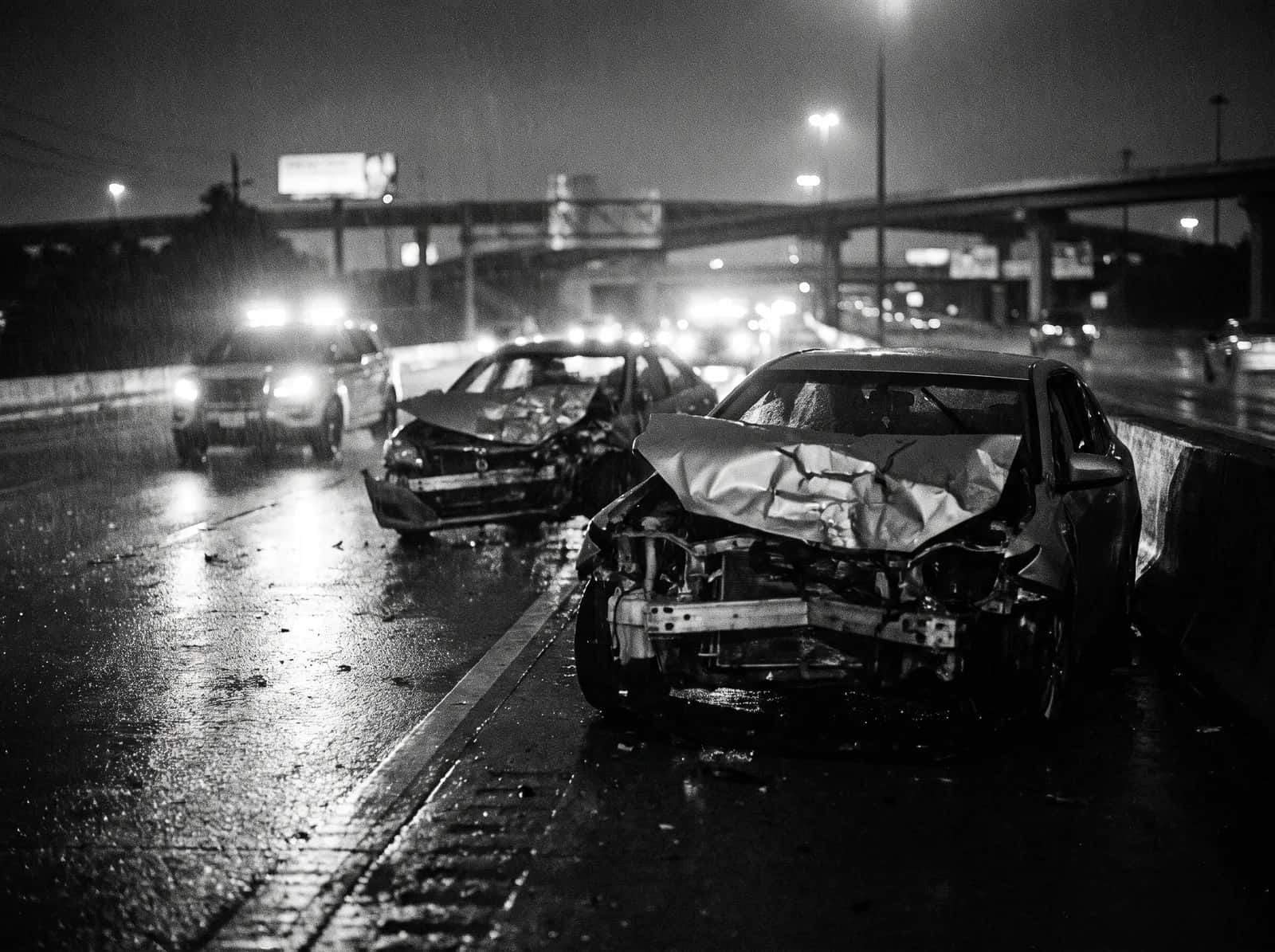

In Austin, a person hurt in a car accident caused by someone else can recover medical costs, lost income, and pain under Texas law. Owsley Law Firm handles Austin car accidents from its Houston offices, comes to you, and charges no fee unless it wins. Call before you speak with any insurer.
Car Accidents in Austin
Where do Austin car accidents happen?
Austin car crashes often begin on I-35, MoPac and US-183. Travis County cases are filed at the Civil and Family Courts Facility, and the firm meets Austin clients by appointment at 301 Congress Avenue.
Austin car crashes begin on I-35. The lower deck through downtown has short merges and no shoulder, the Rundberg corridor in north Austin combines heavy traffic with frequent pedestrian crossings, and the expansion project moves lanes and barriers month to month. MoPac’s express-lane entrances create the same speed-differential crashes Dallas sees on LBJ. Outside the core, the 85 mile per hour limit on SH-130 south of Mustang Ridge makes any error catastrophic. The firm’s Austin car cases most often start on I-35 between Cesar Chavez and US-183.
Corridors where Austin car accidents cluster
- I-35 through downtown between Cesar Chavez and Airport Boulevard
- I-35 at US-183 and the Rundberg corridor in north Austin
- MoPac at Lady Bird Lake and the express-lane entrances
- US-183 at SH-71 near the airport
- SH-130 toll road between Pflugerville and Mustang Ridge
- Lamar Boulevard and Riverside Drive through South Austin
Cases from Austin
What does a Austin car accident case look like?
A commuter on the I-35 lower deck is hit from behind in stop-and-go traffic by a distracted driver; the phone records, subpoenaed later, show a text sent at the second of impact.
How many serious crashes happen in Travis County?
TxDOT's 2024 county crash table lists 15,872 crashes in Travis County, including 139 fatal crashes that killed 155 people and 511 crashes with suspected serious injuries.
Those numbers come from the officers' crash reports that Austin Police, the Travis County Sheriff, suburban departments, and DPS file with TxDOT. They are a reminder that Austin's traffic is not only congested but dangerous, especially on I-35, MoPac, US-183, and the high-speed toll roads outside the core.
Every one of those reports started a claim with an insurer that handles Austin crashes daily. The way an injured person gets past the adjuster's formula is the same everywhere: a specific, well-documented record of fault, injury, and loss.
- 15,872 total crashes in Travis County in 2024 (TxDOT)
- 139 fatal crashes and 155 deaths
- 511 crashes with suspected serious injuries
How does the I-35 Capital Express construction affect crash claims?
It adds lane shifts, closures, and changing traffic patterns through the heart of the city, and a crash in a work zone can involve the contractor's traffic control as well as the other driver.
TxDOT's I-35 Capital Express Central project runs from US 290 East to SH 71 and Ben White Boulevard through downtown Austin. It adds two non-tolled managed lanes in each direction, lowers the main lanes, and removes the upper decks in the University segment, with construction phases TxDOT lists as running into the 2030s. For drivers, that means years of moving barriers, narrowed lanes, and new exit patterns.
Most work zone crashes are still the fault of a driver who was speeding, following too closely, or not paying attention, and Texas raises traffic fines in work zones when workers are present. But a contractor that sets up confusing lane shifts, missing signs, or bad barriers can share fault. Those claims depend on the traffic control plan and the contractor's daily records, which should be requested before the zone changes again.
Who writes the crash report in Austin, and how do you get it?
Inside Austin it is usually Austin Police; in unincorporated Travis County it is often the Sheriff's Office; Round Rock, Pflugerville, Cedar Park, and other cities have their own departments; DPS works some state highways.
The officer must file the crash report with TxDOT no later than the tenth day after a crash causing injury, death, or at least $1,000 in damage. You can then buy the CR-3 report through the TxDOT Crash Report Online Purchase System. The firm obtains it for clients at no charge.
Check the report for errors. On I-35's lower deck and the MoPac express-lane entrances, crashes happen fast and in heavy traffic, and an officer arriving later may record only one side. Photos, dash camera video, and vehicle data can correct the record.
Where should you get treated after an Austin crash?
For serious injuries, Dell Seton Medical Center at the University of Texas is Austin's state-designated Level I trauma center for adults, and Dell Children's Medical Center is a Level I center for children. For everything else, an urgent care or your own doctor the same day starts the record.
Do not wait to see if the pain goes away. A same-day visit documents the injury and its connection to the crash, and gaps in treatment are what insurers use to argue the injury came from somewhere else.
Personal Injury Protection on your own policy pays medical bills and lost income regardless of fault unless you rejected it in writing. Health insurance can also pay, and a plan with a right to reimbursement is repaid from the settlement, and some providers treat under a letter of protection.
What if a state employee, a university vehicle, or a CapMetro bus hit you?
Claims against the State of Texas, its agencies and universities, and local governmental units like Capital Metro run under the Texas Tort Claims Act, with written notice generally due within six months and statutory damage caps.
Austin has more government vehicles on the road than most Texas cities: state agencies, the University of Texas, the City of Austin, Travis County, and Capital Metro. When an employee causes a crash while driving on the job, the Texas Tort Claims Act allows a claim against the governmental unit, but only within its limits.
Section 101.101 generally requires notice within six months, but the City of Austin requires sworn written notice within 45 days, and section 101.023 caps damages for bodily injury at $250,000 for each person and $500,000 for each occurrence for the State, its agencies, and cities, and at $100,000 for each person and $300,000 for each occurrence for other local units of government. Any private driver who shared fault can be pursued separately without a cap. If the employee was off duty in a personal car, the claim is an ordinary one against that driver's insurer.
Which insurance pays after an Austin car accident?
The at-fault driver's liability policy first, your own PIP for medical bills regardless of fault, and your own uninsured or underinsured motorist coverage when the other driver has too little or none.
Texas minimum liability limits are $30,000 per person, $60,000 per crash, and $25,000 for property damage under Transportation Code section 601.072. With Austin medical costs, a serious injury can exceed that quickly. Underinsured motorist coverage under Insurance Code section 1952.101 is often the difference between a full recovery and a partial one.
Austin's rideshare and delivery traffic adds more layers. If an Uber driver, a delivery driver, or a company vehicle was involved, commercial or rideshare policies with much higher limits may apply, depending on what the driver was doing at the time.
How is fault decided on I-35 and MoPac?
Under proportionate responsibility in Chapter 33 of the Civil Practice and Remedies Code. You can recover if you are 50 percent or less at fault, reduced by your share.
Typical fault disputes in Austin involve sudden stops in heavy traffic, lane changes at the express-lane entrances, and drivers merging from short ramps. The insurer will look for any reason to put part of the blame on you, such as following distance or speed.
The best answers are objective: dash camera video, the vehicles' data recorders, phone records showing a distracted driver, and witnesses. The firm collects that evidence early, before it is lost.
What is an Austin car accident case worth?
It depends on fault, the injury and its treatment, lost income, and the insurance that can pay. Our settlement guides explain the factors by crash type and injury.
Texas allows recovery of medical expenses actually paid or incurred, lost earnings and earning capacity, pain, mental anguish, physical impairment, and disfigurement. In a city with high incomes and high costs of living, lost earning capacity can be a large part of a serious case and needs proof from employment records and, sometimes, experts.
Anyone who quotes a number before reviewing your records is guessing. What can be known early is the coverage and the strength of the fault evidence, and both shape the realistic range.
Where is an Austin car accident case filed?
Usually in the Travis County Civil District Courts at the Civil and Family Courts Facility, or in Williamson or Hays County if the crash happened there. Some cases move to the federal court in Austin.
Venue usually follows the crash location or the defendant's home county, so a wreck in Round Rock is normally filed in Williamson County and one in Kyle or Buda in Hays County. The two-year deadline under Civil Practice and Remedies Code section 16.003 applies in every county.
If the parties are from different states and more than $75,000 is at stake, the defense may remove the case to the U.S. District Court for the Western District of Texas, Austin Division, which covers Travis, Williamson, and Hays Counties among others.
What should you do in the first week after an Austin crash?
Get examined, keep every record, avoid recorded statements to the other driver's insurer, and get the free case review before signing anything.
The first week is when evidence is easiest to gather and easiest to lose. Photograph the cars, your injuries, and the scene. Write down what you remember about the crash while it is fresh, and keep the names of witnesses.
Report the crash to your own insurer with the basic facts. If the other driver's insurer calls, you can decline to give a recorded statement and refer them to your lawyer. Do not post about the crash or your injuries on social media, and keep every medical appointment.
- Same-day or next-day medical exam
- Photos of vehicles, injuries, and the scene
- The CR-3 crash report number
- Names and numbers of witnesses
- No recorded statement to the other insurer
How does the firm handle Austin cases from Houston?
By phone, video, and mail from Houston, with meetings by appointment at 301 Congress Avenue, 12th Floor, and travel to Austin for depositions and court.
The team answers calls 24/7, and the free case review can happen the same day by phone or video. When a meeting in person helps, the firm meets Austin clients by appointment at the Industrious meeting space on Congress Avenue downtown.
There is no fee unless the firm wins your case. Clients may be responsible for case expenses, such as court costs, as set out in the written fee agreement.
Austin crash situations and the claim that follows
| Situation | Who the claim is against | Key deadline or limit |
|---|---|---|
| Private driver at fault | That driver's insurer | Two years to sue; policy limits |
| State agency or university vehicle | The State under the Tort Claims Act | Six-month notice; $250,000 per person cap |
| CapMetro or city vehicle | The governmental unit under the Tort Claims Act | Six-month notice, 45 days for the City of Austin; statutory caps |
| Crash in an I-35 work zone | Driver, and possibly the contractor | Request traffic control records early |
| Uninsured or hit-and-run driver | Your uninsured motorist coverage | Report promptly; check policy terms |

What to do now
What should you do after a car accident in Austin?
- Get examined the same day. Dell Seton Medical Center at UT (Level I trauma) and St. David’s Medical Center handle the serious car accident injuries from Austin; an urgent care visit the same day is enough to start the record if you are not transported.
- Photograph the vehicles, the road, and your injuries where it happened, especially on I-35 and US-183, where scenes are cleared within minutes.
- Get the Austin crash report. Austin Police Department reports are available through the TxDOT Crash Report Online Purchase System, usually within 10 days. The firm obtains it for clients at no charge.
- Report the crash to your own insurer, but give no recorded statement to the other driver's carrier until you have counsel.
- Know where the case goes. Austin car accidents suits are filed in the Travis County Civil District Courts, Civil and Family Courts Facility, or Travis County Courts at Law depending on the crash location.
- Call the firm. Austin clients are handled from Houston by phone, video, and mail, and the firm travels to Austin for meetings, depositions, and court. The consultation is free.
Austin car accidents we handle
Specific Austin car accident cases
Go deeper
More on car accident claims in Austin and Texas.
Common questions
Austin car accident questions
Which Austin roads have the most car accidents?
I-35 through downtown and north Austin, MoPac, US-183, and SH-71 near the airport. SH-130 has fewer crashes but far more fatal ones.
Where is an Austin car accident case filed?
In the Travis County Civil District Courts at the Civil and Family Courts Facility, or in Williamson or Hays County if the crash occurred there.
What if a state employee in a university or state vehicle hit me in Austin?
Claims against the State of Texas and its agencies, including state universities, run through the Texas Tort Claims Act. Written notice is generally due within six months, and the state’s damages are capped at $250,000 per person. If the employee was off duty in a personal car, the claim is a normal one against that driver’s own insurer.
What happens if my Austin-area crash happened in Williamson or Hays County?
The case usually follows the crash. A wreck on I-35 in Round Rock is normally filed in Williamson County, and one in Kyle or Buda in Hays County, unless Texas venue rules allow filing where the at-fault driver lives. The law and the two-year deadline are the same in each county, but the courthouse and jury pool are not.
How many crashes were there in Travis County in 2024?
TxDOT's 2024 county table lists 15,872 crashes in Travis County, including 139 fatal crashes that killed 155 people and 511 crashes with suspected serious injuries.
Is a crash in the I-35 construction zone someone else's fault if the lanes were confusing?
Sometimes. The driver who hit you is usually responsible, but a contractor that set up confusing lane shifts or missing signs can share fault. The traffic control plan and daily logs are the evidence, and they should be requested early.
What is the cap on a claim against the State of Texas?
Under section 101.023 of the Tort Claims Act, the State's liability for bodily injury is capped at $250,000 for each person and $500,000 for each single occurrence.
Do I have to come to Houston for an Austin case?
No. The firm handles Austin cases by phone, video, and mail, meets clients by appointment at 301 Congress Avenue, and travels for depositions and court.
What if my crash happened on SH-130?
The same rules apply, but the speeds are higher and injuries tend to be more serious. Preserve photos and vehicle data, and get examined right away.
Will an Austin car accident case go to trial?
Most do not. Many settle without a lawsuit and many lawsuits settle before trial, but the firm prepares every case as if it will be tried.
Sources